


Vol. 12. Núm. 20.
Páginas 1159-1169 (Octubre 2016)

Actualización
Anemia aplásica. Hemoglobinuria paroxística nocturna

Aplastic anemia. Paroxysmal nocturnal hemoglobinuria

E. Salido FierrezV. Cabañas PerianesJ.M. Moraleda Jiménez
Doi : https://10.1016/j.med.2016.10.004
Opciones
Resumen
Introducción

Los síndromes de insuficiencia medular son un grupo heterogéneo de trastornos clínica y fisiopatológicamente distintos, pero que se caracterizan por un fallo de función hematopoyética normal de la médula ósea.

Tipos

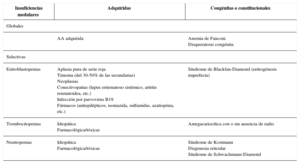
Pueden ser congénitos (anemia de Fanconi y anemia de Blackfand-Diamond) o adquiridos, y afectar de forma selectiva a una de las series (eritroblastopenia, leucopenia o trombocitopenia) o afectar de forma global a toda la hematopoyesis. Pueden conferir un riesgo significativo de morbilidad y muerte debido a su historia natural progresiva, la eventual evolución clonal y las complicaciones de la terapia subóptima. Algunas de estas enfermedades se superponen y pueden ser indistinguibles en las primeras etapas.

Síndrome de insuficiencia medular

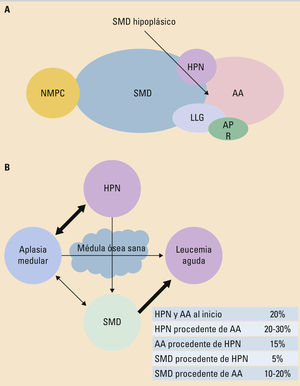
Esta actualización trata la anemia aplásica, el síndrome de insuficiencia medular más representativo y la hemoglobinuria paroxística nocturna. Aunque estas dos entidades se engloban dentro de los síndromes de insuficiencia medular, son fisiopatológica y clínicamente distintas, pero tienen un comportamiento dinámico, pudiendo transformarse una en la otra o solaparse en distintos estadios evolutivos de la enfermedad, hecho que caracteriza en general a todos los síndromes de insuficiencia medular.

Palabras clave
Anemia aplásica
Fracaso medular
Hemoglobinuria paroxística nocturna
Hemólisis
Abstract
Introduction

The bone marrow failure syndromes are a heterogeneous group of clinical disorders pathophysiologically different and characterized by failure in normal hematopoietic function of the bone marrow.

Clasification

They are classified in: congenital (Fanconi anemia and Blackfand-Diamond anemia) or acquired, affecting selectively blood cell lineages (erythroblastopenia, leucopenia or thrombocytopenia) or impairing the hematopoiesis globally. The risk of morbidity and death is significant due to their progressive natural history, the risk of clonal evolution and complications of suboptimal therapy. It is not surprising that these conditions overlap in their presentation making undistinguishable in the early stages.

Bone marrow failure syndromes

In this chapter, aplastic anemia (AA), the most representative bone marrow failure syndrome, and paroxysmal nocturnal hemoglobinuria (PNH), will be described. Both are bone marrow failure syndromes but are clinical and pathophysiologically different. Clinically, AA overlaps with PNH in one patient, and PNH can evolve from a AA.

Keywords
Aplastic anemia
Bone-marrow failure
Paroxysmal nocturnal hemoglobinuria
Hemolysis

Identifíquese

¿Aún no es suscriptor de la revista?

Comprar el acceso al artículo

Comprando el artículo el pdf del mismo podrá ser descargado

Teléfono para incidencias

De lunes a viernes de 9h a 18h (GMT+1) excepto los meses de julio y agosto que será de 9 a 15h

Llamadas desde España 932 415 960
Llamadas desde fuera de España +34 932 415 960
Bibliografía
[1]
201610220039446488
201610220039446489
N.S. Young, A. Bacigalupo, J.C. Marsh.
Aplastic anemia: pathophysiology and treatment.
Biol Blood Marrow Transplant., (2010), 161 pp. S119-S125
[2]
2016102200394464810
2016102200394464811
M. Miano, C. Dufour.
The diagnosis and treatment of aplastic anemia: a review.
Int J Hematol., (2015), 101 pp. 527-535
[3]
J.C. Vallejo.
Insuficiencia medulares. Aplasia medular.
Pregrado de Hematología., 3ª ed., Luzán 5 S.A, pp. 67-80
[4]
A.M. Risitano, J.P. Maciejewski, S. Green, M. Plasilova, W. Zeng, N.S. Young.
In-vivo dominant immune responses in aplastic anaemia: molecular tracking of putatively pathogenetic T-cell clones by TCR beta-CDR3 sequencing.
[5]
S. Kordasti, J. Marsh, S. Al-Khan, J. Jiang, A. Smith, A. Mohamedali, et al.
Functional characterization of CD41 T cells in aplastic anemia.
Blood, (2012), 119 pp. 2033-2043
[6]
2016102200394464812
2016102200394464813
D.V. Babushok, N. Perdigones, J.C. Perin, TS2 Olson, W2 Ye, J.J. Roth, et al.
Emergence of clonal hematopoiesis in the majority of patients with acquired aplastic anemia.
Cancer Genet., (2015), 208 pp. 115-128
[7]
2016102200394464814
2016102200394464815
N.S. Young.
Current concepts in the pathophysiology and treatment of aplastic anemia.
Hematology Am Soc Hematol Educ Program., (2013), 2013 pp. 76-81
[8]
2016102200394464816
2016102200394464817
T. Yoshizato, B. Dumitriu, K. Hosokawa, H. Makishima, K. Yoshida, D. Townsley, et al.
Somatic mutations and clonal hematopoiesis in aplastic anemia.
N Engl J Med., (2015), 373 pp. 35-47
[9]
2016102200394464818
2016102200394464819
S. Ogawa.
Clonal hematopoiesis in acquired aplastic anemia.
[10]
A. Bacigalupo, M. Valle, M. Podestà, A. Pitto, E. Zocchi, A. De Flora, et al.
T-cell suppression mediated by mesenchymal stem cells is deficient in patients with severe aplastic anemia.
Exp Hematol., (2005), 33 pp. 819-827
[11]
2016102200394464820
2016102200394464821
A. Shimamura, B.P. Alter.
Pathophysiology and management of inherited bone marrow failure syndromes.
Blood Rev., (2010), 24 pp. 101-122
[12]
2016102200394464822
2016102200394464823
S.B. Killick, N. Bown, J. Cavenagh, I. Dokal, T. Foukaneli, A. Hill, et al.
Guidelines for the diagnosis and management of adult aplastic anaemia. British Society for Standards in Haematology.
Br J Haematol., (2016), 172 pp. 187-207
[13]
N. Tuzuner, J.M. Bennet.
Reference standards for bone marrow cellularity.
Leuk Res., (1994), 18 pp. 645-647
[14]
2016102200394464824
B.M. Camítta, R. Store, E.D. Thomas.
Aplastic anemia: pathogenesís, diagnosis, treatment and prognosis.
N Eng J Med., (1982), 306 pp. 645-652
[15]
2016102200394464825
2016102200394464826
J.C. Marsh, A.G. Kulasekararaj.
Management of the refractory aplastic anemia patient: what are the options.
Blood, (2013), 122 pp. 3561-3567
[16]
2016102200394464827
2016102200394464828
P. Scheinberg, N.S. Young.
How I treat acquired aplastic anemia.
Blood, (2012), 120 pp. 1185-1196
[17]
2016102200394464829
2016102200394464830
P. Scheinberg.
Aplastic anemia: therapeutic updates in immunosuppression and transplantation.
Hematology Am Soc Hematol Educ Program., (2012), 2012 pp. 292-300
[18]
Crosby WH. hemoglobinuria paroxística nocturna; una descripción del clásica por Paul Strubling en 1882 y una bibliografía de la enfermedad. Sangre Mar. 1951; 3:270-84.
[19]
2016102200394464831
2016102200394464832
P. Hillmen, S.M. Lewis, M. Bessler, L. Luzzatto, J.V. Dacie.
Natural history of paroxysmal nocturnal hemoglobinuria.
N Engl J Med., (1995), 333 pp. 1253-1258
[20]
2016102200394464833
2016102200394464834
G. Socie, J.Y. Mary, A. de Gramont, B. Rio, M. Leporrier, C. Rose, et al.
Paroxysmal nocturnal haemoglobinuria: long-term follow-up and prognostic factors. French Society of Haematology.
Lancet, (1996), 348 pp. 573-577
[21]
2016102200394464835
Hill A, Platts PJ, Smith A, Richards SJ, Cullen L, Hill QA, et al. La incidencia y prevalencia de hemoglobinuria paroxística nocturna (PNH) y la supervivencia de los pacientes en Yorkshire. 108 [11], 294A de sangre. 11/01/2006.
[22]
2016102200394464836
2016102200394464837
R.A. Brodsky.
Complement in hemolytic anemia.
Blood, (2015), 126 pp. 2459-2465
[23]
W.F. Rosse.
The molecular basis of paroxysmal nocturnal hemoglobinuria.
Blood, (1995), 86 pp. 3277-3286
[24]
M.J. Walport.
Complement. First of two parts.
N Engl J Med., (2001), 344 pp. 1058-1066
[25]
2016102200394464838
2016102200394464839
A. Hill, R.J. Kelly, P. Hillmen.
Thrombosis in paroxysmal nocturnal hemoglobinuria.
Blood, (2013), 121 pp. 4985-4996
[26]
2016102200394464840
2016102200394464841
H1 Schrezenmeier, P. Muus, G. Socié, J. Szer, A. Urbano-Ispizua, J.P. Maciejewski, et al.
Baseline characteristics and disease burden in patients in the International Paroxysmal Nocturnal Hemoglobinuria Registry.
Haematologica, (2014), 99 pp. 922-929
[27]
2016102200394464842
2016102200394464843
C. Parker, M. Omine, S. Richards, J. Nishimura, M. Bessler, R. Ware.
Diagnosis and management of paroxysmal nocturnal hemoglobinuria.
Blood, (2005), 106 pp. 3699-3709
[28]
R. Marasca, V. Coluccio, R. Santachiara, G. Leonardi, G. Torelli, R. Notaro, et al.
Pregnancy in PNH: another eculizumab baby.
Br J Haematol., (2010), 150 pp. 707-708
[29]
J.J. Pu, G. Mukhina, H. Wang, W.J. Savage, R.A. Brodsky.
Natural history of paroxysmal nocturnal hemoglobinuria clones in patients presenting as aplastic anemia.
Eur J Haematol., (2011), 87 pp. 37-45
[31]
2016102200394464844
2016102200394464845
Luzzatto, G. Gianfaldoni, R. Notaro.
Management of paroxysmal nocturnal haemoglobinuria: a personal view.
Br J Haematol., (2011), 153 pp. 709-720
[32]
2016102200394464846
2016102200394464847
A. Villegas, B. Arrizabalaga, S. Bonanad, E. Colado, A. Gaya, A. González, Grupo de Trabajo de HPN de la Sociedad Española de Hematología y Hemoterapia, et al.
Spanish consensus statement for diagnosis and treatment of paroxysmal nocturnal haemoglobinuria.
[33]
2016102200394464848
2016102200394464849
P. Hillmen, M. Elebute, R. Kelly, A. Urbano-Ispizua, A. Hill, R.P. Rother, et al.
Long-term effect of the complement inhibitor eculizumab on kidney function in patients with paroxysmal nocturnal hemoglobinuria.
Am J Hematol., (2010), 85 pp. 553-559
[34]
R. Kelly, L. Arnold, S.J. Richards, A. Hill, C. Bomken, J. Hanley, et al.
The management of pregnancy in paroxysmal haemoglobinuria on long-term eculizumab.
Br J Haematol., (2010), 149 pp. 416-450
[35]
2016102200394464850
2016102200394464851
P. Hillmen, C. Hall, J.C. Marsh, M. Elebute, M.P. Bombara, B.E. Petro, et al.
Effect of eculizumab on hemolysis and transfusion requirements in patients with paroxysmal nocturnal hemoglobinuria.
N Engl J Med., (2004), 350 pp. 552-559
[36]
2016102200394464852
2016102200394464853
P. Hillmen, N.S. Young, J. Schubert, R.A. Brodsky, G. Socié, P. Muus, et al.
The complement inhibitor eculizumab in paroxysmal nocturnal hemoglobinuria.
N Engl J Med., (2006), 355 pp. 1233-1243
[37]
2016102200394464854
2016102200394464855
M.J. Borowitz, F.E. Craig, J.A. Digiuseppe, A.J. Illingworth, W. Rosse, D.R. Sutherland, et al.
Guidelines for the diagnosis and monitoring of paroxysmal nocturnal hemoglobinuria and related disorders by flow cytometry.
Cytometry B Clin Cytom., (2010), 78 pp. 211-230
[38]
2016102200394464856
2016102200394464857
P. Hillmen, P. Muus, A. Röth, M.O. Elebute, A.M. Risitano, H. Schrezenmeier, et al.
Long-term safety and efficacy of sustained eculizumab treatment in patients with paroxysmal nocturnal haemoglobinuria.
Br J Haematol., (2013), 162 pp. 62-73
[39]
2016102200394464858
2016102200394464859
R. Kelly, A. Hill, L.M. Arnold, G.L. Brooksbank, S.J. Richards, M. Cullen, et al.
Long-term treatment with eculizumab in paroxysmal nocturnal hemoglobinuria. Sustained efficacy and improved survival.
Blood, (2011), 117 pp. 6786-6792
[40]
2016102200394464860
Almeida AM, Bedrosian CL, Cole C, Muus P, Schrezenmeier H, Jeff Szer J, et al. Clinical benefit of eculizumab in patients with no transfusion history in the International Paroxysmal Nocturnal Hemoglobinuria Registry. Póster presentado en la 57ª Reunión Anual ASH 8-15 diciembre 2015, Orlando Florida EEUU.