
Vol. 14. Núm. 65.
Páginas 4013-4022 (Octubre 2026)

Actualización
Bronquiectasias

Bronchiectasis

S. Agudo CaballeroaR. Nieto RoyoabcL. Máiz Carroabc
Doi : https://10.1016/j.med.2026.10.020
Opciones
Resumen

Las bronquiectasias son una enfermedad inflamatoria crónica que se caracteriza por una dilatación irreversible de los bronquios, asociada a tos persistente, expectoración y exacerbaciones recurrentes. Su prevalencia está aumentando, debido a un mejor diagnóstico y a la asociación con patologías como el asma y la enfermedad pulmonar obstructiva crónica. Su fisiopatología se explica mediante el «vórtice vicioso», donde infección, inflamación y daño estructural se retroalimentan. La inflamación suele ser neutrofílica, aunque existe un fenotipo eosinofílico.

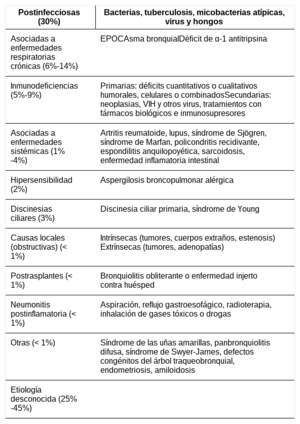
Las causas son muy numerosas. Las más frecuentes son las postinfecciosas y las idiopáticas. Para el diagnóstico se necesita una tomografía computarizada de tórax. El tratamiento es integral e incluye antibióticos (especialmente los empleados por vía inhalada en la infección bronquial crónica por Pseudomonas aeruginosa), macrólidos (por su efecto antiinflamatorio), mucolíticos orales, soluciones salinas hipertónicas, técnicas de drenaje de secreciones, ejercicio físico y una nutrición adecuada. Las agudizaciones requieren antibióticos frente a los microorganismos que infectan crónicamente las vías aéreas. En casos muy seleccionados, tras el fracaso de todas las opciones terapéuticas disponibles, puede valorarse la cirugía o el trasplante pulmonar. El seguimiento debe realizarse en unidades especializadas, con un enfoque multidisciplinario.

Palabras clave
Bronquiectasias
Infección bronquial crónica
Antibióticos inhalados
Inflamación bronquial
Abstract

Bronchiectasis is a chronic inflammatory disease characterized by irreversible dilation of the bronchi associated with persistent cough, expectoration, and recurrent exacerbations. Its prevalence is increasing due to improved diagnosis and its association with conditions such as asthma and chronic obstructive pulmonary disease. Its pathophysiology can be described as a «vicious cycle», in which infection, inflammation, and structural damage feed into one another. The inflammation is usually neutrophilic, although there is also an eosinophilic phenotype.

There are numerous causes, the most common of which are post-infectious and idiopathic. A chest computed tomography scan is required for diagnosis. Treatment is comprehensive and includes antibiotics (especially those administered by inhalation for chronic bronchial infection caused by Pseudomonas aeruginosa), macrolides (for their anti-inflammatory effect), oral mucolytics, hypertonic saline solutions, secretion drainage techniques, physical exercise, and adequate nutrition. Exacerbations require antibiotics targeting the microorganisms that chronically infect the airways. In very select cases, after all available therapeutic options have failed, surgery or lung transplantation may be considered. Follow-up should be conducted in specialized units with a multidisciplinary approach.

Keywords
Bronchiectasis
Chronic bronchial infection
Inhaled antibiotics
Bronchial inflammation

Identifíquese

¿Aún no es suscriptor de la revista?

Comprar el acceso al artículo

Comprando el artículo el pdf del mismo podrá ser descargado

Teléfono para incidencias

De lunes a viernes de 9h a 18h (GMT+1) excepto los meses de julio y agosto que será de 9 a 15h

Llamadas desde España 932 415 960
Llamadas desde fuera de España +34 932 415 960
Bibliografía
[1]
S. Aliberti
202611050417370388
, P.C. Goeminne, A.E. O’Donnell, T.R. Aksamit, H. Al-Jahdali, A.F. Barker, et al.
Criteria and definitions for the radiological and clinical diagnosis of bronchiectasis in adults for use in clinical trials: international consensus recommendations.
Lancet Respir Med., (2022), 10 pp. 298-306
[2]
D. Weycker
202611050417370389
, J. Edelsberg, G. Oster, G. Tino.
Prevalence and economic burden of Bronchiectasis.
Clin Pulm Med., (2005), 12 pp. 205-209
[3]
A.E. Seitz
2026110504173703810
, K.N. Olivier, J. Adjemian, S.M. Holland, D.R. Prevots.
Trends in bronchiectasis among medicare beneficiaries in the United States, 2000 to 2007.
Chest., (2012), 142 pp. 432-439
[4]
F.C. Ringshausen
2026110504173703811
, A. de Roux, R. Diel, D. Hohmann, T. Welte, J. Rademacher.
Bronchiectasis in Germany: a population-based estimation of disease prevalence.
Eur Respir J., (2015), 46 pp. 1805-1807
[5]
J.K. Quint
2026110504173703812
, E.R. Millett, M. Joshi, V. Navaratnam, S.L. Thomas, J.R. Hurst, et al.
Changes in the incidence, prevalence and mortality of bronchiectasis in the UK from 2004 to 2013: a population-based cohort study.
Eur Respir J., (2016), 47 pp. 186-193
[6]
P.A. Flume
2026110504173703813
, J.D. Chalmers, K.N. Olivier.
Advances in bronchiectasis: endotyping, genetics, microbiome, and disease heterogeneity.
Lancet., (2018), 392 pp. 880-890
[7]
J. Liang
2026110504173703814
, X. Bai, X. Liu.
The role of neutrophils in bronchiectasis.
Ann Med., (2025), 57 pp. 2584413
[8]
H. Choi
2026110504173703815
, S. Ryu, H.R. Keir, Y.H. Giam, A.J. Dicker, L. Perea, et al.
Inflammatory Molecular Endotypes in Bronchiectasis: A European Multicenter Cohort Study.
Am J Respir Crit Care Med., (2023), 208 pp. 1166-1176
[9]
M.Á. Martínez-García
2026110504173703816
, R. Méndez, C. Olveira, R. Girón, M. García-Clemente, L. Máiz, et al.
The U-Shaped relationship between eosinophil count and bronchiectasis severity: The effect of inhaled corticosteroids.
Chest., (2023 1), 164 pp. 606-613
[10]
M.C. Pasteur
2026110504173703817
, S.M. Helliwell, S.J. Houghton, S.C. Webb, J.E. Foweraker, R.A. Coulden, et al.
An investigation into causative factors in patients with bronchiectasis.
Am J Respir Crit Care Med., (2000), 162 pp. 1277-1284
[11]
C. Olveira
2026110504173703818
, A. Padilla, M.A. Martínez-García, D. de la Rosa, R.M. Girón, M. Vendrell, et al.
Etiology of bronchiectasis in a cohort of 2047 patients. An analysis of the Spanish Historical Bronchiectasis Registry.
Arch Bronconeumol., (2017), 53 pp. 366-374
[12]
M. Vendrell
2026110504173703819
, J. de Gracia, M.J. Rodrigo, M.J. Cruz, A. Álvarez, M. García, et al.
Antibody production deficiency with normal IgG levels in bronchiectasis of unknown etiology.
Chest., (2005), 127 pp. 197-204
[13]
M.A. Martínez-García
2026110504173703820
, D. de la Rosa Carrillo, J.J. Soler-Cataluña, Y. Donat-Sanz, P.C. Serra, M.A. Lerma, et al.
Prognostic value of bronchiectasis in patients with moderate-to-severe chronic obstructive pulmonary disease.
Am J Respir Crit Care Med., (2013), 187 pp. 823-831
[14]
G. Oscullo
2026110504173703821
, J.D. Gómez-Olivas, M. Ingles, S. Mompean, R. Martinez-Perez, G. Suarez-Cuartin, et al.
Bronchiectasis-COPD Overlap Syndrome: role of peripheral eosinophil count and inhaled corticosteroid treatment.
J Clin Med., (2023), 12 pp. 6417
[15]
L. Traversi
2026110504173703822
, M. Miravitlles, M.A. Martinez-Garcia, M. Shteinberg, A. Bossios, K. Dimakou, et al.
ROSE: radiology, obstruction, symptoms and exposure - a Delphi consensus definition of the association of COPD and bronchiectasis by the EMBARC Airways Working Group.
ERJ Open Res., (2021), 7
[16]
M. García-Clemente
2026110504173703823
, A.I. Enríquez-Rodríguez, M. Iscar-Urrutia, B. Escobar-Mallada, M. Arias-Guillén, F.J. López-González, et al.
Severe asthma and bronchiectasis.
J Asthma., (2020), 57 pp. 505-509
[17]
D. Dogru
2026110504173703824
, A. Nik-Ain, N. Kiper, A. Göçmen, U. Ozçelik, E. Yalçin, et al.
Bronchiectasis: the consequences of late diagnosis in chronic respiratory symptoms.
J Trop Pediatr., (2005), 51 pp. 362-365
[18]
D.J. Maselli
2026110504173703825
, B. Amalakuhan, H. Keyt, A.A. Díaz.
Suspecting non-cystic fibrosis bronchiectasis.
Int J Clin Pract., (2017), 71 pp. e12924
[19]
A.D. Saleh
2026110504173703826
, J.D. Chalmers, A. De Soyza, T.C. Fardon, S.O. Koustas, J. Scott, et al.
The heterogeneity of systemic inflammation in bronchiectasis.
Resp Med., (2017), 127 pp. 33-39
[20]
M. Martínez-García
2026110504173703827
, J. Soler Cataluña, M. Perpiñá Tordera, P. Román-Sánchez, J. Soriano.
Factors associated with lung function decline in adult patients with stable non-cystic fibrosis bronchiectasis.
Chest., (2007), 132 pp. 1565-1572
[21]
M.H. Hsieh
2026110504173703828
, Y.F. Fang, G.Y. Chen, F.T. Chung, Y.C. Liu, C.H. Wu, et al.
The role of the high- sensitivity C-reactive protein in patients with stable non-cystic fibrosis bronchiectasis.
Pulm Med., (2013), 2013 pp. 795140
[22]
J.D. Chalmers
2026110504173703829
, K.L. Moffitt, G. Suarez-Cuartin, O. Sibila, S. Finch, E. Furrie, et al.
Neutrophil elastase activity is associated with exacerbations and lung function decline in bronchiectasis.
Am J Respir Crit Care Med., (2017), 195 pp. 1384-1393
[23]
A. Shoemark
2026110504173703830
, E. Cant, L. Carreto, A. Smith, M. Oriano, H.R. Keir, et al.
A point-of-care neutrophil elastase activity assay identifies bronchiectasis severity, airway infection and risk of exacerbation.
Eur Respir J., (2019), 53 pp. 1900303
[24]
L.E. Hill
2026110504173703831
, G. Ritchie, A.J. Wightman, A.T. Hill, J.T. Murchison.
Comparison between conventional interrupted high-resolution CT and volume multidetector CT acquisition in the assessment of bronchiectasis.
Br J Radiol., (2010), 83 pp. 67-70
[25]
J.D. Dodd
2026110504173703832
, L.P. Lavelle, A. Fabre, D. Brady.
Imaging in cystic fibrosis and non-cystic fibrosis bronchiectasis.
Semin Respir Crit Care Med., (2015), 36 pp. 194-196
[26]
D.P. Naidich
2026110504173703833
, D.I. McCauley, N.F. Khouri, F.P. Stitik, S.S. Siegelman.
Computed tomography of bronchiectasis.
J Comput Assist Tomogr., (1982), 6 pp. 437-444
[27]
M. Bhalla
2026110504173703834
, N. Turcios, Aponte, M. Jenkins, B.S. Leitman, D.I. McCauley, et al.
Cystic fibrosis: scoring system with thin-section CT.
Radiology., (1991), 179 pp. 783-788
[28]
J.D. Chalmers
2026110504173703835
, E. Polverino, M.L. Crichton, F.C. Ringshausen, A. De Soyza, M. Vendrell, et al.
EMBARC Registry Investigators. Bronchiectasis in Europe: data on disease characteristics from the European Bronchiectasis registry (EMBARC).
Lancet Respir Med., (2023), 11 pp. 637-649
[29]
R. Cantón
2026110504173703836
, L. Máiz, A. Escribano, C. Olveira, A. Oliver, O. Asensio, et al.
en representación del Grupo Español de Consenso del Tratamiento Antimicrobiano en el Paciente con Fibrosis Quística. Spanish consensus on the prevention and treatment of Pseudomonas aeruginosa bronchial infections in cystic fibrosis patients.
Arch Bronconeumol., (2015), 51 pp. 140-145
[30]
Y. Wang
2026110504173703837
, J. Xiao, X. Yang, Y. Liu, J. Du, A. Bossios, et al.
Pulmonary microbiology and microbiota in adults with non-cystic fibrosis bronchiectasis: a systematic review and meta-analysis.
Respir Res., (2025), 26 pp. 77
[31]
D. Araújo
2026110504173703838
, M. Shteinberg, S. Aliberti, P.C. Goeminne, A.T. Hill, T.C. Fardon, et al.
The independent contribution of Pseudomonas aeruginosa infection to long-term clinical outcomes in bronchiectasis.
Eur Respir J., (2018), 51 pp. 1701953
[32]
M. Conceição
2026110504173703839
, M. Shteinberg, P. Goeminne, J. Altenburg, J.D. Chalmers.
Eradication treatment for Pseudomonas aeruginosa infection in adults with bronchiectasis: a systematic review and meta-analysis.
Eur Respir Rev., (2024), 33 pp. 230178
[33]
R. Cordeiro
2026110504173703840
, H. Choi, C.S. Haworth, J.D. Chalmers.
The efficacy and safety of inhaled antibiotics for the treatment of bronchiectasis in adults: Updated systematic review and meta-analysis.
[34]
C.S. Haworth
2026110504173703841
, M. Shteinberg, K. Winthrop, A. Barker, F. Blasi, K. Dimakou, et al.
PROMIS trial investigators. Inhaled colistimethate sodium in patients with bronchiectasis and Pseudomonas aeruginosa infection: results of PROMIS-I and PROMIS-II, two randomised, double-blind, placebo-controlled phase 3 trials assessing safety and efficacy over 12 months.
Lancet Respir Med., (2024), 12 pp. 787-798
[35]
G. Oscullo
2026110504173703842
, R. Méndez, C. Olveira, R. Girón, M. García-Clemente, L. Máiz, et al.
Effect of N-acetylcysteine on bronchiectasis in a real-life study. Data from the Spanish RIBRON Registry.
Arch Bronconeumol., (2025), 61 pp. 196-202
[36]
L. Máiz
2026110504173703843
, R.M. Girón, E. Prats, M.G. Clemente, E. Polverino, S. Caño, et al.
Addition of hyaluronic acid improves tolerance to 7% hypertonic saline solution in bronchiectasis patients.
Ther Adv Respir Dis., (2018), 12