






Vol. 12. Núm. 33.
Páginas 1955-1965 (Mayo 2017)

Actualización
Cáncer de vejiga

Bladder cancer

E. Ríos GonzálezaA.M. Jiménez Gordob
Doi : https://10.1016/j.med.2017.04.020
Opciones
Resumen
Introducción

El cáncer de vejiga es un tumor de histología predominantemente urotelial. El consumo de tabaco es el factor etiológico que más impacto tiene en el desarrollo del mismo.

Diagnóstico

Aproximadamente el 70% de los tumores se diagnostican en estadios iniciales sin afectar al músculo detrusor, por lo que se asocian a altas tasas de supervivencia, aunque pueden recidivar con relativa frecuencia.

Tratamiento

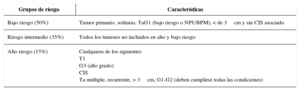
En los tumores no músculo infiltrante y en función de los factores pronósticos se establecen grupos de riesgo (bajo, medio y alto) que determinan el mejor tratamiento posible. En los casos de bajo riesgo es suficiente la administración de una dosis posoperatoria de quimioterapia intravesical. En los casos de riesgo intermedio el paciente debe recibir quimioterapia o inmunoterapia intravesical adyuvante. En los casos de alto riesgo se recomienda la inmunoterapia intravesical durante un periodo de uno a tres años. La afectación del músculo detrusor tiene implicaciones pronósticas y de tratamiento. En el caso de los tumores musculoinfiltrantes, la cirugía con quimioterapia neoadyuvante es el tratamiento estándar. En los tumores metastásicos la quimioterapia basada en cisplatino es el tratamiento de elección.

Palabras clave
Cáncer de vejiga
Quimioterapia
Cistectomía
Inmunoterapia
Abstract
Introduction

Bladder cancer is a tumour of predominantly urothelial histology. Tobacco use is the major aetiological factor for the development of bladder cancer.

Diagnosis

Approximately 70% of tumours are diagnosed in the initial stages without affecting the detrusor muscle, and therefore it is associated with high survival rates, although recurrence can be relatively common.

Treatment

Risk groups (low, medium and high) are established depending on prognostic factors which determine the best treatment possible. In low- risk cases administration of a postoperative dose of intravesical chemotherapy or adjuvant intravesical immunotherapy is sufficient. Intravesical immunotherapy over a period of one to three years is recommended for high-risk cases. Involvement of the detrusor muscle has implications with regard to prognosis and treatment. Surgery with neoadjuvant chemotherapy is the standard treatment for muscle-infiltrating tumours. Cisplatin-based chemotherapy is the treatment of choice for metastatic tumours.

Keywords
Bladder cancer
Chemotherapy
Cystectomy
Immunotherapy

Identifíquese

¿Aún no es suscriptor de la revista?

Comprar el acceso al artículo

Comprando el artículo el pdf del mismo podrá ser descargado

Teléfono para incidencias

De lunes a viernes de 9h a 18h (GMT+1) excepto los meses de julio y agosto que será de 9 a 15h

Llamadas desde España 932 415 960
Llamadas desde fuera de España +34 932 415 960
Bibliografía
[1]
J. Ferlay, E. Steliarova-Foucher, J. Lortet-Tieulent, S. Rosso, J.W. Coebergh, H. Comber, et al.
Cancer incidence and mortality patterns in Europe: estimates for 40 countries in 2012.
Eur J Cancer., (2013), 49
1374-403
[2]
A.R. Feldman, L. Kessler, M.H. Myers, M.D. Naughton.
The prevalence of cancer. Estimates base on the Connecticut tumor registry.
N Engl J Medicine., (1986), 315
1394-7
[3]
N.D. Freedman, D.T. Silverman, A.R. Hollenbek, A. Schatzkin, C.C. Abnet.
Association between smoking and risk of bladder cancer among men and women.
[4]
P. Brennan, O. Bogillot, S. Cordier, E. Greiser, W. Schill, P. Vineis, et al.
Cigarrette smoking and bladder cancer in men: a pooled analysis of 11 case-control studies.
Int J Cancer., (2000), 86
289-94
[5]
C.L. Pashos, M.F. Botteman, B.L. Laskin, A. Reaelli.
Bladder cancer: epidemiology, diagnosis and management.
Cancer Pract., (2002), 10
311-22
[6]
201705120936555058
M. Harling, A. Schablon, G. Schedlbauer, M. Dulon, A. Nienhaus.
Bladder cancer among hairdressers: a metaanalysis.
Occup Environ Med., (2010), 67
351-8
[7]
201705120936555059
2017051209365550510
Witjes JA, Comperat E, Cowan NC, Gakis G, Lebrét T, van der Heijden AG, et al. EAU Guidelines on muscle-invasive and metastatic bladder cancer. Disponible en: https://uroweb.org/guideline/bladder-cancer-muscle-invasive-and-metastatic/.[consultado Sep 2016].
[8]
I. Gouda, N. Mokhtar, D. Bilal, T. El-Bolkainy, M. El-Bolkainy.
Bilharziasis and bladder cancer: a time trend analysis of 9843 patients.
J Egypt Natl Canc Inst., (2007), 19
158-62
[9]
2017051209365550511
2017051209365550512
NCCN clinical practice guidelines in oncology. Bladder cancer. Version 2.2016. Disponible en: www.NCCN.org.[consultado september 2016].
[10]
V. Chalasani, J.L. Chin, J.I. Izawa.
Histologic variants of urothelial bladder cancer and nonurothelial histology in bladder cancer.
Can Urol Assoc J., (2009), 3 pp. S193
[11]
AJCC Cancer Stagin manual, 7th ed., Springer,
[12]
2017051209365550513
R.J. Sylvester, A. van der Meijden, J.A. Witjes, G. Jakse, N. Nonomura, C. Cheng, et al.
High-grade Ta urothelial carcinoma and carcinoma in situ of the bladder.
[13]
R. Montironi, A. López-Beltran.
The 2004 WHO classification of bladder tumors: a summary and comentary.
Int J Surg Pathol., (2005), 13
143-53
[14]
M.H. Khadra, R.S. Pickard, M. Charlton, P.H. Powell, D.E. Neal.
A prospective analysis of 1930 patients with hematuria to evaluate current diagnostiv prsctice.
J Urol., (2000), 163
524-7
[15]
2017051209365550514
E. Pasin, D.Y. Josephson, A.P. Mitra, R.J. Cote, J.P. Stein.
Superficial bladder cancer: an update on etiology, molecular development, classification and natural history.
Rev Urol., (2008), 10 pp. 31
[16]
2017051209365550515
2017051209365550516
R.J. Sylvester, A.P. van der Meijden, W. Oosterlinck, J.A. Witjes, C. Bouffioux, L. Denis, et al.
Predicting recurrence and progression in individual patients with stage Ta-T1 bladder cancer using EORTC tables: a combined analisys of 2596 patients from seven EORTC trials.
[17]
F.A. Yafi, F. Brimo, J. Steinberg, A.G. Aprikian, S. Tanguay, W. Kassouf.
Prospective analysis of sensitivity and specificity of urinary cytology and other urinary biomarkers for bladdder cancer.
e25
[18]
S.N. Datta, G.M. Allen, R. Evans, K.C. Vaughton, M.C. Lucas.
Urinary tract ultrasonography in the evaluation of haematuria- a report of over 1000 cases.
Ann R Coll Surg Engl., (2002), 84 pp. 203
[19]
2017051209365550517
2017051209365550518
Babjuk M, Böhle A, Burger M, Compérat E, Kaasinen E, Palou J, et al. EAU Guidelines on non-muscle-invasive Bladder Cancer (Ta, T1 and CIS). Disponible en: https://uroweb.org/guideline/non-muscle-invasive-bladder-cancer/.[consultado Sep 2016].
[20]
G. Jakse, F. Algaba, P. Malmström, W. Oosterlinck.
A Second-look TUR in T1 transitional cell carcinoma: why?.
[21]
2017051209365550519
J.B. Thrasher, E.D. Crawford.
Complications of intravesical chemotherapy.
Urol Clin North Am., (1992), 19 pp. 529
[22]
2017051209365550520
2017051209365550521
R.J. Sylvester, W. Oosterlinck, S. Holmang, M.R. Sydes, A. Birtle, S. Gudjonsson, et al.
Systematic review and individual patient data meta-analysis of randomized trials comparing a single immediate instillation of chemotherapy after transurethral resection with transurethral resection alone in patients with stage Ta-T1 urothelial carcinoma of the bladder: wich patients benefit from the instillation?.
[23]
2017051209365550522
B. Ehdaie, R. Sylvester, H.W. Herr.
Manteinance bacillus Calmette-Guerin treatment of non-muscle-invasive bladder cancer: a critical evaluation of the evidence.
[24]
2017051209365550523
J. Oddens, M. Brausi, R. Sylvester, A. Bono, C. van de Beek, G. van Andel, et al.
Final results of an EORTC-GU cancer group randomized study of maintenance bacillus Calmette-Guerin in intermediate and high-risk Ta, T1 papillary carcinoma of the urinary bladder: one-third dose versus full dose and 1 year versus 3 years of maintenance.
[25]
2017051209365550524
2017051209365550525
J.A. Martínez-Piñeiro, N. Flores, S. Isorna, E. Solsona, J.L. Sebastian, C. Pertusa, et al.
Long-term follow-up of a randomized prospective trial comparing a standard 81mg dose of intravesical bacille Calmette-Guérin with a reduced dose of 27mg in superficial bladder cancer.
BJU Int., (2002), 89 pp. 671
[26]
E. Solsona, I. Iborra, A. Collado, J. Rubio-Briones, J. Casanova, A. Calatrava.
Feasibility of radical transurethral resection as monotherapy for selected patiens with muscle invasive bladder cancer.
[27]
2017051209365550526
2017051209365550527
Advanced Bladder Cancer (ABC). Meta-analysis collaboration. Neoadjuvant chemotherapy in invasive bladder cancer: update of a systematic review and meta-analysis of individual patient data advanced bladder cancer (ABC) meta-analysis collaboration.
[28]
2017051209365550528
2017051209365550529
Advanced Bladder Cancer (ABC). Meta-analysis collaboration. Adjuvant chemotherapy in invasive bladder cancer: a systematic review and meta-analysis of individual patient data Advanced Bladder Cancer (ABC) Meta-analysis collaboration.
[29]
2017051209365550530
G. Griffiths, R. Hall, R. Sylvester, D. Raghavan, M.K. Parmar.
International phase III trial assessing neoadjuvant cisplatin, methotrexate, and vinblastine chemotherapy for muscle-invasive bladder cancer: long-term results of the BA06 30894 trial.
J Clin Oncol., (2011), 29 pp. 2171
[30]
2017051209365550531
C.N. Sternberg, I. Skoneczna, J.M. Kerst, P. Albers, S.D. Fossa, M. Agerbaek, et al.
Immediate versus deferred chemotherapy after radical cystectomy in patients with pT3-pT4 or N+ M0 urothelial carcinoma of the bladder (EORTC 30994): an intergroup, open-label, randomised phase 3 trial.
Lancet Oncol., (2015), 16 pp. 76
[31]
2017051209365550532
2017051209365550533
H. von der Maase, L. Sengelov, J.T. Roberts, S. Ricci, L. Dogliotti, T. Oliver, et al.
Long-term survival results of a randomized trial comparing gemcitabine plus cisplatin, with methotrexate, vinblastine, doxorubicin, plus cisplatin in patients with bladder cancer.
J Clin Oncol., (2005), 23 pp. 4602
[32]
2017051209365550534
J. Bellmunt, H. von der Maase, G.M. Mead, I. Skonecczna, M. de Santis, G. Daugaard, et al.
Randomized phase III study comparing paclitaxel/cisplatin/gemcitabine and gemcitabine/cisplatin in patients with locally advanced or metastatic urothelial cancer without prior systemic therapy: EORTC Intergroup Study 30987.
J Clin Oncol., (2012), 30 pp. 1107
[33]
2017051209365550535
J. Bellmunt, C. Théodore, T. Demkov, B. Komyakov, L. Sengelov, G. Daugaard, et al.
Phase III trial of vinflunine plus best supportive care compared with best supportive care alone after a platinum-containing regimen in patients with advanced transitional cell carcinoma of the urothelial tract.
J Clin Oncol., (2009), 27 pp. 4454
[34]
2017051209365550536
D.J. Vaughn, C.M. Broome, M. Hussain, J.C. Gutheil, A.B. Markowitz.
Phase II trial of weekly paclitaxel in patients with previously treated advanced urothelial cáncer.
J Clin Oncol., (2002), 20 pp. 937-940
[35]
2017051209365550537
J.A. McCaffrey, S. Hilton, M. Mazumdar, S. Sadan, W.K. Kelly, H.I. Scher, et al.
Phase II trial of docetaxel in patients with advanced or metastatic transitional-cell carcinoma.
J Clin Oncol., (1997), 15 pp. 1853-1857
[36]
2017051209365550538
J.E. Rosenberg, J. Hoffman-Censits, T. Powles, M.S. van der Heijden, A.V. Balar, A. Necchi, et al.
Atezolizumab in patients with locally advanced and metastatic urothelial carcinoma who have progressed following treatment with platinum based chemotherapy: single arm multicenter phase II trial.
[37]
2017051209365550539
Balard AV, Galsky MD, Oriot Y, Dawson NA, Necchi A, Srinivas S, et al. Atezolizumab (Atezo) as first line (1L) therapy in cisplatin-ineligible locally advanced/metastatic urothelial carcinoma (mUC): primary analysis of IMvigor 210 cohort 1.(Abstract LBA 4500 American Society of Clinical Oncology 2016 Annual Meeting).