

Vol. 12. Núm. 52.
Páginas 3110-3113 (Abril 2018)

Protocolos de práctica asistencial
Criterios de ingreso hospitalario y en la Unidad de Cuidados Intensivos de un paciente séptico

Hospital and intensive care unit admission criteria for the septic patient

M. Hernández BernalM.J. Asensio MartínE. Herrero de LucasB. Civantos Martín
Doi : https://10.1016/j.med.2018.03.018
Opciones
Resumen
Introducción

La incidencia de la sepsis continúa aumentando. Se define como la disfunción orgánica potencialmente mortal, secundaria a la respuesta anómala ante una infección.

Diagnóstico

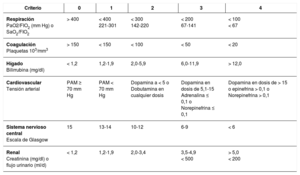
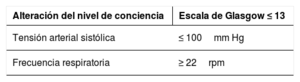
Se introduce una nueva escala, útil para el reconocimiento de sepsis en pacientes no ingresados en la UCI, denominada quick SOFA. Tanto la sepsis como el shock séptico son emergencias médicas y el tratamiento debe ser iniciado inmediatamente, aplicándose la máxima prioridad y atención consensuada y continuada entre los servicios de Urgencias y la UCI.

Tratamiento

En el primer contacto, valoración según esquema ABCD, que de encontrarse alterado se realizará aviso precoz a la UCI e inicio de medidas simultáneas. Según la Surviving Sepsis Campaign, se debe iniciar precozmente la reanimación con cristaloides, toma de muestras para cultivo y antibioterapia y determinación de niveles de lactato. Se requiere revaloración frecuente de la situación hemodinámica y evaluación continua de respuesta a medidas implantadas. Ante la falta de respuesta al volumen se debe ingresar al paciente en Medicina Intensiva.

Palabras clave
Sepsis-3
Escala SOFA
Quick SOFA
Variables dinámicas
Abstract
Introduction

The incidence of sepsis continues increasing. It's defined as life-threatening organ dysfunction caused by a dysregulated host response to infection.

Diagnosis

A new scale is introduced, useful for the recognition of sepsis in patients not admitted to the ICU, called quick-SOFA. Sepsis and septic shock are medical emergencies and the treatment should be initiated immediately, with the highest priority and consensual and continuous care, between the emergency and ICU services.

Treatment

In the first contact, assessment according to ABCD scheme, that of being altered, early warning to UCI and initiate simultaneous measures. According to the Surviving Sepsis Campaign, early resuscitation with crystalloids, sampling for culture and antibiotic therapy, and determination of lactic levels should be initiated. It requires frequent reassessment of the hemodynamic situation and continuous assessment of response to implanted measures. In the absence of response to the volume should be admitted to Intensive Care Medicine.

Keywords
Sepsis-3
SOFA score
Quick-SOFA score
Hemodynamic variables

Identifíquese

¿Aún no es suscriptor de la revista?

Comprar el acceso al artículo

Comprando el artículo el pdf del mismo podrá ser descargado

Teléfono para incidencias

De lunes a viernes de 9h a 18h (GMT+1) excepto los meses de julio y agosto que será de 9 a 15h

Llamadas desde España 932 415 960
Llamadas desde fuera de España +34 932 415 960
Bibliografía
[1]
201803200426425178
201803200426425179
M. Singer, C.S. Deutsman, C.W. Seymour, M. Shankar-Hari, D. Annane, M. Bauer, et al.
The Third International Consensus Definitions for Sepsis and septic Shock (Sepsis-3).
JAMA., (2016), 315 pp. 801-810
[2]
2018032004264251710
2018032004264251711
M.M. Churpek, F.J. Zadravecz, C. Winslow, M.D. Howell, D.P. Edelson.
Incidence and prognostic value of the systemic inflammatory response syndrome and organ dysfunctions in ward patients.
Am J Respir Crit Care Med., (2015), 192 pp. 958-964
[3]
2018032004264251712
2018032004264251713
A.E. Jones, S. Trzeciak, J.A. Kline.
The Sequential Organ Failure Assessment score for predicting outcome in patients with severe sepsis and evidence of hypoperfusion at the time of emergency department presentation.
Crit Care Med., (2009), 37 pp. 1649-1654
[4]
2018032004264251714
2018032004264251715
A. Rhodes, L.E. Evans, W. Alhazzani, M.M. Levy, M. Antonelli, R. Ferrer, et al.
Surviving Sepsis Campaign: International guidelines for management sepsis and septic shock: 2016.
Critical Care Med., (2017), 45 pp. 486-552
[5]
2018032004264251716
2018032004264251717
E. Rivers, B. Nguyen, S. Havstad, J. Ressler, A. Muzzin, B. Knoblich, et al.
Early goal-directed therapy in the treatment of severe sepsis and septic shock.
N Engl J Med., (2001), 345 pp. 1368-1377
[6]
2018032004264251718
2018032004264251719
A. Ochagavía, F. Baigorri, J. Mesquida, J.M. Ayuela, A. Ferrándiz, X. García, et al.
Hemodynamic monitoring in the critically patient. Recommendations of the Cardiological Intensive Care and CPR Working Gr*oup of the Spanish Society of Intensive Care and Coronary Units.
Medicina Intensiva (English edition), (2014 5), 38 pp. 154-169
[7]
2018032004264251720
2018032004264251721
J.L. Vincent, D. De Backer.
Circulatory shock.
N Engl J Med., (2013), 369 pp. 1726-1734
[8]
2018032004264251722
2018032004264251723
J.L. Vincent, A. Rhodes, A. Perel, G.S. Martin, G. Della Roca, B. Vallet, et al.
Clinical review: update on hemodynamic monitoring-a consensus of 16.
Crit Care., (2011), 15 pp. 229