
Vol. 14. Núm. 65.
Páginas 4036-4043 (Octubre 2026)

Actualización
Enfermedad tromboembólica pulmonar

Pulmonary embolism

D. Ceballos Gómez-BarredaaR. Morillo GuerreroabD. Jiménez Castroabc
Doi : https://10.1016/j.med.2026.10.022
Opciones
Resumen

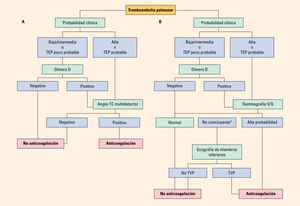
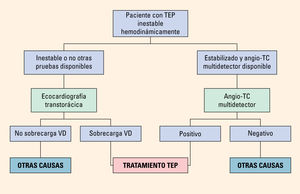
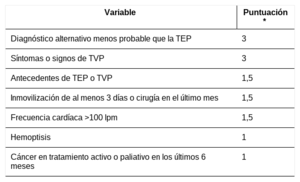
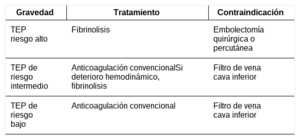
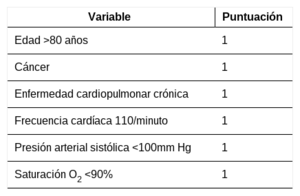
La tromboembolia pulmonar es una entidad cardiovascular aguda de elevada morbimortalidad y constituye la tercera causa de muerte de origen cardiovascular. Su diagnóstico se basa en una estrategia integrada que combina la probabilidad clínica, la determinación del dímero D y las pruebas de imagen, siendo la angiografía torácica por tomografía computarizada multidetector la técnica de elección. La aplicación de algoritmos diagnósticos recomendados por las guías de práctica clínica mejora el pronóstico y la supervivencia de los pacientes. Tras el diagnóstico, es fundamental realizar una estratificación pronóstica que permita clasificar a los pacientes según su riesgo (bajo, intermedio-bajo, intermedio-alto y alto), con el fin de guiar el tratamiento, cuyo pilar fundamental en la mayoría de los casos es la anticoagulación.

Palabras clave
Tromboembolia pulmonar
Diagnóstico
Pronóstico
Anticoagulación
Abstract

Pulmonary embolism is an acute cardiovascular condition associated with high morbidity and mortality and is the third leading cause of cardiovascular death. Its diagnosis is based on an integrated strategy that combines clinical probability, D-dimer determination, and imaging studies, with multidetector computed tomography (MDCT) thoracic angiography being the technique of choice. The use of diagnostic algorithms recommended by clinical practice guidelines improves patient prognosis and survival. Following diagnosis, it is essential to perform prognostic stratification to classify patients according to their risk (low, intermediate-low, intermediate-high, and high) in order to guide treatment. In most cases, the cornerstone of treatment is anticoagulation.

Keywords
Pulmonary embolism
Diagnosis
Prognosis
Anticoagulation

Identifíquese

¿Aún no es suscriptor de la revista?

Comprar el acceso al artículo

Comprando el artículo el pdf del mismo podrá ser descargado

Teléfono para incidencias

De lunes a viernes de 9h a 18h (GMT+1) excepto los meses de julio y agosto que será de 9 a 15h

Llamadas desde España 932 415 960
Llamadas desde fuera de España +34 932 415 960
Bibliografía
[1]
G.E. Raskob
202611050417462838
202611050417462839
, P. Angchaisuksiri, A.N. Blanco, H. Buller, A. Gallus, B.J. Hunt, et al.
Thrombosis: a major contributor to global disease burden.
Arterioscler Thromb Vasc Biol., (2014), 34 pp. 23632371
[2]
M.D. Silverstein
2026110504174628310
2026110504174628311
, J.A. Heit, D.N. Mohr, T.M. Petterson, M. O’Fallon, L.J. Melton III.
Trends in the incidence of deep vein thrombosis and pulmonary embolism.
Arch Intern Med., (1998), 158 pp. 585-593
[3]
M.A. Rogers
2026110504174628312
2026110504174628313
, D.A. Levine, N. Blumberg, S.A. Flanders, V. Chopra, K.M. Langa.
Triggersof hospitalization for venous thromboembolism.
Circulation., (2012), 125 pp. 20922099
[4]
Anderson Jr., F.A.
2026110504174628314
2026110504174628315
, F.A. Spencer.
Risk factors for venous thromboembolism.
Circulation., (2003), 107 pp. I9I16
[5]
C.V. Pollack
2026110504174628316
2026110504174628317
, D. Schreiber, S.Z. Goldhaber, D. Slattery, J. Fanikos, B.J. ONeil, et al.
Clinical. character istics, management, and outcomes of patients diagnosed with acute pulmonary embolism in the emergency department: initial report of EMPEROR (Multicenter Emergency Medicine Pulmonary Embolism in the Real World Registry).
J Am Coll Cardiol., (2011), 57 pp. 700706
[6]
P. Prandoni
2026110504174628318
2026110504174628319
, A.W. Lensing, M.H. Prins, M. Ciammaichella, M. Perlati, N. Mumoli, et al.
PESITInvesti gators Prevalence of pulmonary embolism among patients hospitalized forsyncope.
N Engl J Med., (2016), 375 pp. 15241531
[7]
S. Barco
2026110504174628320
2026110504174628321
, Y.M. Ende-Verhaar, C. Becattini, D. Jimenez, M. Lankeit, M.V. Huisman, et al.
Differential impact of syncope on the prognosis ofpatients with acute pulmonary embolism: a systematic review and meta-analysis.
Eur Heart J., (2018), 39 pp. 41864195
[8]
V.P. Harjola
2026110504174628322
2026110504174628323
, A. Mebazaa, J. Celutkiene, D. Bettex, H. Bueno, O. Chioncel, et al.
Contemporary management of acute right ventricular failure: a state ment from the Heart Failure Association and the WorkingGroup on Pulmonary Circulation and Right Ventricular Function of the European Society of Cardiology.
Eur J Heart Fail., (2016), 18 pp. 226241
[9]
H. Thiele
2026110504174628324
2026110504174628325
, E.M. Ohman, S. Desch, I. Eitel, S. de Waha.
Management of cardiogenic shock.
Eur Heart J., (2015), 36 pp. 1223-1230
[10]
J.D. Shopp
2026110504174628326
2026110504174628327
, L.K. Stewart, T.W. Emmett, J.A. Kline.
Findings from 12-lead electrocardiog raphy that predict circulatory shock from pulmonary embolism: systematic review and meta-analysis.
Acad Emerg Med., (2015), 22 pp. 1127-1137
[11]
C.G. Elliott
2026110504174628328
2026110504174628329
, S.Z. Goldhaber, L. Visani, M. DeRosa.
Chest radiographs in acute pulmonary embolism results from the International Cooperative Pulmonary Embolism Registry.
Chest., (2000), 118 pp. 3338
[12]
M.A. Rodger
2026110504174628330
2026110504174628331
, M. Carrier, G.N. Jones, P. Rasuli, F. Raymond, H. Djunaedi, et al.
Diagnostic valueofarterial bloodgasmeasurementinsuspectedpulmonaryembolism.
Am J Respir Crit Care Med., (2000), 162 pp. 21052108
[13]
M. Righini
2026110504174628332
2026110504174628333
, G. Le Gal, S. De Lucia, P.M. Roy, G. Meyer, D. Aujesky, et al.
Clinical usefulness of D-dimer testing in cancer patients with suspected pulmonary embolism.
Thromb Haemost;., (2006), 95 pp. 715719
[14]
A. Perrier
2026110504174628334
2026110504174628335
, P.M. Roy, O. Sanchez, G. Le Gal, G. Meyer, A.L. Gourdier, et al.
Multidetector-row computed tomography in suspected pulmonary embolism.
N Engl J., (2005), 352 pp. 17601768
[15]
M. Righini
2026110504174628336
2026110504174628337
, J. Van Es, P.L. Den Exter, P.M. Roy, F. Verschuren, A. Ghuysen, et al.
Age-adjusted dimercutoff levels to rule out pulmonary embolism: the ADJUST-PE study.
JAMA., (2014), 311 pp. 11171124
[16]
T. van der Hulle
2026110504174628338
2026110504174628339
, W.Y. Cheung, S. Kooij, L.F.M. Beenen, T. van Bemmel, et al.
Years Study Group. Simplified diagnostic management of suspected pulmonary embolism (the YEARS study): a prospective multicentre cohort study.
Lancet., (2017), 390 pp. 289297
[17]
G.J. Geersing
2026110504174628340
2026110504174628341
, P.M. Erkens, W.A. Lucassen, H.R. Buller, H.T. Cate, A.W. Hoes, et al.
Safe exclusion of pulmonary embolism using the Wells rule and qualitative D-dimer testing in primary care: prospective cohort study.
BMJ., (2012), 345 pp. e6564
[18]
P.D. Stein
2026110504174628342
2026110504174628343
, S.E. Fowler, L.R. Goodman, A. Gottschalk, C.A. Hales, R.D. Hull, et al.
PIOPED IIInvestigators Multidetector computed tomography for acute pulmonary embolism.
N Engl J Med., (2006), 354 pp. 23172327
[19]
J.H. Reid
2026110504174628344
2026110504174628345
, E.E. Coche, T. Inoue, E.E. Kim, M. Dondi, N. Watanabe, et al.
Interna tional Atomic Energy Agency ConsultantsGroup. Is the lung scan alive and well? Facts and controversies in defining the role of lung scintigraphy for the diagnosis of pulmonary embolism in the era of MDCT.
Eur J Nucl Med Mol Imaging., (2009), 36 pp. 505521
[20]
A. Perrier, H. Bounameaux.
Ultrasonography of leg veins in patients suspected of having pulmonary embolism.
Ann Intern Med., (1998), 128 pp. 243243
[21]
S. Dresden
2026110504174628346
2026110504174628347
, P. Mitchell, L. Rahimi, M. Leo, J. Rubin-Smith, S. Bibi, et al.
Right ventricular dilatation on bedside echocardiography performed by emergency physicians aids in the diagnosis of pulmonary embo lism.
Ann Emerg Med., (2014), 63 pp. 1624
[22]
G. Meyer
2026110504174628348
2026110504174628349
, E. Vicaut, T. Danays, G. Agnelli, C. Becattini, J. Beyer-Westendorf, et al.
ESC Guidelines 53.
Disponible en: https://academic.oup.com/eurheartj/advance-article-abstract/doi/10.1093/eurheartj/ehz405/5556136 by guest on 19 December, (2019),
[23]
W.B. Keeling
2026110504174628350
2026110504174628351
, T. Sundt, M. Leacche, Y. Okita, J. Binongo, Y. Lasajanak, et al.
Outcomes after surgical pulmonary embolectomy for acute pulmonary embolus: a multi-institutional study.
Ann Thorac Surg., (2016), 102 pp. 14981502
[24]
S.V. Konstantinides
2026110504174628352
2026110504174628353
, A. Torbicki, G. Agnelli, N. Danchin, D. Fitzmaurice, N. Galiè, et al.
Task force for the diagnosis and management of acute pulmonary embolism of the European Society of Cardiology (ESC). 2014 ESC guidelines on the diagnosis and management of acute pulmonary embolism.
Eur Heart J., (2014), 35 pp. 3033-3069
[25]
PREPIC., Study Group
2026110504174628354
2026110504174628355
.
Eight-year follow-up of patients with permanent vena cava filters in the prevention of pulmonary embolism: the PREPIC (Prevention du Risque d’ embolie pulmonaire par interruption cave) randomized study.
Circulation., (2005), 112 pp. 4164