
Vol. 14. Núm. 65.
Páginas 4023-4035 (Octubre 2026)

Actualización
Hipertensión pulmonar

Pulmonary hypertension

I. Jara AlonsoaF. Vargas UrsúaaA. Tenesab
Doi : https://10.1016/j.med.2026.10.021
Opciones
Resumen

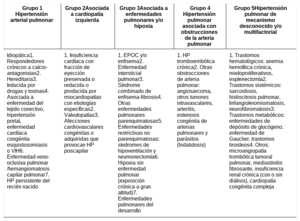
La hipertensión pulmonar (HP) es un síndrome que consiste en el aumento de presión en la arteria pulmonar, lo cual puede condicionar a largo plazo una morbimortalidad elevada provocada por los efectos de esta elevación de presiones en el lado derecho del corazón y el daño vascular pulmonar. Es un síndrome complejo que requiere seguimiento y tratamiento en unidades multidisciplinares. Se divide en 5 grupos, englobando cada grupo enfermedades con etiologías distintas pero que fisiopatológicamente derivan en la elevación crónica de PAP, además de compartir el mismo tratamiento. Los pacientes clasificados como HP grupo 1 o hipertensión arterial pulmonar (HAP) se caracterizan por la afectación de la capacidad vasodilatadora y el remodelado de los vasos sanguíneos; los de grupo 2, por la elevación de presión se asocia con afectación del corazón izquierdo; los de grupo 3, por una afectación asociada con patología pulmonar o hipoxia; los de grupo 4, por una obstrucción arterial pulmonar, y los de grupo 5, por causas no conocidas o multifactoriales. Las manifestaciones clínicas se pueden solapar con otras patologías cardiopulmonares, por lo que es importante definir criterios de sospecha en pacientes con riesgo, seguir el algoritmo de diagnóstico e iniciar un tratamiento precoz. El tratamiento es distinto en función del grupo, pero su finalidad es principalmente disminuir la presión en la arteria pulmonar o tratar las causas que lo provocan.

Palabras clave
Hipertensión pulmonar
Concepto
Etiopatogenia
Clasificación
Manifestaciones clínicas
Complicaciones
Estrategias diagnósticas
Tratamiento
Manejo crónico
Abstract

Pulmonary hypertension (PH) is a syndrome characterized by increased pulmonary artery pressure. It can lead to high morbidity and mortality in the long term due to the effects of this elevated pressure on the right side of the heart and pulmonary vascular damage. It is a complex syndrome that requires follow-up and treatment in multidisciplinary units. It is divided into five groups with each group encompassing diseases with different etiologies but which, pathophysiologically, result in chronic elevation of pulmonary artery pressure and share the same treatment. Patients classified as Group 1 PH or pulmonary arterial hypertension (PAH) are characterized by impaired vasodilation and vascular remodeling; those in Group 2 by elevated pressure associated with left heart disease; those in Group 3 by disease associated with lung disease or hypoxia; those in Group 4 by pulmonary artery obstruction; and those in Group 5 by unknown or multifactorial causes. Clinical manifestations may overlap with those of other cardiopulmonary conditions. Therefore, it is important to establish criteria for suspecting the condition in at-risk patients, follow the diagnostic algorithm, and start treatment early. The treatment is different depending on the group, but its purpose is primarily to reduce pulmonary artery pressure or treat the underlying causes.

Keywords
Pulmonary hypertension
Concept
Etiopathogenesis
Classification
Clinical manifestations
Complications
Diagnostic strategies
Treatment
Long-term management

Identifíquese

¿Aún no es suscriptor de la revista?

Comprar el acceso al artículo

Comprando el artículo el pdf del mismo podrá ser descargado

Teléfono para incidencias

De lunes a viernes de 9h a 18h (GMT+1) excepto los meses de julio y agosto que será de 9 a 15h

Llamadas desde España 932 415 960
Llamadas desde fuera de España +34 932 415 960
Bibliografía
[1]
M. Humbert, G. Kovacs, M.M. Hoeper, R. Badagliacca, R.M.F. Berger, M. Brida, et al.
ESC/ERS Scientific Document Group. 2022 ESC/ERS Guidelines for the diagnosis and treatment of pulmonary hypertension.
Eur Heart J., (2022), 43 pp. 3618-3731
[2]
D.F. Condon, N.P. Nickel, R. Anderson, S. Mirza, V.A. de Jesus Perez.
The 6th World Symposium on Pulmonary Hypertension: what's old is new.
F1000Res., (2019), 8
[3]
G. Kovacs, A. Olschewski, A. Berghold, H. Olschewski.
Pulmonary vascular resistances during exercise in normal subjects: a systematic review.
Eur Respir J., (2012), 39 pp. 319-328
[4]
G. Kovacs, S. Bartolome, C.P. Denton, M.A. Gatzoulis, S. Gu, D. Khanna, et al.
Definition, classification and diagnosis of pulmonary hypertension.
Eur Respir J., (2024), 64 pp. 2401324
[5]
N. Karia, L. Howard, M. Johnson, D.G. Kiely, J. Lordan, C. McCabe, et al.
Predictors of outcomes in mild pulmonary hypertension according to 2022 ESC/ERS guidelines: the EVIDENCE-PAH UK study.
Eur Heart J, (2023), 44 pp. 4678-4691
[6]
GBD 2021 Pulmonary Arterial Hypertension Collaborators.
Global, regional, and national burden of pulmonary arterial hypertension, 1990-2021: a systematic analysis for the Global Burden of Disease Study 2021.
Lancet Respir Med., (2025), 13 pp. 69-79
[7]
C.A. Wagenvoort.
The pathology of primary pulmonary hypertension.
J Pathol., (1970), 101
[8]
A. Mocumbi, M. Humbert, A. Saxena, Z.C. Jing, K. Sliwa, F. Thienemann, et al.
Pulmonary hypertension.
Nat Rev Dis Primers., (2024), 10 pp. 1
[9]
P.M. Hassoun.
Pulmonary arterial hypertension.
N Engl J Med., (2021), 385 pp. 2361-2376
[10]
S. Liang, A.A. Desai, S.M. Black, H. Tang.
Cytokines, chemokines, and inflammation in pulmonary arterial hypertension.
Adv Exp Med Biol., (2021), 1303 pp. 275-303
[11]
L.C. Price, S.J. Wort, F. Perros, P. Dorfmüller, A. Huertas, D. Montani, et al.
Inflammation in pulmonary arterial hypertension.
Chest., (2012), 141 pp. 210-221
[12]
B.W. Christman, C.D. McPherson, J.H. Newman, G.A. King, G.R. Bernard, B.M. Groves, et al.
An imbalance between the excretion of thromboxane and prostacyclin metabolites in pulmonary hypertension.
N Engl J Med., (1992), 327 pp. 70-75
[13]
A. Giaid, M. Yanagisawa, D. Langleben, R.P. Michel, R. Levy, H. Shennib, S. Kimura, et al.
Expression of endothelin-1 in the lungs of patients with pulmonary hypertension.
N Engl J Med., (1993), 328 pp. 1732-1739
[14]
R. Budhiraja, R.M. Tuder, P.M. Hassoun.
Endothelial dysfunction in pulmonary hypertension.
Circulation., (2004), 109 pp. 159-165
[15]
Z. Deng, J.H. Morse, S.L. Slager, N. Cuervo, K.J. Moore, G. Venetos, et al.
Familial primary pulmonary hypertension (gene PPH1) is caused by mutations in the bone morphogenetic protein receptor-II gene.
Am J Hum Genet., (2000), 67 pp. 737-744
[16]
N.W. Morrell, M.A. Aldred, W.K. Chung, C.G. Elliott, W.C. Nichols, F. Soubrier, et al.
Genetics and genomics of pulmonary arterial hypertension.
Eur Respir J., (2019), 53 pp. 1801899
[17]
W. Seeger, Y. Adir, J.A. Barberà, H. Champion, J.G. Coghlan, V. Cottin, et al.
Pulmonary hypertension in chronic lung diseases.
J Am Coll Cardiol., (2013), 62 pp. D109-D116
[18]
N.H. Kim, M. Delcroix, D.P. Jenkins, R. Channick, P. Dartevelle, P. Jansa, et al.
Chronic thromboembolic pulmonary hypertension.
J Am Coll Cardiol., (2013), 62 pp. D92-D99
[19]
R.J. Barst, M. McGoon, A. Torbicki, O. Sitbon, M.J. Krowka, H. Olschewski, et al.
Diagnosis and differential assessment of pulmonary arterial hypertension.
J Am Coll Cardiol., (2004), 43 pp. 40S-47S
[20]
J. Żyłkowska, M. Kurzyna, R. Pietura, A. Fijałkowska, M. Florczyk, C. Czajka, et al.
Recurrent hemoptysis: an emerging life-threatening complication in idiopathic pulmonary arterial hypertension.
Chest., (2011), 139 pp. 690-693
[21]
J. Żyłkowska, M. Kurzyna, M. Florczyk, B. Burakowska, F. Grzegorczyk, J. Burakowski, et al.
Pulmonary artery dilatation correlates with the risk of unexpected death in chronic arterial or thromboembolic pulmonary hypertension.
Chest., (2012), 142 pp. 1406-1416
[22]
E.A. Demerouti, A.N. Manginas, G.D. Athanassopoulos, G.T. Karatasakis.
Complications leading to sudden cardiac death in pulmonary arterial hypertension.
Respir Care., (2013), 58 pp. 1246-1254
[23]
J. Tongers, B. Schwerdtfeger, G. Klein, T. Kempf, A. Schaefer, J.M. Knapp, et al.
Incidence and clinical relevance of supraventricular tachyarrhythmias in pulmonary hypertension.
Am Heart J., (2007), 153 pp. 127-132
[24]
S. Rich, D.R. Dantzker, S.M. Ayres, E.H. Bergofsky, B.H. Brundage, K.M. Detre, et al.
Primary pulmonary hypertension. A national prospective study.
Ann Intern Med., (1987), 107 pp. 216-223
[25]
P. Trip, E.J. Nossent, F.S. de Man, I.A. van den Berk, A. Boonstra, H. Groepenhoff, et al.
Severely reduced diffusion capacity in idiopathic pulmonary arterial hypertension: patient characteristics and treatment responses.
Eur Respir J., (2013), 42 pp. 1575-1585
[26]
X.G. Sun, J.E. Hansen, R.J. Oudiz, K. Wasserman.
Pulmonary function in primary pulmonary hypertension.
J Am Coll Cardiol., (2003), 41 pp. 1028-1035
[27]
C. Hadinnapola, M. Bleda, M. Haimel, N. Screaton, A. Swift, P. Dorfmüller, et al.
NIHR BioResource–Rare Diseases Consortium; UK National Cohort Study of Idiopathic and Heritable PAH, Gräf S, Morrell NW. Phenotypic Characterization of EIF2AK4 Mutation Carriers in a Large Cohort of Patients Diagnosed Clinically With Pulmonary Arterial Hypertension.
Circulation., (2017), 136 pp. 2022-2033
[28]
T.A. Zelniker, D. Huscher, A. Vonk-Noordegraaf, R. Ewert, T.J. Lange, H. Klose, et al.
The 6MWT as a prognostic tool in pulmonary arterial hypertension: results from the COMPERA registry.
Clin Res Cardiol., (2018), 107 pp. 460-470
[29]
R.J. Oudiz.
The role of exercise testing in the management of pulmonary arterial hypertension.
Semin Respir Crit Care Med., (2005), 26 pp. 379-384
[30]
N. Tunariu, S.J. Gibbs, Z. Win, W. Gin-Sing, A. Graham, P. Gishen, et al.
Ventilation-perfusion scintigraphy is more sensitive than multidetector CTPA in detecting chronic thromboembolic pulmonary disease as a treatable cause of pulmonary hypertension.
J Nucl Med., (2007), 48 pp. 680-684
[31]
M. Bajc, J.B. Neilly, M. Miniati, C. Schuemichen, M. Meignan, B. Jonson.
EANM Committee. EANM guidelines for ventilation/perfusion scintigraphy: Part 1. Pulmonary imaging with ventilation/perfusion single photon emission tomography.
Eur J Nucl Med Mol Imaging, (2009), 36 pp. 1356-1370
[32]
S. Rajaram, A.J. Swift, R. Condliffe, C. Johns, C.A. Elliot, C. Hill, et al.
CT features of pulmonary arterial hypertension and its major subtypes: a systematic CT evaluation of 292 patients from the ASPIRE Registry.
[33]
Y. Shen, C. Wan, P. Tian, Y. Wu, X. Li, T. Yang, et al.
CT-base pulmonary artery measurement in the detection of pulmonary hypertension: a meta-analysis and systematic review.
Medicine (Baltimore)., (2014), 93 pp. e256
[34]
R.T. Tan, R. Kuzo, L.R. Goodman, R. Siegel, G.B. Haasler, K.W. Presberg.
Utility of CT scan evaluation for predicting pulmonary hypertension in patients with parenchymal lung disease. Medical College of Wisconsin Lung Transplant Group.
Chest., (1998), 113 pp. 1250-1256
[35]
P.F. Fedullo, W.R. Auger, K.M. Kerr, L.J. Rubin.
Chronic thromboembolic pulmonary hypertension.
N Engl J Med., (2001), 345 pp. 1465-1472
[36]
A.J. Peacock, A. Vonk Noordegraaf.
Cardiac magnetic resonance imaging in pulmonary arterial hypertension.
Eur Respir Rev., (2013), 22 pp. 526-534
[37]
G. Kovacs, A. Avian, M. Pienn, R. Naeije, H. Olschewski.
Reading pulmonary vascular pressure tracings. How to handle the problems of zero leveling and respiratory swings.
Am J Respir Crit Care Med., (2014), 190 pp. 252-257
[38]
M.M. Hoeper, S.H. Lee, R. Voswinckel, M. Palazzini, X. Jais, A. Marinelli, et al.
Complications of right heart catheterization procedures in patients with pulmonary hypertension in experienced centers.
J Am Coll Cardiol., (2006), 48 pp. 2546-2552
[39]
A.E. Frost, H.W. Farber, R.J. Barst, D.P. Miller, C.G. Elliott, M.D. McGoon.
Demographics and outcomes of patients diagnosed with pulmonary hypertension with pulmonary capillary wedge pressures 16 to 18mm Hg: insights from the REVEAL Registry.
Chest., (2013), 143 pp. 185-195
[40]
A. Prasad, J.L. Hastings, S. Shibata, Z.B. Popovic, A. Arbab-Zadeh, P.S. Bhella, et al.
Characterization of static and dynamic left ventricular diastolic function in patients with heart failure with a preserved ejection fraction.
Circ Heart Fail., (2010), 3 pp. 617-626
[41]
B.A. Maron, G. Bortman, T. De Marco, J.H. Huston, I.M. Lang, S.H. Rosenkranz, et al.
Pulmonary hypertension associated with left heart disease.
Eur Respir J., (2024), 64 pp. 2401344
[42]
S.D. Halpern, D.B. Taichman.
Misclassification of pulmonary hypertension due to reliance on pulmonary capillary wedge pressure rather than left ventricular end-diastolic pressure.
Chest., (2009), 136 pp. 37-43
[43]
O.A. Shlobin, Y. Adir, J.A. Barbera, V. Cottin, S. Harari, E.M. Jutant, et al.
Pulmonary hypertension associated with lung diseases.
Eur Respir J., (2024), 64 pp. 2401200
[44]
N. Galiè, P.A. Corris, A. Frost, R.E. Girgis, J. Granton, Z.C. Jing, et al.
Updated treatment algorithm of pulmonary arterial hypertension.
J Am Coll Cardiol., (2013), 62 pp. D60-D72
[45]
B. Löwe, K. Gräfe, C. Ufer, K. Kroenke, E. Grünig, W. Herzog, et al.
Anxiety and depression in patients with pulmonary hypertension.
Psychosom Med., (2004), 66 pp. 831-836
[46]
S. Rich, E. Kaufmann, P.S. Levy.
The effect of high doses of calcium-channel blockers on survival in primary pulmonary hypertension.
N Engl J Med., (1992), 327 pp. 76-81
[47]
N. Galiè, G. Ussia, P. Passarelli, R. Parlangeli, A. Branzi, B. Magnani.
Role of pharmacologic tests in the treatment of primary pulmonary hypertension.
Am J Cardiol., (1995), 75 pp. 55A-62A
[48]
S. Rich, E. Kaufmann, P.S. Levy.
The effect of high doses of calcium-channel blockers on survival in primary pulmonary hypertension.
N Engl J Med., (1992), 327 pp. 76-81
[49]
R.N. Channick, G. Simonneau, O. Sitbon, I.M. Robbins, A. Frost, V.F. Tapson, et al.
Effects of the dual endothelin-receptor antagonist bosentan in patients with pulmonary hypertension: a randomised placebo-controlled study.
Lancet., (2001), 358 pp. 1119-1123
[50]
L.J. Rubin, D.B. Badesch, R.J. Barst, N. Galie, C.M. Black, A. Keogh, et al.
Bosentan therapy for pulmonary arterial hypertension.
N Engl J Med., (2002), 346 pp. 896-903
[51]
N. Galiè, M. Beghetti, M.A. Gatzoulis, J. Granton, R.M. Berger, A. Lauer, et al.
Bosentan Randomized Trial of Endothelin Antagonist Therapy-5 (BREATHE-5) Investigators. Bosentan therapy in patients with Eisenmenger syndrome: a multicenter, double-blind, randomized, placebo-controlled study.
Circulation., (2006), 114 pp. 48-54
[52]
N. Galié, D. Badesch, R. Oudiz, G. Simonneau, M.D. McGoon, A.M. Keogh, et al.
Ambrisentan therapy for pulmonary arterial hypertension.
J Am Coll Cardiol., (2005), 46 pp. 529-535
[53]
N. Galiè, H. Olschewski, R.J. Oudiz, F. Torres, A. Frost, H.A. Ghofrani, et al.
Ambrisentan in Pulmonary Arterial Hypertension, Randomized, Double-Blind, Placebo-Controlled, Multicenter, Efficacy Studies (ARIES) Group. Ambrisentan for the treatment of pulmonary arterial hypertension: results of the ambrisentan in pulmonary arterial hypertension, randomized, double-blind, placebo-controlled, multicenter, efficacy (ARIES) study 1 and 2.
Circulation., (2008), 117 pp. 3010-3019
[54]
T. Pulido, I. Adzerikho, R.N. Channick, M. Delcroix, N. Galiè, H.A. Ghofrani, et al.
SERAPHIN Investigators. Macitentan and morbidity and mortality in pulmonary arterial hypertension.
N Engl J Med, (2013), 369 pp. 809-818
[55]
K.M. Chin, S.P. Gaine, C. Gerges, Z.C. Jing, S.C. Mathai, Y. Tamura, et al.
Treatment algorithm for pulmonary arterial hypertension.
Eur Respir J., (2024), 64 pp. 2401325
[56]
N. Galiè, H.A. Ghofrani, A. Torbicki, R.J. Barst, L.J. Rubin, D. Badesch, et al.
Sildenafil Use in Pulmonary Arterial Hypertension (SUPER) Study Group. Sildenafil citrate therapy for pulmonary arterial hypertension.
N Engl J Med., (2005), 353 pp. 2148-2157
[57]
B.K. Sastry, C. Narasimhan, N.K. Reddy, B.S. Raju.
Clinical efficacy of sildenafil in primary pulmonary hypertension: a randomized, placebo-controlled, double-blind, crossover study.
J Am Coll Cardiol., (2004), 43 pp. 1149-1153
[58]
T.P. Singh, M. Rohit, A. Grover, S. Malhotra, R. Vijayvergiya.
A randomized, placebo-controlled, double-blind, crossover study to evaluate the efficacy of oral sildenafil therapy in severe pulmonary artery hypertension.
Am Heart J., (2006), 151
[59]
N. Galiè, B.H. Brundage, H.A. Ghofrani, R.J. Oudiz, G. Simonneau, Z. Safdar, et al.
Pulmonary Arterial Hypertension and Response to Tadalafil (PHIRST) Study Group. Tadalafil therapy for pulmonary arterial hypertension.
Circulation., (2009), 119 pp. 2894-2903
[60]
Z.C. Jing, Z.X. Yu, J.Y. Shen, B.X. Wu, K.F. Xu, X.Y. Zhu, et al.
Efficacy and Safety of Vardenafil in the Treatment of Pulmonary Arterial Hypertension (EVALUATION) Study Group. Vardenafil in pulmonary arterial hypertension: a randomized, double-blind, placebo-controlled study.
Am J Respir Crit Care Med., (2011), 183 pp. 1723-1729
[61]
H.A. Ghofrani, N. Galiè, F. Grimminger, E. Grünig, M. Humbert, Z.C. Jing, et al.
PATENT-1 Study Group. Riociguat for the treatment of pulmonary arterial hypertension.
N Engl J Med., (2013), 369 pp. 330-340
[62]
D.A. Jones, C.W. Benjamin, D.A. Linseman.
Activation of thromboxane and prostacyclin receptors elicits opposing effects on vascular smooth muscle cell growth and mitogen-activated protein kinase signaling cascades.
Mol Pharmacol., (1995), 48 pp. 890-896
[63]
N. Galiè, A. Manes, A. Branzi.
Prostanoids for pulmonary arterial hypertension.
Am J Respir Med., (2003), 2 pp. 123-137
[64]
A.K. Doran, D.D. Ivy, R.J. Barst, N. Hill, S. Murali, R.L. Benza.
Scientific Leadership Council of the Pulmonary Hypertension Association. Guidelines for the prevention of central venous catheter-related blood stream infections with prostanoid therapy for pulmonary arterial hypertension.
Int J Clin Pract Suppl., (2008), pp. 5-9
[65]
O. Sitbon, M. Humbert, H. Nunes, F. Parent, G. Garcia, P. Hervé, et al.
Long-term intravenous epoprostenol infusion in primary pulmonary hypertension: prognostic factors and survival.
J Am Coll Cardiol., (2002), 40 pp. 780-788
[66]
V.V. McLaughlin, A. Shillington, S. Rich.
Survival in primary pulmonary hypertension: the impact of epoprostenol therapy.
Circulation., (2002), 106 pp. 1477-1482
[67]
H.H. Leuchte, J. Behr.
Iloprost for idiopathic pulmonary arterial hypertension.
Expert Rev Cardiovasc Ther., (2005), 3 pp. 215-223
[68]
V.F. Tapson, M. Gomberg-Maitland, V.V. McLaughlin, R.L. Benza, A.C. Widlitz, A. Krichman, et al.
Safety and efficacy of IV treprostinil for pulmonary arterial hypertension: a prospective, multicenter, open-label, 12-week trial.
Chest., (2006), 129 pp. 683-688
[69]
O. Sitbon, R. Channick, K.M. Chin, A. Frey, S. Gaine, N. Galiè, et al.
GRIPHON Investigators. Selexipag for the Treatment of Pulmonary Arterial Hypertension.
N Engl J Med, (2015), 373 pp. 2522-2533
[70]
M. Humbert, V. McLaughlin, J.S.R. Gibbs, M. Gomberg-Maitland, M.M. Hoeper, I.R. Preston, et al.
PULSAR Trial Investigators. Sotatercept for the treatment of pulmonary arterial hypertension.
N Engl J Med., (2021), 384 pp. 1204-1215
[71]
M.M. Hoeper, M. Gomberg-Maitland, D.B. Badesch, J.S.R. Gibbs, E. Grünig, G. Kopeć, et al.
Efficacy and safety of the activin signalling inhibitor, sotatercept, in a pooled analysis of PULSAR and STELLAR studies.
Eur Respir J., (2025), 65 pp. 2401424
[72]
M. Kurzyna, M. Dabrowski, D. Bielecki, A. Fijalkowska, P. Pruszczyk, G. Opolski, et al.
Atrial septostomy in treatment of end-stage right heart failure in patients with pulmonary hypertension.
Chest., (2007), 131 pp. 977-983
[73]
A.M. Keogh, E. Mayer, R.L. Benza, P. Corris, P.G. Dartevelle, A.E. Frost, et al.
Interventional and surgical modalities of treatment in pulmonary hypertension.
J Am Coll Cardiol., (2009), 54 pp. S67-S77
[74]
J.L. Lordan, P.A. Corris.
Pulmonary arterial hypertension and lung transplantation.
Expert Rev Respir Med., (2011), 5 pp. 441-454
[75]
M.E. Nassif, M. Qintar, S.L. Windsor, R. Jermyn, D.M. Shavelle, F. Tang, S. Lamba, K. Bhatt, J. Brush, A. Civitello, R. Gordon, O. Jonsson, B. Lampert, J. Pelzel, M.n. Kosiborod, et al.
Empagliflozin effects on pulmonary artery pressure in patients with heart failure: Results from the EMBRACE-HF Trial.
Circulation., (2021), 143 pp. 1673-1686
[76]
A. Waxman, R. Restrepo-Jaramillo, T. Thenappan, A. Ravichandran, P. Engel, A. Bajwa, et al.
Inhaled treprostinil in pulmonary hypertension due to interstitial lung disease.
N Engl J Med., (2021), 384 pp. 325-334
[77]
N.H. Kim, A.M. D’Armini, M. Delcroix, X. Jaïs, M. Jevnikar, M.M. Madani, et al.
Chronic thromboembolic pulmonary disease.
Eur Respir J., (2024), 64 pp. 2401294
[78]
P. Escribano Subias, A. Cruz-Utrilla.
Protocolos de actuación en hipertensión pulmonar.
(2025),
[79]
F. Dardi, A. Boucly, R. Benza, R. Frantz, V. Mercurio, H. Olschewski, et al.
Risk stratification and treatment goals in pulmonary arterial hypertension.
Eur Respir J., (2024), 64 pp. 2401323