

Vol. 13. Núm. 42.
Páginas 2490-2493 (Octubre 2021)

Protocolos de práctica asistencial
Indicaciones e interpretación de la resonancia magnética cardíaca

Indications and interpretation of cardiac magnetic resonance

A. García CamposM. Pérez DomínguezB. Díaz FernándezJ.R. González-Juanatey
Doi : https://10.1016/j.med.2021.09.026
Opciones
Resumen

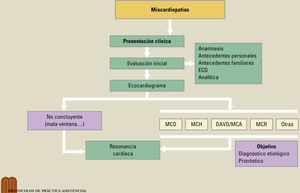
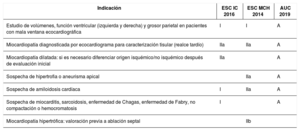
La resonancia cardíaca es una técnica fundamental en el estudio de las miocardiopatías. Su principal valor radica en la gran precisión y reproducibilidad de la medida de volúmenes ventriculares, fracción de eyección, grosor parietal y masa miocárdica, así como en su poder de caracterización tisular que permite afinar el diagnóstico etiológico. El grupo que más se beneficia de un estudio con resonancia cardíaca son los pacientes con sospecha de miocardiopatía, cuyo diagnóstico no se puede establecer con ecocardiograma por limitaciones técnicas (mala ventana). Esta técnica estaría indicada en el estudio etiológico de las miocardiopatías dilatadas y en los fenotipos hipertróficos. Otra de las fortalezas de la resonancia es el demostrado valor pronóstico de sus hallazgos en este grupo de pacientes.

Palabras clave
Resonancia cardíaca
Miocardiopatía
Indicación
Abstract

Cardiac magnetic resonance is a fundamental technique in the study of cardiomyopathies. Its main value lies in the great precision and reproducibility of ventricular volumes, ejection fraction, parietal thickness, and myocardial mass measurements as well as its ability to characterize tissue, which allows for refining the etiological diagnosis. The group that most benefits from a cardiac magnetic resonance study is patients suspected of having cardiomyopathy, whose diagnosis cannot be established via echocardiogram due to technique limitations (poor window). This technique would be indicated in the etiological study of dilated cardiomyopathies and in hypertrophic phenotypes. Another strength of cardiac magnetic resonance is the demonstrated prognostic value of its findings in this group of patients.

Keywords
Cardiac magnetic resonance
Cardiomyopathy
Indication

Identifíquese

¿Aún no es suscriptor de la revista?

Comprar el acceso al artículo

Comprando el artículo el pdf del mismo podrá ser descargado

Teléfono para incidencias

De lunes a viernes de 9h a 18h (GMT+1) excepto los meses de julio y agosto que será de 9 a 15h

Llamadas desde España 932 415 960
Llamadas desde fuera de España +34 932 415 960
Bibliografía
[1]
B.P. Halliday
202110140523136238
202110140523136239
, A. Gulati, A. Ali, K. Guha, S. Newsome, M. Arzanauskaite, et al.
Association between midwall late gadolinium enhancement and sudden cardiac death in patients with dilated cardiomyopathy and mild and moderate left ventricular systolic dysfunction.
Circulation., (2017), 135 pp. 2106-2115
[2]
A.R. Patel
2021101405231362310
2021101405231362311
, C.M. Kramer.
Role of cardiac magnetic resonance in the diagnosis and prognosis of nonischemic cardiomyopathy.
JACC Cardiovasc Imaging., (2017), 10 pp. 1180-1193
[3]
Cardiovascular magnetic resonance, 2ª ed, Elsevier,
[4]
Authors/Task Force members
2021101405231362313
, P.M. Elliott, A. Anastasakis, M.A. Borger, M. Borggrefe, F. Cecchi, P. Charron, et al.
2014 ESC Guidelines on diagnosis and management of hypertrophic cardiomyopathy: the Task Force for the Diagnosis and Management of Hypertrophic Cardiomyopathy of the European Society of Cardiology (ESC).
Eur Heart J., (2014), 35 pp. 2733-2779
[5]
P. Ponikowski
2021101405231362314
, A.A. Voors, S.D. Anker, H. Bueno, J.G.F. Cleland, A.J.S. Coats, et al.
2016 ESC Guidelines for the diagnosis and treatment of acute and chronic heart failure The Task Force for the diagnosis and treatment of acute and chronic heart failure of the European Society of Cardiology (ESC) Developed with the special contribution.
Eur Heart J., (2016), 37 pp. 2129-2200
[6]
E. Donal
2021101405231362315
2021101405231362316
, V. Delgado, C. Bucciarelli-Ducci, E. Galli, K.H. Haugaa, P. Charron, et al.
Multimodality imaging in the diagnosis, risk stratification, and management of patients with dilated cardiomyopathies: An expert consensus document from the European Association of Cardiovascular Imaging.
Eur Heart J Cardiovasc Imaging., (2019), 20 pp. 1075-1093
[7]
J.U. Doherty
2021101405231362317
, S. Kort, R. Mehran, S. Kort, R. Mehran, P. Schoenhagen, et al.
ACC/AATS/AHA/ASE/ASNC/HRS/SCAI/SCCT/SCMR/STS 2019 Appropriate use criteria for multimodality imaging in the assessment of cardiac structure and function in nonvalvular heart disease: A report of the American College of Cardiology appropriate use criteria.
J Am Soc Echocardiogr., (2019), 32 pp. 553-579
[8]
J.H. Indik
2021101405231362318
, J.R. Gimbel, H. Abe, R. Alkmim-Teixeira, U. Birgersdotter-Green, G.D. Clarke, et al.
2017 HRS expert consensus statement on magnetic resonance imaging and radiation exposure in patients with cardiovascular implantable electronic devices.
Hear Rhythm., (2017), 14 pp. e97-e153
[9]
N. Kawel-Boehm
2021101405231362319
, A. Maceira, E.R. Valsangiacomo-Buechel, et al.
Normal values for cardiovascular magnetic resonance in adults and children.
J Cardiovasc Magn Reson., (2015), 17 pp. 1-33
[10]
J.P.G. Van Der Ven
2021101405231362320
, Z. Sadighy, E.R. Valsangiacomo Buechel, S. Sarikouch, D. Robbers-Visser, C.J. Kellenberger, et al.
Multicentre reference values for cardiac magnetic resonance imaging derived ventricular size and function for children aged 0-18 years.
Eur Heart J Cardiovasc Imaging., (2020), 21 pp. 102-113
[11]
S.E. Petersen
2021101405231362321
, N. Aung, M.M. Sanghvi, F. Zemrak, K. Fung, J.M.F. Paiva, et al.
Reference ranges for cardiac structure and function using cardiovascular magnetic resonance (CMR) in Caucasians from the UK Biobank population cohort.
J Cardiovasc Magn Reson., (2017), 19 pp. 1-19
[12]
H. Mahrholdt
2021101405231362322
2021101405231362323
, A. Wagner, R.M. Judd, U. Sechtem, R.J. Kim.
Delayed enhancement cardiovascular magnetic resonance assessment of non-ischaemic cardiomyopathies.
Eur Heart J., (2005), 26 pp. 1461-1474