

Vol. 13. Núm. 49.
Páginas 2873-2882 (Febrero 2022)

Infecciones por estafilococos

Staphylococci infections

J. Calderón ParraabcA. Ramos MartínezabcS. de la Fuente-Moralabc
Doi : https://10.1016/j.med.2022.02.013
Opciones
Resumen

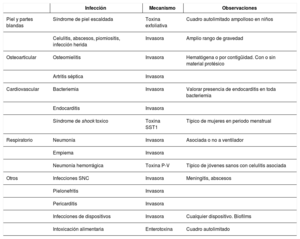
Los estafilococos comprenden multitud de especies con diferente capacidad patógena en el ser humano, destacando Staphylococcus aureus (SA) como la especie más virulenta. SA es capaz de producir multitud de síndromes clínicos, tanto mediados por toxina como por invasión y destrucción tisular, destacando por frecuencia y gravedad las infecciones de piel y partes blandas, osteoarticulares, bacteriemia, endocarditis, infecciones de dispositivos protésicos y neumonía (incluyendo neumonía hemorrágica en pacientes jóvenes). Puede poseer varios mecanismos de resistencia, destacando por su importancia terapéutica la resistencia a betalactámicos (SA resistente a meticilina —SARM—) mediada por la producción de PBP2a (gen mecA). El tratamiento del SA sensible a meticilina se basa en cloxacilina o cefazolina, mientras que entre las opciones terapéuticas para SARM encontramos vancomicina, daptomicina o linezolid. Los estafilococos coagulasa negativos presentan menor virulencia, aunque suelen ser resistentes a meticilina. Solo producen infecciones en pacientes con predisposición (inmunosuprimidos, material protésico, accesos venosos, etc.), con excepción de Staphylococcus lugdunensis que puede producir infecciones similares a SA y que suele ser, además, sensible a penicilina.

Palabras clave
Staphylococcus aureus
Estafilococos coagulasa-negativo
Estafilococo sensible a meticilina
Estafilococo resistente a meticilina
Abstract

Staphylococci encompass a multitude of species with different pathological capacities in human beings, with Staphylococcus aureus (SA) standing out as the most virulent species. SA is capable of producing a multitude of clinical syndromes, both mediated by the toxin and by tissue invasion and destruction. Of note for their frequency and severity are skin and soft tissue infections, bone and joint infections, bacteremia, endocarditis, prosthetic device infections, and pneumonia (including hemorrhagic pneumonia in young patients). It can have various mechanisms of resistance, of which resistance to beta-lactams (methicillin-resistant SA, MRSA) mediated by the production of PBP2a (mecA gene) is of note for its therapeutic importance. Treatment of methicillin-sensitive SA is based on cloxacillin or cefazolin whereas treatment options for MRSA are vancomycin, daptomycin, or linezolid. Coagulase-negative staphylococci are less virulent, although they tend to be resistant to methicillin. They only cause infections in patients with predisposing conditions (immunosuppressed, prosthetic material, venous access, etc.), with the exception of Staphylococcus lugdunensis, which can cause infections similar to SA and which also tend to be sensitive to penicillin.

Keywords
Staphylococcus aureus
Coagulase-negative staphylococci
Methicillin-sensitive staphylococcus
Methicillin-resistant staphylococcus

Identifíquese

¿Aún no es suscriptor de la revista?
Comprar el acceso al artículo

Comprando el artículo el pdf del mismo podrá ser descargado

Teléfono para incidencias

De lunes a viernes de 9h a 18h (GMT+1) excepto los meses de julio y agosto que será de 9 a 15h
Llamadas desde España 932 415 960
Llamadas desde fuera de España +34 932 415 960
Bibliografía
[1]
Mandell, Douglas, and Bennett's Principles and practices of infectious diseases, 8ª ed., Elsevier,
[2]
Mandell, Douglas, and Bennett's Principles and practices of infectious diseases, 8ª ed., Elsevier, pp. 2432-2443
[3]
S.Y.C.
202202220910474638
202202220910474639
Tong, J.S. Davis, E. Eichenberger, T.L. Holland, V.G. Fowler.
Staphylococcus aureus infections: epidemiology, pathophysiology, clinical manifestations, and management.
Clin Microbiol Rev., (2015), 28 pp. 603-661
[4]
F.D. Lowy.
Infecciones estafilocócicas.
Harrison. Principios de Medicina Interna, 20ª ed., McGraw-Hill,
[5]
J.
2022022209104746310
Kenner, T. O’Connor, N. Piantanida, J. Fishbain, B. Eberly, H. Viscount, et al.
Rates of carriage of methicillin-resistant and methicillin-susceptible Staphylococcus aureus in an outpatient population.
Infect Control Hosp Epidemiol., (2003), 24 pp. 439-444
[6]
J.M. Boyce, G. Potter-Bynoe, C. Chenevert, T. King.
Environmental contamination due to methicillin-resistant Staphylococcus aureus: possible infection control implications.
Infect Control Hosp Epidemiol., (1997), 18 pp. 622-627
[7]
2022022209104746311
EPINE. Prevalencia de infecciones (relacionadas con la asistencia sanitaria y comunitarias) y uso de antimicrobianos en hospitales de agudos [Internet]. 2019. Disponible en: https://epine., es/api/documento-publico/2019%20EPINE%20Informe%20Espa%C3%B1a%2027112019., pdf/reports-esp.
[8]
T.S. Naimi, K.H. LeDell, K. Como-Sabetti, S.M. Borchardt, D.J. Boxrud, J. Etienne, et al.
Comparison of community- and health care-associated methicillin-resistant Staphylococcus aureus infection.
JAMA., (2003), 290 pp. 2976-2984
[9]
Mandell, Douglas, and Bennett's Principles and practices of infectious diseases, 8ª ed., Elsevier, pp. 2393-2443
[10]
D.E.
2022022209104746312
Moormeier, K.W. Bayles.
Staphylococcus aureus biofilm: a complex developmental organism.
Mol Microbiol., (2017), 104 pp. 365-376
[11]
J.L. Lister, A.R. Horswill.
Staphylococcus aureus biofilms: recent developments in biofilm dispersal.
Front Cell Infect Microbiol., (2014), 4 pp. 178
[12]
J. Renneberg, V.T. Rosdahl.
Epidemiological studies of penicillin resistance in Danish Staphylococcus aureus strains in the period 1977-1990.
Scand J Infect Dis., (1992), 24 pp. 401-409
[13]
Y. Utsui, T. Yokota.
Role of an altered penicillin-binding protein in methicillin- and cephem-resistant Staphylococcus aureus.
Antimicrob Agents Chemother., (1985), 28 pp. 397-403
[14]
S.J.
2022022209104746313
2022022209104746314
Peacock, G.K. Paterson.
Mechanisms of methicillin resistance in Staphylococcus aureus.
Annu Rev Biochem., (2015), 84 pp. 577-601
[15]
L. García-Álvarez, M.T.G. Holden, H. Lindsay, C.R. Webb, D.F.J. Brown, M.D. Curran, et al.
Meticillin-resistant Staphylococcusaureus with a novel mecA homologue in human and bovine populations in the UK and Denmark: a descriptive study.
Lancet Infect Dis., (2011), 11 pp. 595-603
[16]
B.P. Howden, A.Y. Peleg, T.P. Stinear.
The evolution of vancomycin intermediate Staphylococcus aureus (VISA) and heterogenous-VISA.
Infect Genet Evol J Mol Epidemiol Evol Genet Infect Dis., (2014), 21 pp. 575-582
[17]
S.J.
2022022209104746315
van Hal, T.P. Lodise, D.L. Paterson.
The clinical significance of vancomycin minimum inhibitory concentration in Staphylococcus aureus infections: a systematic review and meta-analysis.
Clin Infect Dis Off Publ Infect Dis Soc Am., (2012), 54 pp. 755-771
[18]
W.A.
2022022209104746316
2022022209104746317
McGuinness, N. Malachowa, F.R. DeLeo.
Vancomycin resistance in Staphylococcus aureus.
Yale J Biol Med., (2017), 90 pp. 269-281
[19]
N. Gómez Casanova, M. Siller Ruiz, J.L. Muñoz Bellido.
Mechanisms of resistance to daptomycin in Staphylococcus aureus.
Rev Espanola Quimioter Publicacion Of Soc Espanola Quimioter., (2017), 30 pp. 391-396
[20]
S. Ghosh, M. Banerjee.
Methicillin resistance & inducible clindamycin resistance in Staphylococcus aureus.
Indian J Med Res., (2016), 143 pp. 362-364
[21]
A. Henderson, P. Harris, G. Hartel, D. Paterson, J. Turnidge, J.S. Davis, et al.
Benzylpenicillin versus flucloxacillin for penicillin-susceptible Staphylococcus aureus bloodstream infections from a large retrospective cohort study.
Int J Antimicrob Agents., (2019), 54 pp. 491-495
[22]
S.Y.C.
2022022209104746318
2022022209104746319
Tong, D.C. Lye, D. Yahav, A. Sud, J.O. Robinson, J. Nelson, et al.
Effect of vancomycin or daptomycin with vs without an antistaphylococcal β-lactam on mortality, bacteremia, relapse, or treatment failure in patients with MRSA bacteremia: A randomized clinical trial.
JAMA., (2020), 323 pp. 527-537
[23]
E.H. Nauta, H. Mattie.
Dicloxacillin and cloxacillin: pharmacokinetics in healthy and hemodialysis subjects.
Clin Pharmacol Ther., (1976), 20 pp. 98-108
[24]
S.
2022022209104746320
Weis, M. Kesselmeier, J.S. Davis, A.M. Morris, S. Lee, A. Scherag, et al.
Cefazolin versus anti-staphylococcal penicillins for the treatment of patients with Staphylococcus aureus bacteraemia.
Clin Microbiol Infect Off Publ Eur Soc Clin Microbiol Infect Dis., (2019), 25 pp. 818-827
[25]
R.E. Buck, K.E. Price.
Cefadroxil, a new broad-spectrum cephalosporin.
Antimicrob Agents Chemother., (1977), 11 pp. 324-330
[26]
W.R.
2022022209104746321
Miller, C. Seas, L.P. Carvajal, L. Díaz, A.M. Echeverri, C. Ferro, et al.
The cefazolin inoculum effect is associated with increased mortality in methicillin-susceptible Staphylococcus aureus bacteremia.
Open Forum Infect Dis., (2018), 5 pp. 123
[27]
2022022209104746322
Brown NM, Goodman AL, Horner C, Jenkins A, Brown EM. Treatment of methicillin-resistant Staphylococcus aureus (MRSA): updated guidelines from the UK. JAC-Antimicrob Resist [Internet]. [citado 27 de julio de 2021];3(1):dlaa114. Disponible en: https://academic.oup.com/jacamr/article/doi/10.1093/jacamr/dlaa114/6127118.
[28]
M.J.
2022022209104746323
Rybak, J. Le, T.P. Lodise, D.P. Levine, J.S. Bradley, C. Liu, et al.
Therapeutic monitoring of vancomycin for serious methicillin-resistant Staphylococcus aureus infections: A revised consensus guideline and review by the American Society of Health-System Pharmacists, the Infectious Diseases Society of America, the Pediatric Infectious Diseases Society, and the Society of Infectious Diseases Pharmacists.
Am J Health Syst Pharm., (2020), 77 pp. 835-864
[29]
R.L. Crass, K.L. Powell, A.M. Huang.
Daptomycin for the treatment of Staphylococcus aureus infections complicated by septic pulmonary emboli.
Diagn Microbiol Infect Dis., (2019), 93 pp. 131-135
[30]
P. Uppal, K.L. LaPlante, M.M. Gaitanis, M.D. Jankowich, K.E. Ward.
Daptomycin-induced eosinophilic pneumonia - a systematic review.
Antimicrob Resist Infect Control., (2016), 5 pp. 55
[31]
J.
2022022209104746324
Li, Q.-H. Zhao, K.-C. Huang, Z.-Q. Li, L.-Y. Zhang, D.-Y. Qin, et al.
Linezolid vs. vancomycin in treatment of methicillin-resistant staphylococcus aureus infections: a meta-analysis.
Eur Rev Med Pharmacol Sci., (2017), 21 pp. 3974-3979
[32]
W. Zimmerli, P. Sendi.
Role of rifampin against staphylococcal biofilm infections in vitro, in animal models, and in orthopedic-device-related infections.
Antimicrob Agents Chemother., (2019), 63 pp. e01746-e1818
[33]
P.
2022022209104746325
Sendi, W. Zimmerli.
The use of rifampin in staphylococcal orthopaedic-device-related infections.
Clin Microbiol Infect., (2017), 23 pp. 349-350
[34]
A.S. Michalopoulos, I.G. Livaditis, V. Gougoutas.
The revival of fosfomycin.
Int J Infect Dis IJID Off Publ Int Soc Infect Dis., (2011), 15 pp. e732-e739
[35]
A.
2022022209104746326
Ramos-Martínez, A. Muñoz Serrano, A. de Alarcón González, P. Muñoz, A. Fernández-Cruz, M. Valerio, et al.
Gentamicin may have no effect on mortality of staphylococcal prosthetic valve endocarditis.
J Infect Chemother Off J Jpn Soc Chemother., (2018), 24 pp. 555-562
[36]
M.
2022022209104746327
2022022209104746328
Holubar, L. Meng, W. Alegria, S. Deresinski.
Bacteremia due to methicillin-resistant Staphylococcus aureus: An update on new therapeutic approaches.
Infect Dis Clin North Am., (2020), 34 pp. 849-861
[37]
F.
2022022209104746329
2022022209104746330
Gudiol, J.M. Aguado, B. Almirante, E. Bouza, E. Cercenado, Domínguez MÁ, et al.
Diagnosis and treatment of bacteremia and endocarditis due to Staphylococcus aureus. A clinical guideline from the Spanish Society of Clinical Microbiology and Infectious Diseases (SEIMC).
Enferm Infecc Microbiol Clin., (2015), 33
[38]
T.L.
2022022209104746331
Holland, I. Raad, H.W. Boucher, D.J. Anderson, S.E. Cosgrove, P.S. Aycock, et al.
Effect of algorithm-based therapy vs usual care on clinical success and serious adverse events in patients with staphylococcal bacteremia: A randomized clinical trial.
JAMA., (2018), 320 pp. 1249-1258
[39]
Ehlers S, Merrill SA. Staphylococcus Saprophyticus. En: StatPearls [Internet]. Treasure Island (FL): StatPearls Publishing; 2021 [citado 27 de julio de 2021]. Disponible en: http://www.ncbi.nlm.nih.gov/books/NBK482367/.
[40]
S. Heilbronner, T.J. Foster.
Staphylococcus lugdunensis: a skin commensal with invasive pathogenic potential.
Clin Microbiol Rev., (2021), 34 pp. e00205-e220