

Vol. 14. Núm. 58.
Páginas 13559-13570 (Junio 2026)

Actualización
Infecciones víricas emergentes: Virus zoonóticos humanos, virus de la viruela del mono, gripe aviar, hantavirus y ébola

Emerging viral infections: human zoonotic viruses, monkeypox virus, avian influenza, hantavirus, and Ebola

I.M. Corral-BuenoJ. Balsa VázquezL.M. Gete GarcíaL. López Requejo y G. Rojo Marcos
Doi : https://10.1016/j.med.2026.06.021
Opciones
Resumen

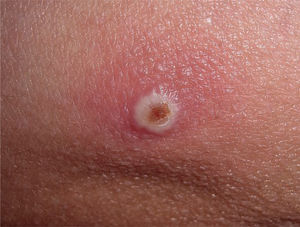
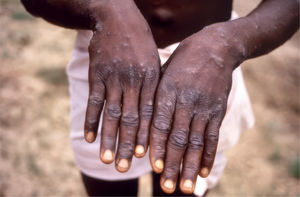
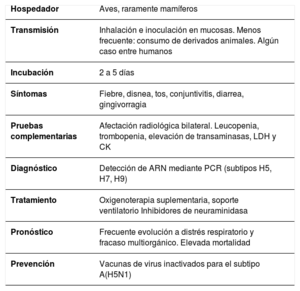
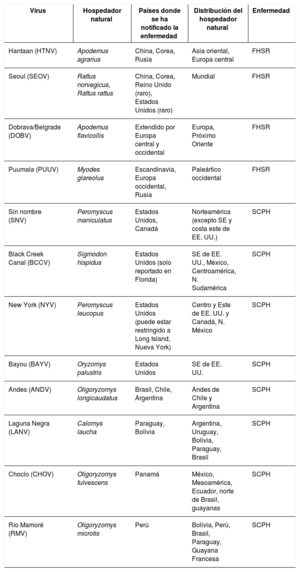
Las infecciones emergentes son un problema de salud global en constante progresión, debido a la adquisición de nuevas vías de transmisión entre especies y, por ende, para contagiar a los seres humanos. Esta actualización se centrará en los aspectos clínicos y epidemiológicos más relevantes de algunos de los virus zoonóticos de mayor interés para la práctica clínica. Por un lado, infecciones que han cobrado una mayor relevancia en los últimos años por epidemias recientes son el virus de la viruela del mono (mpox), con su afectación fundamentalmente cutánea, o el virus del Ébola, con una alta mortalidad. Por otro lado, revisaremos otros virus zoonóticos más estrechamente relacionados con la actividad avícola o ganadera y que cursan con brotes periódicos, como son el hantavirus y la gripe aviar.

Palabras clave
Mpox
Ébola
Hantavirus
Gripe aviar
Abstract

Emerging infections are a global health problem that is constantly evolving due to the emergence of new transmission routes between species and, consequently, the spread of infection to humans. This update will focus on the most relevant clinical and epidemiological aspects of some of the zoonotic viruses of greatest interest to clinical practice. On the one hand, infections that have gained greater relevance in recent years due to recent epidemics include monkeypox virus (mpox), which primarily affects the skin, and Ebola virus, which has a high mortality rate. On the other hand, other zoonotic viruses more closely related to poultry or livestock farming and which cause periodic outbreaks, such as hantavirus and avian influenza, will be reviewed.

Keywords
Mpox
Ebola
Hantavirus
Avian influenza

Identifíquese

¿Aún no es suscriptor de la revista?

Comprar el acceso al artículo

Comprando el artículo el pdf del mismo podrá ser descargado

Teléfono para incidencias

De lunes a viernes de 9h a 18h (GMT+1) excepto los meses de julio y agosto que será de 9 a 15h

Llamadas desde España 932 415 960
Llamadas desde fuera de España +34 932 415 960
Bibliografía
[1]
K.E. Jones, N.G. Patel, M.A. Levy, A. Storeygard, D. Balk, J.L. Gittleman, et al.
Global trends in emerging infectious diseases.
Nature., (2008), 451 pp. 990-993
[2]
H. Harapan
202607020418290428
202607020418290429
, Y. Ophinni, D. Megawati, A. Frediansyah, S.S. Mamada, M. Salampe, et al.
Monkeypox: A comprehensive review.
Viruses., (2022), 14 pp. 2155
[3]
A.M. McCollum
2026070204182904210
, I.K. Damon.
Human monkeypox.
Clin Infect Dis., (2014), 58 pp. 260-267
[4]
D. Cuetos-Suárez
2026070204182904211
, R.K. Gan, D. Cuetos-Suárez, P. Arcos González, R. Castro-Delgado.
A review of Mpox outbreak and public health response in Spain.
Risk Manag Health Policy., (2024), 17 pp. 297-310
[5]
J. Lu
2026070204182904212
, H. Xing, C. Wang, M. Tang, C. Wu, F. Ye, et al.
Mpox (formerly monkeypox): pathogenesis, prevention, and treatment.
Signal Transduct Target Ther., (2023), 8 pp. 458
[6]
O. Mitjà
2026070204182904213
2026070204182904214
, D. Ogoina, B.K. Titanji, C. Galvan, J.J. Muyembe, M. Marks, et al.
Monkeypox. Lancet, (2023), 401 pp. 60-74
[7]
A. Català, P. Clavo-Escribano, J. Riera-Monroig, G. Martín-Ezquerra, P. Fernandez-Gonzalez, L. Revelles-Peñas, et al.
Monkeypox outbreak in Spain: clinical and epidemiological findings in a prospective cross-sectional study of 185 cases.
Br J Dermatol., (2022), 187 pp. 765-772
[8]
M. Puccioni-Sohler, C.M. de Oliveira, M. Namen, C.R. Damaso.
Emerging Monkeypox virus and neuroinflammatory disorders.
[9]
World Health Organization. 2022-25 Mpox Outbreak: Global Trends. [Internet] Geneva: WHO. [Publicado 2025] [Consultado octubre 2025]. https://worldhealthorg.shinyapps.io/mpx_global/.
[10]
Y. Sun
2026070204182904215
, W. Nie, D. Tian, Q. Ye.
Human monkeypox virus: Epidemiologic review and research progress in diagnosis and treatment.
J Clin Virol., (2024), 171 pp. 105662
[11]
M. Kang
2026070204182904216
, L.F. Wang, B.W. Sun, W.B. Wan, X. Ji, G. Baele, et al.
Zoonotic infections by avian influenza virus: changing global epidemiology, investigation, and control.
Lancet Infect Dis., (2024), 24 pp. e522-e531
[12]
J.S. Peiris
2026070204182904217
2026070204182904218
, M.D. de Jong, Y. Guan.
Avian influenza virus (H5N1): a threat to human health.
Clin Microbiol Rev., (2007), 20 pp. 243-267
[13]
J. Shi
2026070204182904219
, X. Zeng, P. Cui, C. Yan, H. Chen.
Alarming situation of emerging H5 and H7 avian influenza and effective control strategies.
Emerg Microbes Infect., (2023), 12 pp. 2155072
[14]
La gripe
2026070204182904220
aviar y su prevención mediante la vacunación. Madrid: Sociedad Española de Epidemiología. 2025. [Publicado 2025] [Consultado 2025] Disponible en: https://seepidemiologia.es/wp-content/uploads/2025/02/Gui%CC%81a-Gripe-Aviar-SEE-1.pdf.
[15]
S. Garg, K. Reinhart, A. Couture, K. Kniss, C.T. Davis, M.K. Kirby, et al.
Highly pathogenic avian influenza A(H5N1) Virus Infections in Humans.
N Engl J Med., (2025), 392 pp. 843-854
[16]
M.J. Loeffelholz
2026070204182904221
.
Avian influenza A H5N1 virus.
Clin Lab Med., (2010), 30 pp. 1-20
[17]
D.S. Hui.
Review of clinical symptoms and spectrum in humans with influenza A/H5N1 infection.
Respirology., (2008), 13 pp. S10-S13
[18]
P.A. Vial
2026070204182904222
2026070204182904223
, M. Ferrés, C. Vial, J. Klingström, C. Ahlm, R. López, N. Le Corre, G.J. Mertz.
Hantavirus in humans: a review of clinical aspects and management.
Lancet Infect Dis., (2023), 23 pp. e371-e382
[19]
A. Tscherne
2026070204182904224
2026070204182904225
, P. Guardado-Calvo, J.J. Clark, R. Krause, F. Krammer.
Puumala Orthohantavirus: prevalence, biology, disease, animal models and recent advances in therapeutics development and structural biology.
Front Immunol., (2025), 16 pp. 1575112
[20]
A. Sehgal
2026070204182904226
2026070204182904227
, S. Mehta, K. Sahay, E. Martynova, A. Rizvanov, M. Baranwal, et al.
Hemorrhagic fever with renal syndrome in Asia: History, pathogenesis, diagnosis, treatment, and prevention.
Viruses., (2023), 15 pp. 561
[21]
C. Firth
2026070204182904228
, R. Tokarz, D.B. Simith, M.R. Nunes, M. Bhat, E.S. Rosa, et al.
Diversity and distribution of hantaviruses in South America.
J Virol, (2012), 86 pp. 13756-13766
[22]
D.C. Watson
2026070204182904229
2026070204182904230
, M. Sargianou, A. Papa, P. Chra, I. Starakis, G. Panos.
Epidemiology of Hantavirus infections in humans: a comprehensive, global overview.
Crit Rev Microbiol., (2014), 40 pp. 261-272
[23]
Y. Wang
2026070204182904231
, C. Zhang, J. Gao, Z. Chen, Z. Liu, J. Huang, et al.
Spatiotemporal trends of hemorrhagic fever with renal syndrome (HFRS) in China under climate variation.
Proc Natl Acad Sci U S A., (2024), 121
[24]
S.C.S. Oloris
2026070204182904232
, V.F. Neves, F.C.M. Iani, C.F. de Oliveira Scarponi.
Orthohantavirus infections in South America: a systematic review and meta-analysis.
Arch Virol., (2024), 169 pp. 187
[25]
D. Noack
2026070204182904233
2026070204182904234
, M. Goeijenbier, C.B.E.M. Reusken, M.P.G. Koopmans, B.H.G. Rockx.
Orthohantavirus pathogenesis and cell tropism.
Front Cell Infect Microbiol., (2020), 10 pp. 399
[26]
N. Charbonnel
2026070204182904235
, M. Pagès, T. Sironen, H. Henttonen, O. Vapalahti, J. Mustonen, et al.
Immunogenetic factors affecting susceptibility of humans and rodents to hantaviruses and the clinical course of hantaviral disease in humans.
Viruses., (2014), 6 pp. 2214-2241
[27]
N. Munir
2026070204182904236
2026070204182904237
, M. Jahangeer, S. Hussain, Z. Mahmood, M. Ashiq, F. Ehsan, et al.
Hantavirus diseases pathophysiology, their diagnostic strategies and therapeutic approaches: A review.
Clin Exp Pharmacol Physiol., (2021), 48 pp. 20-34
[28]
J.M. Rusnak
2026070204182904238
2026070204182904239
, W.R. Byrne, K.N. Chung, P.H. Gibbs, T.T. Kim, E.F. Boudreau, et al.
Experience with intravenous ribavirin in the treatment of hemorrhagic fever with renal syndrome in Korea.
Antiviral Res., (2009), 81 pp. 68-76
[29]
H. Feldmann
2026070204182904240
2026070204182904241
, A. Sprecher, T.W. Geisbert.
Ebola.
N Engl J Med, (2020), 382 pp. 1832-1842
[30]
D. Malvy
2026070204182904242
, A.K. McElroy, H. de Clerck, S. Günther, J. van Griensven.
Ebola virus disease.
Lancet., (2019), 393 pp. 936-948
[31]
Centers
2026070204182904243
for Disease Control and Prevention. Ebola virus disease distribution map: cases of Ebola virus disease in Africa since 1976. Date accessed: January 27, 2019. https://www.cdc.gov/vhf/ebola/history/distribution-map.html.
[32]
A.A. Bukreyev
2026070204182904244
, K. Chandran, O. Dolnik, J.M. Dye, H. Ebihara, E.M. Leroy, et al.
Discussions and decisions of the 2012-2014 International Committee on Taxonomy of Viruses (ICTV) Filoviridae Study Group, January 2012–June 2013.
Arch Virol., (2014), 159 pp. 821-830
[33]
J. Emanuel
2026070204182904245
2026070204182904246
, A. Marzi, H. Feldmann.
Filoviruses: Ecology, molecular biology, and evolution.
Adv Virus Res., (2018), 100 pp. 189-221
[34]
C.F. Houlihan
2026070204182904247
, C.R. McGowan, S. Dicks, M. Baguelin, D.A.J. Moore, D. Mabey, et al.
Ebola exposure, illness experience, and Ebola antibody prevalence in international responders to the West African Ebola epidemic 2014-2016: A cross-sectional study.
PLoS Med., (2017), 14 pp. e1002300
[35]
L. Baseler
2026070204182904248
2026070204182904249
, D.S. Chertow, K.M. Johnson, H. Feldmann, D.M. Morens.
The pathogenesis of Ebola virus disease.
Annu Rev Pathol., (2017), 12 pp. 387-418
[36]
M.J. Choi
2026070204182904250
2026070204182904251
, C.M. Cossaboom, A.N. Whitesell, J.W. Dyal, A. Joyce, R.L. Morgan, et al.
Use of ebola vaccine: Recommendations of the advisory committee on immunization practices, United States, 2020.
MMWR Recomm Rep., (2021), 70 pp. 1-12
[37]
O. Faye
2026070204182904252
, A. Andronico, O. Faye, H. Salje, P.Y. Boëlle, N. Magassouba, et al.
Use of viremia to evaluate the baseline case fatality ratio of Ebola virus disease and inform treatment studies: a retrospective cohort study.
PLoS Med., (2015), 12 pp. e1001908
[38]
National Center
2026070204182904253
for Emerging and Zoonotic Infectious Diseases (U.S.). Division of High-Consequence Pathogens and Pathology. Viral Special Pathogens Branch. Ebola Virus Ecology and Transmission. Disponible en: https://stacks.cdc.gov/view/cdc/38795.