


Vol. 13. Núm. 87.
Páginas 5115-5124 (Octubre 2023)

Actualización
Insuficiencia cardíaca aguda y edema agudo de pulmón. Manejo diagnóstico y terapéutico en urgencias

Acute heart failure. Acute pulmonary edema. Diagnostic and therapeutic management in the emergency department

M. Fernández CardonaaM.D. PulferaM. Martínez-SellesbcdJ.A. Andueza Lilload
Doi : https://10.1016/j.med.2023.09.001
Opciones
Resumen

La insuficiencia cardíaca aguda es un síndrome clínico complejo que engloba diferentes entidades con diversos mecanismos fisiopatológicos y presentaciones clínicas que precisan distintas estrategias terapéuticas. Todas comparten un fallo de la función de bomba cardíaca que deriva en la aparición de síntomas y signos de congestión pulmonar y sistémica, junto con hipoperfusión periférica. Es una entidad con una incidencia creciente asociada a una alta morbimortalidad y un elevado coste sociosanitario.

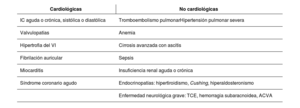
Existen cuatro presentaciones clínicas fundamentales: descompensación aguda de insuficiencia cardíaca crónica (la más frecuente), edema agudo de pulmón, insuficiencia de ventrículo derecho aislada y shock cardiogénico. Es importante identificar el factor desencadenante, requiriendo un manejo específico y urgente los siguientes: el síndrome coronario agudo, la emergencia hipertensiva, las arritmias con respuesta ventricular rápida o bradicardias/alteraciones graves de la conducción, el tromboembolismo pulmonar y las causas mecánicas agudas. El diagnóstico de sospecha es clínico, confirmándose con diversas pruebas complementarias como electrocardiograma, radiografía de tórax, analítica sanguínea completa con péptidos natriuréticos y ecocardiograma.

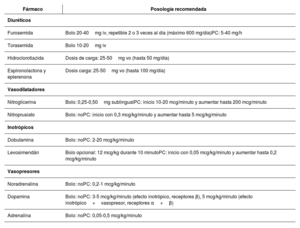
El inicio del tratamiento debe ser inmediato ante la sospecha clínica y, según el cuadro de presentación, incluirá: oxigenoterapia, diuréticos, vasodilatadores, inotrópicos, vasopresores o incluso soporte ventilatorio o circulatorio.

Palabras clave
Insuficiencia cardíaca aguda
Edema agudo de pulmón
Péptidos natriuréticos
Diuréticos
Vasodilatadores
Abstract

Acute heart failure is a complex clinical syndrome. It encompasses different diseases with diverse pathophysiologic mechanisms and clinical presentations that require different therapeutic strategies. What they all have in common is failure in heart pump function that leads to the onset of signs and systems of pulmonary and systemic congestion along with peripheral hypoperfusion. It is a disease with a growing incidence associated with high morbidity and mortality and an elevated social and healthcare cost.

There are four fundamental clinical presentations: acute decompensation of chronic heart failure (the most common), acute pulmonary edema, isolated right ventricular failure, and cardiogenic shock. It is important to identify the triggering factor; the following require specific emergency management: acute coronary syndrome, hypertensive emergency, arrhythmias with rapid ventricular response or bradycardias/severe conduction disorders, pulmonary embolism, and acute mechanical causes. The suspected diagnosis is clinical and confirmed through various additional tests such as an electrocardiogram, chest x-ray, complete blood count with natriuretic peptides, and an echocardiogram.

Treatment must be started immediately if there is clinical suspicion. According to the presenting symptoms, it will include oxygen therapy, diuretics, vasodilators, inotropics, vasopressors, or even ventilatory or circulatory support.

Keywords
Acute heart failure
Acute pulmonary edema
Natriuretic peptides
Diuretics
Vasodilators

Identifíquese

¿Aún no es suscriptor de la revista?

Comprar el acceso al artículo

Comprando el artículo el pdf del mismo podrá ser descargado

Teléfono para incidencias

De lunes a viernes de 9h a 18h (GMT+1) excepto los meses de julio y agosto que será de 9 a 15h

Llamadas desde España 932 415 960
Llamadas desde fuera de España +34 932 415 960
Bibliografía
[1]
T.A. McDonagh
202310091551571708
202310091551571709
, M. Metra, M. Adamo, R.S. Gardner, A. Baumbach, M. Bohm, et al.
Guía ESC 2021 sobre el diagnóstico y tratamiento de la insuficiencia cardiaca aguda y crónica.
Rev Esp Cardiol., (2022), 75 pp. 523
[2]
P. Ponikowski
2023100915515717010
2023100915515717011
, A.A. Voors, S.D. Anker, H. Bueno, J.G. Cleland, A.J. Coats, et al.
2016 ESC guidelines for the diagnosis and treatment of acute and chronic heart failure: The Task Force for the diagnosis and treatment of acute and chronic heart failure of the European Society of Cardiology (ESC). Developed with the special contribution of the Heart Failure Association (HFA) of the ESC.
Eur Heart J., (2016), 37 pp. 2129-2200
[3]
M. Anguita Sánchez
2023100915515717012
, M.G. Crespo Leiro, E. de Teresa Galván, M. Jiménez Navarro, L. Alonso-Pulpon, J. Muniz Garcia, et al.
Prevalence of heart failure in the Spanish general population aged over 45 years. The PRICE Study.
Rev Esp Cardiol., (2008), 61 pp. 1041-1049
[4]
O. Chioncel
2023100915515717013
2023100915515717014
, A. Mebazaa, V.-P. Harjola, A.J. Coats, M.F. Piepoli, M.G. Crespo-Leiro, et al.
Clinical phenotypes and outcome of patients hospitalized for acute heart failure: the ESC Heart Failure Long-Term Registry.
Eur J Heart Fail., (2017), 19 pp. 1242-1254
[5]
P. Llorens
2023100915515717015
2023100915515717016
, N. Manito Lorite, L. Manzano Espinosa, F.J. Martín Sánchez, J. Camín Colet, F. Formiga, et al.
Consejo para la mejora de la atención integral de los pacientes con insuficiencia cardiaca aguda.
Emergencias., (2015), 27 pp. 245-266
[6]
V. Fuster.
Hurst's the heart.
13ª ed, McGraw Hill, (2011),
[7]
M. Mysliwiec
2023100915515717017
2023100915515717018
, R.E. Bonita.
Outpatient emergencies: Acute heart failure.
Med Clin North Am., (2017), 101 pp. 507-519
[8]
B.R. Hunter
2023100915515717019
, J. Martindale, O. Abdel-Hafez, P.S. Pang.
Approach to acute hheart failure in the emergency department.
Prog Cardiovasc Dis., (2017), 60 pp. 178-186
[9]
J.J. McMurray
2023100915515717020
, S. Adamopopulus, S.D. Anker, A. Auricchio, M. Bohm, K. Dickstein, et al.
ESC guidelines for the diagnosis and treatment of acute and chronic heart failure 2012: The Task Force for the diagnosis and treatment of acute and chronic heart failure 2012 of the European Society of Cardiology (ESC). Developed in collaboration with the Heart Failure Association (HFA) of the ESC.
Eur Heart J., (2012), 14 pp. 803-869
[10]
J.L. Januzzi, R. van Kimmenade, J. Lainchbury, A. Bayes-Genis, J. Ordonez-Llanos, M. Santalo-Bel, et al.
NT-proBNP testing for diagnosis and short-term prognosis in acute destabilized heart failure: an international pooled analysis of 1256 patients. The International Collaborative of NT-proBNP Study.
Eur Heart J., (2006), 27 pp. 330-337
[11]
M. Pfisterer
2023100915515717021
, P. Buser, H. Rickli, M. Gutmann, P. Erne, P. Rickenbacher, et al.
for the TIME-CHF Investigators. BNP-guided vs symptom-guided heart failure therapy: The trial of intensified vs satandard medical therapy in elderly patients with congestive heart failure (TIME-CHF) randomized trial.
JAMA., (2009), 301 pp. 383-392
[12]
E. Platz
2023100915515717022
2023100915515717023
, A.A. Merz, P.S. Jhund, A. Vazir, R. Campbell, J.J. McMurray.
Dynamic changes and prgnostic value of pulmonary ultrasound in acute and chronic heart failure: a systematic review.
Eur J Heart Fail., (2017), 19 pp. 1154-1163
[13]
A. Mebazaa
2023100915515717024
2023100915515717025
, M.B. Yilmaz, P. Levy, P. Ponikowski, W.F. Peacock, S. Laribi, et al.
Recommendations on pre-hospital and early hospital management of acute heart failure: a consensus paper from the HFA of the ESC, the European Society of Emergency Medicine and the Society of Academic Emergency Medicine.
Eur J Heart Fail., (2015), 17 pp. 544-558
[14]
G.M. Felker
2023100915515717026
2023100915515717027
, J.R. Teerlink.
Diagnóstico y tratamiento de la insuficiencia cardiaca aguda. Tratado de cardiología. Texto de medicina cardiovascular.
10ª ed, Elsevier, (2016), pp. 484-507
[15]
J.H. Park, S. Balmain, C. Berry, J.J. Morton, J.J. McMurray.
Potentially detrimental cardiovascular effects of oxygen in patients with chronic left ventricular systolic dysfunction.
Heart., (2010), 96 pp. 533-538
[16]
C.L. Weng
2023100915515717028
2023100915515717029
, Y.T. Zhao, Q.H. Liu, C.J. Fu, F. Sun, Y.L. Ma, et al.
Metaanalysis: noninvasive vemtilation in acute cardiogenic pulmonary edema.
Ann Intern Med., (2010), 152 pp. 590-600
[17]
W. Mullens
2023100915515717030
2023100915515717031
, K. Damman, V.P. Harjola, A. Mebazaa, H.P. Brunner-La Rocca, P. Martens, et al.
The use of diurestics in heart failure with congestiona position statement from the Heart Failure Association of the European Society of Cardiology.
EUr J Heart Fail., (2019), 21 pp. 137-155
[18]
G.M. Felker
2023100915515717032
, D.H. Ellison, W. Mullens, Z.L. Cox, J.M. Testani.
Diuretic therapy for patients with heart failure: JACC state-of-the –art review.
J Am Coll Cardiol., (2020), 75 pp. 1178-1195
[19]
DammanK, J.M. Ter Maaten, J.E. Coster, J.A. Krikken, V.M. van Deursen, H.K. Krijnen, et al.
Clinical importance of urinay sodium excretion in acute heart failure.
Eur J Heart Fail., (2020), 22 pp. 1438-1447
[20]
A. Wakai
2023100915515717033
, A. McCabe, R. Kidney, S.C. Brooks, R.A. Seupaul, D.B. Diercks, et al.
Nitrates for acute heart failure síndromes.
Cochrane Database Syst Rev., (2013), pp. DC005151
[21]
A. Mebazaa
2023100915515717034
, M.S. Nieminen, G.S. Filippatos, J.G. Cleland, J.E. Salon, R. Thakkar, et al.
Levosimendan vs dobutamine: outcomes for acute heart failure patientes on b-bloquers in SURVIVE.
Eur J Heart Fail., (2009), 11 pp. 304-311
[22]
B. Levy
2023100915515717035
, R. Clere-Jehl, A. Legras, T. Morichau-Beauchant, M. Leone, G. Frederique, et al.
Epinephrine versus norepinephrine for cardiogenic shock after acute myocardial infarction.
J Am Coll Cardiol., (2018), 72 pp. 173-182
[23]
V. Leopold
2023100915515717036
, E. Gayat, R. Pirracchio, J. Spinar, J. Parenica, T. Tarvasmaki, et al.
Epinephrine and short-term survival in cardiogenic shock: an individual data meta-analysis.
Emerg Med J., (2008), 25 pp. 205-209
[24]
Miro O, Gil V, Martín-Sánchez FJ, Herreo-Puente P, Jacob J, Mebazaa A, et al. ICA-SEMES Research Group. Morphine use in the ED and outcomes of patients with acute heart failure: a propensity score-matching analysis base don the EAHFE registry. Chest. 017;152:821-32.
[25]
B.N. Therany
2023100915515717037
2023100915515717038
, A.G. Truesdell, M.A. Psotka, C. Rosner, R. Singh, S.S. Sinha, et al.
A standardized and comprehensive approach to the management of cardiogenic shock.
JACC Heart Fail., (2020), 8 pp. 879-891
[26]
P. Ponikowski
2023100915515717039
, B.A. Kirwan, S.D. Anker, T. McDonagh, M. DOrobantu, J. Drozdz, et al.
AFFIRMAHF investigators. Ferric carboxymaltose for iron deficency at discharge after acute heart failure: a multicentre, double-blind, randomised, controlled trial.
Lancet., (2020), 396 pp. 1895-1904
[27]
D.L. Bhatt
2023100915515717040
, SzarekM, P.G. Steg, C.P. Cannon, L.A. Leiter, D.K. McGuire, et al.
SOLOIST-WHF Trial Investigators. Sotaglifozine in patients with diabetes and recent worsening heart failure.
N Engl J Med., (2021), 381 pp. 117-128
[28]
J.T. Fuhrmann
2023100915515717041
, A. Schmeisser, M.R. Schulze, C. Wunderlich, S.P. Schoen, T. Rauwolf, et al.
Levosimendan is superior to enoximone in refractory cardiogenic shock complicating acute myocardial infarction.
Crit Care Med., (2008), 36 pp. 2257-2266
[29]
A.P. Ambrosy, P.S. Pang, S. Khan, M.A. Konstam, G.C. Fonarow, B. Traver, et al.
EVEREST Trail Investigators. Clinical coirse and predictive value of congestion during hospitalization in patients admitted for worsening sings and symptoms of heart failure with reduced ejection fraction: findings from the EVEREST trial.
Eur Heart J., (2013), 34 pp. 835-843