

Vol. 14. Núm. 35.
Páginas 2114-2125 (Junio 2025)

Actualización
Insuficiencia cardíaca crónica con fracción de eyección ventricular izquierda reducida y ligeramente reducida

Chronic heart failure with reduced and mildly reduced left ventricular ejection fraction

J. Serpa MoránaJ. Gómez DelgadoaA. Leandro BarrosaA. Ruiz-SaavedraaC. Tejada GonzálezaA. García Lledóab
Doi : https://10.1016/j.med.2025.06.011
Opciones
Resumen

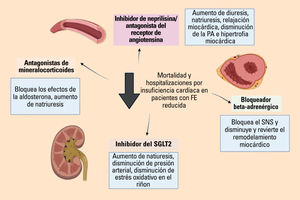
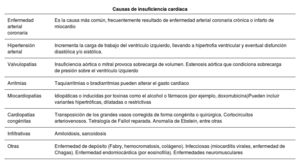
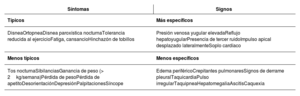
La insuficiencia cardíaca con fracción de eyección reducida o ligeramente reducida se define como un síndrome clínico que se caracteriza por la presencia de síntomas y/o signos derivados de una anormalidad estructural y/o funcional del corazón, que se confirma mediante niveles elevados de péptidos natriuréticos o evidencia objetiva de congestión pulmonar o sistémica, además de una fracción de eyección del ventrículo izquierdo disminuida, igual o menor del 40% o entre el 41%-49%, respectivamente. Su etiología más frecuente es la enfermedad de arterias coronarias, seguida de hipertensión arterial, valvulopatías y miocardiopatías, entre otras. El diagnóstico se centra en un interrogatorio con sintomatología sugestiva y signos clínicos típicos de insuficiencia cardíaca, y resulta imprescindible la realización de electrocardiograma, medición de NT-proBNP y ecocardiograma, además de pruebas complementarias según el contexto clínico del paciente. El tratamiento comprende cambios en el estilo de vida, diuréticos para control de la sobrecarga hídrica y síntomas congestivos y medicamentos de implicación pronóstica, con 4 grupos principales: bloqueadores betaadrenérgicos, inhibidor de la neprilisina/antagonista del receptor de angiotensina, antagonista de mineralocorticoides e inhibidor del SGLT2.

Palabras clave
Fracción de eyección reducida
Fracción de eyección ligeramente reducida
Medicación con implicación pronóstica
Abstract

Heart failure with reduced or slightly reduced ejection fraction is defined as a clinical syndrome characterized by the presence of symptoms and/or signs arising from structural and/or functional abnormality of the heart. It is confirmed by elevated natriuretic peptide levels or objective evidence of pulmonary or systemic congestion in addition to a decreased left ventricular ejection fraction equal to or less than 40% or between 41%–49%, respectively. Its most frequent etiology is coronary artery disease followed by hypertension, valvular heart disease, and cardiomyopathies, among others. Its diagnosis is based on an interview with suggestive symptoms and typical clinical signs of heart failure. It is essential to perform an electrocardiogram, NT-proBNP measurement, and echocardiogram as well as additional tests according to the patient's clinical context. Treatment includes lifestyle changes, diuretics to control fluid overload and congestive symptoms, and drugs with prognostic implications. There are four main drug groups: beta-adrenergic blockers, angiotensin receptor-neprilysin inhibitors, mineralocorticoid antagonists, and SGLT2 inhibitors.

Keywords
Reduced ejection fraction
Mildly reduced ejection fraction
Medication with prognostic implications

Identifíquese

¿Aún no es suscriptor de la revista?

Comprar el acceso al artículo

Comprando el artículo el pdf del mismo podrá ser descargado

Teléfono para incidencias

De lunes a viernes de 9h a 18h (GMT+1) excepto los meses de julio y agosto que será de 9 a 15h

Llamadas desde España 932 415 960
Llamadas desde fuera de España +34 932 415 960
Bibliografía
[1]
T.A. McDonagh
202506240453527468
202506240453527469
, M. Metra, M. Adamo, R.S. Gardner, A. Baumbach, M. Böhm, et al.
Guía ESC 2021 sobre el diagnóstico y tratamiento de la insuficiencia cardiaca aguda y crónica.
Rev Esp Cardiol., (2022), 75
[2]
P. Libby
2025062404535274610
2025062404535274611
, R.O. Bonow, D.L. Mann, G.F. Tomaselli, D.L. Bhatt, S.D. Solomon, et al.
Braunwald's heart disease: a textbook of cardiovascular medicine.
Elsevier, (2021),
[3]
B. Bozkurt
2025062404535274612
, A.J. Coats, H. Tsutsui, M. Abdelhamid, S. Adamopoulos, N. Albert, et al.
Universal definition and classification of heart failure.
J Card Fail., (2021), 27 pp. 387-413
[4]
P.A. Heidenreich
2025062404535274613
2025062404535274614
, B. Bozkurt, D. Aguilar, L.A. Allen, J.J. Byun, M.M. Colvin, et al.
2022 AHA/ACC/HFSA guideline for the management of heart failure: A report of the American College of Cardiology/American Heart Association joint committee on clinical practice guidelines.
Circulation., (2022), 145 pp. e895-e1032
[5]
A. Rastogi
2025062404535274615
, E. Novak, A.E. Platts, D.L. Mann.
Epidemiology, pathophysiology and clinical outcomes for heart failure patients with a mid-range ejection fraction.
Eur J Heart Fail., (2017), 19 pp. 1597-1605
[6]
E. Arbelo
2025062404535274616
, A. Protonotarios, J.R. Gimeno, E. Arbustini, R. Barriales-Villa, C. Basso, et al.
2023 ESC Guidelines for the management of cardiomyopathies.
Eur Heart J., (2023), 44 pp. 3503-3626
[7]
T.M. Maddox
2025062404535274617
2025062404535274618
, J.L. Januzzi, L.A. Allen, K. Breathett, S. Brouse, J. Butler, et al.
2024 ACC Expert Consensus Decision Pathway for treatment of heart failure with reduced ejection fraction.
J Am Coll Cardiol., (2024), 83 pp. 1444-1488
[8]
J.R. Kapoor
2025062404535274619
, R. Kapoor, C. Ju, P.A. Heidenreich, Z.J. Eapen, A.F. Hernandez, et al.
Precipitating clinical factors, heart failure characterization, and outcomes in patients hospitalized with heart failure with reduced, borderline, and preserved ejection fraction.
JACC: Heart Failure., (2016), 4 pp. 464-472
[9]
R.A. Byrne
2025062404535274620
2025062404535274621
, X. Rossello, J.J. Coughlan, E. Barbato, C. Berry, A. Chieffo, et al.
ESC Scientific Document Group. 2023 ESC Guidelines for the management of acute coronary syndromes.
Eur Heart J., (2023), 44 pp. 3720-3826
[10]
A.S. Desai
2025062404535274622
.
Hemoglobin concentration in acute decompensated heart failure.
J Am Coll Cardiol., (2013), 61 pp. 1982-1984
[11]
O. Chioncel
2025062404535274623
, M. Lainscak, P.M. Seferovic, S.D. Anker, M.G. Crespo-Leiro, V.P. Harjola, et al.
Epidemiology and one-year outcomes in patients with chronic heart failure and preserved, mid-range and reduced ejection fraction: an analysis of the ESC Heart Failure Long-Term Registry.
Eur J Heart Fail., (2017), 19 pp. 1574-1585
[12]
W. Mullens
2025062404535274624
, K. Damman, V.P. Harjola, A. Mebazaa, H.P. Brunner-La Rocca, P. Martens, et al.
The use of diuretics in heart failure with congestion - a position statement from the Heart Failure Association of the European Society of Cardiology.
Eur J Heart Fail., (2019), 21 pp. 137-155
[13]
C. Butter
2025062404535274625
, Ernst Wellnhofer, M. Schlegl, G. Winbeck, E. Fleck, H.N. Sabbah.
Enhanced inotropic state of the failing left ventricle by cardiac contractility modulation electrical signals is not associated with increased myocardial oxygen consumption.
J Card Fail., (2007 Mar 1), 13 pp. 137-142
[14]
T.A. McDonagh
2025062404535274626
2025062404535274627
, M. Metra, M. Adamo, R.S. Gardner, A. Baumbach, M. Böhm, et al.
2023 Focused Update of the 2021 ESC Guidelines for the diagnosis and treatment of acute and chronic heart failure.
Eur Heart J., (2023), 44 pp. 3627-3639