

Vol. 12. Núm. 52.
Páginas 3059-3065 (Abril 2018)

Actualización
Interacciones entre el huésped y la microbiota

Interactions between host and microbiota

E. Herrero de LucasL. Cachafeiro FuciñosM.J. Asensio MartínN. Cáceres Giménez
Doi : https://10.1016/j.med.2018.03.011
Opciones
Resumen
Introducción

El término microbiota hace referencia a la comunidad de microorganismos vivos reunidos en un nicho ecológico determinado. La microbiota normal es el conjunto de microorganismos que conviven con el huésped sin causarle enfermedad.

Epidemiología

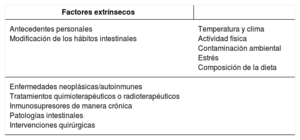
La composición inicial de la microbiota del tracto gastrointestinal se determina desde el nacimiento, existiendo numerosos factores que modulan y condicionan tanto la cantidad como la calidad, y varía sensiblemente a lo largo de toda la vida.

Etiopatogenia

En una amplia variedad de patologías graves se produce una pérdida de la función de la barrera intestinal, con la consiguiente entrada y translocación de bacterias como de productos bacterianos desde la luz del intestino a otros territorios extraintestinales.

Tratamiento

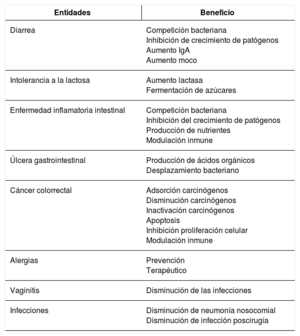
Los probióticos son suplementos alimentarios compuestos de microorganismos vivos que mejoran el balance microbiano, siendo empleados en patologías como diarrea infecciosa, enfermedad inflamatoria intestinal, así como en pacientes críticos para disminuir la incidencia de complicaciones infecciosas.

Palabras clave
Alteración de la barrera intestinal
Funcionalidad de la barrera intestinal
Probióticos
Simbiosis
Abstract
Introduction

The term microbiota refers to the community of living microorganisms gathered in a particular ecological niche. The normal microbiota is the set of microorganisms that coexist with the host without causing disease.

Epidemiology

The initial composition of the microbiota of the gastrointestinal tract is determined from birth, with numerous factors modulating and conditioning both the quantity and quality and vary appreciably throughout the life.

Ethiopathogeny

In a wide variety of serious pathologies there is a loss of intestinal barrier function, with the consequent entry and translocation of bacteria as bacterial products from the gut lumen to other extraintestinal territories.

Treatment

Probiotics are food supplements composed of living microorganisms that can improve the microbial balance by being employed in pathologies such as infectious diarrhea, inflammatory bowel disease as well as in critical patients to reduce the incidence of infectious complications.

Keywords
Loss of intestinal barrier function
Probiotics
Functionality of the intestinal barrier
Simbiosis

Identifíquese

¿Aún no es suscriptor de la revista?

Comprar el acceso al artículo

Comprando el artículo el pdf del mismo podrá ser descargado

Teléfono para incidencias

De lunes a viernes de 9h a 18h (GMT+1) excepto los meses de julio y agosto que será de 9 a 15h

Llamadas desde España 932 415 960
Llamadas desde fuera de España +34 932 415 960
Bibliografía
[1]
201803200424298298
A.M. Stephen, J.H. Cummings.
The microbial contribution to human faecal mass.
J Med Microbiol., (1980), 13 pp. 45-56
[2]
201803200424298299
G.W. Tannock.
Normalmicroflora: an introduction to microbes inhabiting the human body.
Chapman and Hall, (1995),
[3]
2018032004242982910
P.L. Conway.
Microbial ecology of the human large intestine. Human colonic bacteria: role in nutrition physiology and pathology.
CRC Press, (1995), pp. 1-24
[4]
2018032004242982911
W.H. Holzapfel, P. Haberer, J. Snel, U. Schillinger, J.H. Huis in’t Veld.
Overview of gut flora and probiotics.
Int J Food Microbiol., (1998), 41 pp. 85-101
[5]
2018032004242982912
R.I. Mackie, A. Sghir, H.R. Gaskins.
Developmental microbial ecology of the neonatal gastrointestinal tract.
Am J Clin Nutr., (1999), 69 pp. 1035S-1045S
[6]
2018032004242982913
I. Le Huërou-Luron, S. Blat, G. Boudry.
Breast- v. formula-feeding: impacts on the digestive tract and immediate and long-term health effects.
Nutr Res Rev., (2010), 23 pp. 23-36
[7]
2018032004242982914
A. Huurre, M. Kalliomaki, S. Rautava, M. Rinne, S. Salminen, E. Isolauri.
Mode of delivery - effects on gut microbiota and humoral immunity.
Neonatology., (2008), 93 pp. 236-240
[8]
2018032004242982915
E. Biagi, M. Candela, S. Fairweather-Tait, C. Franceschi, P. Brigidi.
Ageing of the human metaorganism: the microbial counterpart.
[9]
2018032004242982916
B. Kleessen, B. Sykura, H.J. Zunft, M. Blaut.
Effects of inulin and lactose on fecal microflora, microbial activity, and bowel habit in elderly constipated persons.
Am J Clin Nutr., (1997), 65 pp. 1397-1402
[10]
2018032004242982917
R.I. Mackie, A. Sghir, H.R. Gaskins.
Developmental microbial ecology of the neonatal gastrointestinal tract.
Am J Clin Nutr., (1999), 69 pp. 1035S-1045S
[11]
2018032004242982918
2018032004242982919
García de Lorenzo, A. Mateos, J. Acosta Escribano, J.A. Rodríguez Montes.
Importancia clínica de la translocación bacteriana.
Nutr Hosp., (2007), 22Supl2 pp. 50-55
[12]
2018032004242982920
E.A. Deitch.
Intestinal permeability is increased in burn patients shortly after injury.
Surgery., (1990), 107 pp. 411-416
[13]
2018032004242982921
2018032004242982922
D.W. Riddington, B. Venkatesh, C.M. Boivin, R.S. Bonser, T.S. Elliott, T. Marshall, et al.
Intestinal permeability, gastric intramucosal pH, and systemic endotoxemia in patients undergoing cardiopulmonary bypass.
JAMA., (1996), 275 pp. 1007-1012
[14]
2018032004242982923
F.R. Demehri, M. Barrett, D.H. Teitelbaum.
Changes to the intestinal microbiome with parenteral nutrition: review of a murine model and potential clinical implications.
Nutr Clin Pract., (2015), 30 pp. 798-806
[15]
2018032004242982924
G.M. Swank, E.A. Deitch.
Role of the gut in multiple organ failure: bacterial translocation and permeability changes.
World J Surg., (1996), 20 pp. 411-417
[16]
2018032004242982925
2018032004242982926
G.M. Swank, E.A. Deitch.
Role of the gut in multiple organ failure: bacterial translocation and permeability changes.
World J Surg., (1996), 20 pp. 411-417
[17]
2018032004242982927
J. Saavedra.
Probiotics and infectious diarrhea.
Am J Gastroenterol., (2000), 95 pp. S16-S18
[18]
2018032004242982928
T. Jiang, D.A. Savaiano.
Modification of colonic fermentation by bifidobacteria and pH in vitro. Impact on lactose metabolism, short-chain fatty acid, and lactate production.
Dig Dis Sci., (1997), 42 pp. 2370-2377
[19]
2018032004242982929
L. Steidler, W. Hans, L. Schotte, S. Neirynck, F. Obermeier, W. Falk, et al.
Treatment of murine colitis by Lactococcus lactis secreting interleukin-10.
Science., (2000), 289 pp. 1352-1355
[20]
2018032004242982930
M.C. Collado, A. González, R. González, M. Hernández, M.A. Ferrus, Y. Sanz.
Antimicrobial peptides are among the antagonistic metabolites produced by Bifidobacterium against Helicobacter pylori.
Int J Antimicrob Agents., (2005), 25 pp. 385-391
[21]
2018032004242982931
K. Hirayama, J. Rafter.
The role of probiotic bacteria in cancer prevention.
Microbes Infect., (2000), 2 pp. 681-686
[22]
2018032004242982932
G.M. Del Miraglia, M.G. De Luca.
The role of probiotics in the clinical management of food allergy and atopic dermatitis.
J Clin Gastroenterol., (2004), 38 pp. S84-S85
[23]
2018032004242982933
G. Reid, A. Bocking.
The potential for probiotics to prevent bacterial vaginosis and preterm labor.
Am J Obstet Gynecol., (2003), 189 pp. 1202-1208
[24]
2018032004242982934
G. Stavrou, E.J. Giamarellos-Bourboulis, K. Kotzampassi.
The role of probiotics in the prevention of severe infections following abdominal surgery.
Int J Antimicrob Agents., (2015), 46 pp. S2-S4
[25]
2018032004242982935
D. Barraud, P.E. Bollaert, S. Gibot.
Impact of the administration of probiotics on mortality in critically ill adult patients: a meta-analysis of randomized controlled trials.
Chest., (2013), 143 pp. 646-655