

Vol. 12. Núm. 8.
Páginas 407-420 (Abril 2016)

Actualización
Pancreatitis aguda

Acute pancreatitis

F. Alberca de las ParrasE. Sánchez VelascoF. Carballo Álvarez
Doi : https://10.1016/j.med.2016.03.018
Opciones
Resumen
Concepto

Es la inflamación en la glándula pancreática que cursa con epigastralgia y elevación de enzimas pancreáticas (amilasa y lipasa).

Epidemiología

La incidencia en España es de 15.000 casos/año.

Etiopatogenia

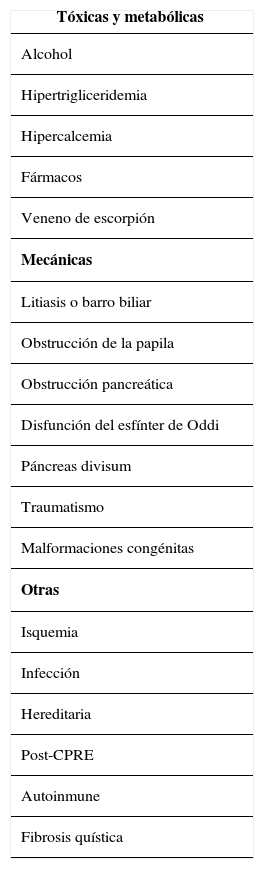
La colelitiasis y el alcohol son las causas más frecuentes.

Manifestaciones clínicas

La epigastralgia es el síntoma predominante. Un 80-90% de los casos presentan náuseas y vómitos y puede asociarse a ictericia y a fallo multiorgánico.

Diagnóstico

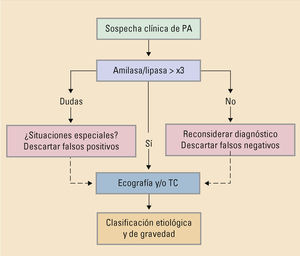
La clínica y la elevación de enzimas pancreáticas llevan al diagnóstico. Las técnicas de imagen (ecografía y TAC abdominal) pueden ayudar. La TAC permite evaluar la gravedad y las complicaciones.

Tratamiento

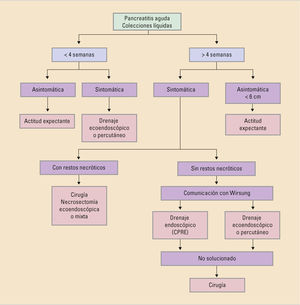
Son clave el ayuno, la estabilidad hemodinámica y eliminar el agente etiológico. Las técnicas endoscópicas están adquiriendo protagonismo en el tratamiento de las complicaciones.

Pronóstico

Los reactantes de inflamación (proteína C reactiva) pueden ser útiles para la predicción de la gravedad. Existen escalas pronósticas que ayudan en la toma de decisiones.

Palabras clave
Dolor
Hiperamilasemia
Colelitiasis
Alcohol
Pseudoquistes
Necrosis
Abstract
Concept

Pancreatitis is the inflammation of pancreatic gland in which the patient presents epigastric pain an elevation of pancreatic enzymes (amylase and lipase).

Epidemiology

The incidence in Spain is 15.000 cases per year.

Clinical symptoms

The most frecuent sympstom is epigastric pain. 80-90% of patients present nausea and vomits, and ictericia or multiorganic failure can be present.

Diagnosis

It is achieved by clinical manifestations and elevation of pancreatic enzymes. Ultrasonography and abdominal Computarized Tomography are usefull, and the last one enables the evaluation of severity and complications.

Treatment

Absolut diet, hemodynamic stability and delete the etiological agent are imperative. Endoscopic procedures are improving its role in the management of complications.

Prognosis

Acute phase reactants (as Reactive C Protein) could support in the prediction of gravity. There are prognostic scales that can help in the management of patients.

Keywords
Pain
Hyperamylasemia
Cholelithiasis
Alcohol ;Pseudocysts
Necrosis

Identifíquese

¿Aún no es suscriptor de la revista?

Comprar el acceso al artículo

Comprando el artículo el pdf del mismo podrá ser descargado

Teléfono para incidencias

De lunes a viernes de 9h a 18h (GMT+1) excepto los meses de julio y agosto que será de 9 a 15h

Llamadas desde España 932 415 960
Llamadas desde fuera de España +34 932 415 960
Bibliografía
[1]
O. Teerenhovi, I. Nordback, J. Isolauri.
Ranson signs and necrosis of the pancreas in acute necrotising pancreatitis.
Acta Chir Scand, (1988), 154 pp. 385-388
[2]
E.L. Bradley 3rd..
A clinically based classification system for acute pancreatitis. Summary of the International Symposium on Acute Pancreatitis, Atlanta, Ga, September 11 through 13, 1992.
Arch Surg, (1993), 128 pp. 586-590
[3]
M.G. Besselink, H.C. van Snatvoort, B.J. Wittemen, H.G. Gooszen.
Dutch Acute Pancreatitis Study Group. Management of severe acute pancreatitis: it's all about timing.
Curr Opin Crit Care, (2007), 13 pp. 200-206
[4]
P.A. Banks, L.T. Bolle, C. Dervenis, H.G. Gooszen, C.D. Johnson, M.G. Sarr, et al.
Acute Pancreatitis Classification Working Group. Classification of acute pancreatitis—2012: revision of the Atlanta classification and definitions by international consensus.
[5]
F.T. De Dombal.
Acute abdominal pain: an O.M.G.E. survey.
Scand J Gastroenterol, (1979), 56 pp. 29-43
[6]
C. Wilson, C.W. Imrie.
Deaths from acute pancreatitis: why do we miss the diagnosis so frequently?.
Int J Pancreatol, (1988), 3 pp. 273-281
[7]
G. Uretsky, M. Goldschmiedt, K. James.
Childhood pancreatitis.
Am Fam Physician, (1999), 59 pp. 2507-2512
[8]
J.A. Moreau, A.R. Zinsmeister, L.J. Melton 3rd, E.P. DiMagno.
Gallstone pancreatitis and the effect of cholecystectomy: a population-based cohort study.
May Clin Proc, (1988), 63 pp. 466-473
[9]
C. Martínez de Pancorbo, F. Carballo, P. Horcajo, M. Aldeguer, I. de la Villa, E. Nieto, et al.
Prevalence and associated factors for gallstone disease: results of a population survey in Spain.
J Clin Epidemiol, (1997), 50 pp. 1347-1355
[10]
C.W. Ko, J.H. Sekijima, S.P. Lee.
Biliary sludge.
Ann Intern Med, (1999), 130 pp. 301-311
[11]
E. Ros, S. Navarro, C. Bru, A. García-Puges, R. Valderrama.
Occult microlithiasis in ‘idiopathic’ acute pancreatitis: prevention of relapses by cholecystectomy or ursodeoxycholic acid therapy.
Gastroenterology, (1991), 101 pp. 1701-1709
[12]
S.P. Lee, J.F. Nicholls, H.Z. Park.
Biliary sludge as a cause of acute pancreatitis.
N Engl J Med, (1992), 326 pp. 589-593
[13]
E.A. Shaffer.
Gallbladder sludge: what is its clinical significance?.
Curr Gastroenterol Rep, (2001), 3 pp. 166-173
[14]
G.A. Lehman, S. Sherman.
Pancreas divisum. Diagnosis, clinical significance, and management alternatives.
Gastrointest Endosc Clin N Am, (1995), 5 pp. 145-170
[15]
R.W. Ammann, P.U. Heitz, G. Kloppel.
Course of alcoholic chronic pancreatitis: a prospective clinicomorphological long-term study.
Gastroenterology, (1996), 111 pp. 224-231
[16]
Wong Lin-Lee, Tsai Her-Hsin, V.F. Andrade-Dávila, M. Chávez-Tostado, C. Dávalos-Cobián, J. García-Correa, et al.
BMC Gastroenterol, (2015 Jul 21), 15 pp. 85
[17]
D.M. Parenti, W. Steinberg, P. Kang.
Infectious causes of acute pancreatitis.
Pancreas, (1996), 13 pp. 356-357
[18]
K. Kawakubo, H. Hata, H. Kawakami, M. Kuwatani, S. Kawahata, K. Kubo, et al.
Pazopanib-Induced Severe Acute Pancreatitis.
Case Rep Oncol, (2015), 8 pp. 356-358
[19]
S.J. Chen, C.S. Lin, C.W. Hsu, C.L. Lin, C.H. Kao.
Acetaminophen poisoning and risk of acute pancreatitis: a population-based cohort study.
Medicine (Baltimore), (2015), 94 pp. e1195
[20]
P.A. Testoni, S. Caporuscio, F. Bagnolo, F. Lella.
Idiopathic recurrent pancreatitis: long-term results after ERCP, endoscopic sphincterotomy, or ursodeoxycholic acid treatment.
Am J Gastroenterol, (2000), 95 pp. 1702-1707
[21]
E. Di Magno, S. Chari.
Pancreatitis aguda.
Sleisenger and Fordtran's Gastroinestinal and liver diseases., 7ª ed., Elsevier,
[22]
V. Ausina, C. Ballús, E. Montserrat, et al.
Elsevier, pp. 257-265
[23]
A. Fauci, E. Braunwald, K. Isselbacher.
Mac Graw-Hill-Interamericana de España, (2003), pp. 2089-2097
[24]
J.E. Domínguez-Muñoz.
Diagnosis of acute pancreatitis: any news or still amylase?.
Acute pancreatitis: novel concepts in biology and therapy., Blackwell Science, pp. 171-180
[25]
J. Ward, A.G. Chalmers, A.J. Guthrie, M. Larvin, P.J. Robinson.
T2-weighted and dynamic enhanced MRI in acute pancreatitis: comparison with contrast enhanced CT.
Clin Radiol, (1997), 52 pp. 109-114
[26]
S. Tenner, J. Baillie, J. DeWitt, S.S. Vege.
American College of Gastroenterology. American College of Gastroenterology guideline: management of acute pancreatitis.
Am J Gastroenterol, (2013), 108 pp. 1400-1415
[27]
J.H.C. Ranson, K.M. Rifkind, D.F. Roses, S.D. Fink, K. Eng, F.C. Spencer.
Prognostics signs and the role of operative management in acute pancreatitis.
Surg Gynecol Obstet, (1974), 139 pp. 69-81
[28]
J.H.C. Ranson.
The timing of biliary surgery in acute pancreatitis.
Ann Surg, (1979), 189 pp. 654-656
[29]
W.A. Knaus, E.A. Draper, D.P. Wagner, J.E. Zimmerman.
APACHE II: a severity of disease classification system.
Crit Care Med, (1985), 13 pp. 818-829
[30]
J.E. Domínguez-Muñoz, F. Carballo, M.J. García, J.M. de Diego, R. Campos, J. Yanguela, et al.
Evaluation of the clinical usefulness of APACHE II and SAPS systems in the initial prognostic classification of acute pancreatitis: a multicenter study.
Pancreas, (1993), 8 pp. 682-686
[31]
A.E. Jones, S. Trzeciak, J.A. Kline.
The Sequential Organ Failure Assessment score for predicting outcome in patients with severe sepsis and evidence of hypoperfusion at the time of emergency department presentation.
Crit Care Med, (2009), 37 pp. 1649-1654
[32]
E.J. Balthazar, D.L. Robinson, A.J. Megibow, J.H. Ranson.
Acute pancreatitis: value of CT in establishing prognosis.
Radiology, (1990), 174 pp. 331-336
[33]
J.M. Mirtallo, A. Forbes, S.A. McClave, G.L. Jensen, D.L. Waitzberg, A.R. Davies.
International Consensus Guideline Committee Pancreatitis Task Force. International consensus guidelines for nutrition therapy in pancreatitis.
JPEN J Parenter Enteral Nutr, (2012), 36 pp. 284-291
[34]
R. Meier, J. Ockenga, M. Pertkiewicz, M. Pap, N. Milinic, J. Macfie, et al.
ESPEN Guidelines on enteral nutrition: pancreas.
Clin Nutr, (2006), 25 pp. 275-284
[35]
M.G. Sarr, H. Sanfey, J.L. Cameron.
Prospective, randomized trial of nasogastric suction in patients with acute pancreatitis.
Surgery, (1986), 100 pp. 500-504
[36]
F. Kalfarentzos, J. Kehagias, N. Mead, K. Kokkinis, C.A. Gogos.
Enteral nutrition is superior to parenteral nutrition in severe acute pancreatitis: results of a randomized prospective trial.
Br J Surg, (1997), 84 pp. 1665-1669
[37]
S.A. McClave, W.K. Chang, R. Dhaliwal, D.K. Hayland.
Nutrition support in acute pancreatitis: a systematic review of the literature.
J Parenter Enteral Nutr, (2006), 30 pp. 143-156
[38]
Working: Group IAP/APA Acute Pancreatitis Guidelines. IAP/APA evidence-based guidelines for the management of acute pancreatitis. Pancreatology. 2013; 13(4)Suppl2:e1-15.
[39]
Villatoro E, Bassi C, Larvin M. Tratamiento antibiótico para la profilaxis de la infección de la necrosis pancreática en la pancreatitis aguda. (Revisión Cochrane traducida). En: La Biblioteca Cochrane Plus, Número 4. Oxford: Update Software Ltd. Disponible en: http://www.update-software.com.
[40]
N.S. Jafri, S.S. Mahid, S. Idstein, C.A. Hornung, S. Galadiuk.
Antibiotic prophylaxis is not protective in severe acute pancreatitis: a systematic review and meta-analysis.
Am J Surgery, (2009), 197 pp. 806-813
[41]
L. Tiong, R. Jalleh, S.G. Barreto.
Selective digestive decontamination in severe acute pancreatitis.
Astrocyte, (2014), 1 pp. 93-99
[42]
M.S. Petrov, H.C. van Santvoort, M.G.H. Besselink, G.J.M.G. van der Heijden, K.J. van Erpecum, H.G. Gooszen.
Early endoscopic retrograde cholanagiopancreatography versus conservative management in acute biliary pancreatitis without cholangitis. A Meta-analysis of randomized trials.
Ann Surg, (2008), 247 pp. 250-257
[43]
E.J. van Geenen, H.C. van Santvoort, M.G. Besselink, D.L. van der Peet, K.J. van Erpecum, P. Fockens, et al.
Lack of consensus on the role of endoscopic retrograde cholangiography in acute biliary pancreatitis in published meta-analyses and guidelines: a systematic review.
Pancreas, (2013), 42 pp. 774-780
[44]
T.B. Gardner.
Endoscopic management of necrotizing pancreatitis.
Gastrointest Endosc, (2012), 76 pp. 1214-1223
[45]
G. Castellanos, A. Piñero, A. Serrano, C. Llamas, M. Fuster, J.A. Fernández, et al.
Traslumbar retroperitoneal endoscopy. An alternativ in the followup and management of drained infected pancreatic necrosis.
Arch Surg, (2005), 140 pp. 952-955
[46]
M.L. Freeman, J. Werner, H.C. van Santvoort, T.H. Baron, M.G. Besselink, J.A. Windsor, et al.
and An International Multidisciplinary Panel of Speakers and Moderators. Interventions for Necrotizing Pancreatitis: Summary of a Multidisciplinary Consensus Conference.
Pancreas, (2012), 41 pp. 1176-1194