

Vol. 13. Núm. 91.
Páginas 5385-5392 (Noviembre 2023)

Actualización
Patología del equilibrio. Vértigos periféricos

Balance disorders. Peripheral vertigo

F. RamírezabA. CortezaT. Rivera-Rodríguezac
Doi : https://10.1016/j.med.2023.11.012
Opciones
Resumen

Definimos el vértigo como la ilusión de movimiento de uno mismo o del entorno, aunque cada paciente puede experimentar sensaciones distintas. Podemos clasificarlo según el tiempo de duración de la crisis, la frecuencia temporal, el tiempo de evolución o los desencadenantes. Muchas de las patologías que afectan al oído interno no tienen definido el mecanismo fisiopatológico que los origina; sin embargo, sabemos que las infecciones víricas pueden ocasionar laberintitis serosas o neuritis vestibular, que traumatismos craneales o posturas anómalas pueden ocasionar vértigo posicional paroxístico benigno (VPPB) y el envejecimiento de los receptores vestibulares puede desencadenar el presbivértigo.

El diagnóstico se basa en una anamnesis detallada, exploración física que explore los reflejos vestibuloocular y vestíbulo espinal, pruebas complementarias como audiometría o videonistagmografía y finalmente pruebas de imagen, principalmente la resonancia magnética.

La fase aguda se tratará con medicamentos que disminuyan las náuseas y vómitos, siendo los principales los sedantes vestibulares, que no deben ser usados durante más de 3 días. Hay tratamientos específicos para cada patología, como es el caso del VPPB, donde realizaremos maniobras de recolocación.

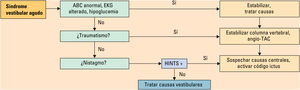
En urgencias realizaremos exploraciones a pie de cama del paciente, el protocolo HINTS es el que ha demostrado tener más sensibilidad y especificidad.

Palabras Clave
Vértigo
Mareo
Síndrome vestibular agudo
Abstract

Vertigo is defined as the illusion of movement of oneself or one's surroundings, although each patient may experience different sensations. It can be classified according to the duration of the crisis, how often it occurs, the time it has been ongoing, or the triggers. Many diseases that affect the inner ear do not have a defined pathophysiological mechanism that causes them. However, it is known that viral infections can cause serous labyrinthitis or vestibular neuritis, that cranial trauma or abnormal postures can cause benign paroxysmal positional vertigo (BPPV), and that aging of the vestibular receptors can trigger presbyvertigo.

The diagnosis is based on a detailed case history; a physical examination that explores the vestibulo-ocular and vestibulo-spinal reflexes; additional tests such as audiometry or videonystagmography; and finally imaging tests, mainly magnetic resonance imaging.

The acute phase will be treated with drugs that decrease nausea and vomiting. The main drugs are vestibular sedatives, which should not be used for more than three days. There are specific treatments for each disease, such as in the case of BPPV, in which repositioning maneuvers are performed.

In the emergency department, examinations are performed at the patient's bedside. The HINTS examination has been demonstrated to have the greatest sensitivity and specificity.

Keywords
Vertigo
Dizziness
Acute vestibular syndrome

Identifíquese

¿Aún no es suscriptor de la revista?

Comprar el acceso al artículo

Comprando el artículo el pdf del mismo podrá ser descargado

Teléfono para incidencias

De lunes a viernes de 9h a 18h (GMT+1) excepto los meses de julio y agosto que será de 9 a 15h

Llamadas desde España 932 415 960
Llamadas desde fuera de España +34 932 415 960
Bibliografía
[1]
202312120614085428
202312120614085429
, T.D. Fife.
Approach to the history and evaluation of vertigo and dizziness.
Continuum (Minneap Minn) [Internet]., (2021), 27 pp. 306-329
[2]
2023121206140854210
2023121206140854211
, E. Merino-Gálvez, J. Gómez-Hervás, D. Pérez-Mestre, J.M. Llamas-Peiro, E. Perez-Gil, M. Belda-Palazon.
Epidemiology of otorhinolaryngologic emergencies in a secondary hospital: analysis of 64,054 cases.
Eur Arch Otorhinolaryngol [Internet]., (2019), 276 pp. 911-917
[3]
2023121206140854212
, J.C. Kattah, A.V. Talkad, D.Z. Wang, Y.-H. Hsieh, D.E. Newman-Toker.
HINTS to diagnose stroke in the acute vestibular syndrome: three-step bedside oculomotor examination more sensitive than early MRI diffusion-weighted imaging: Three-step bedside oculomotor examination more sensitive than early MRI diffusion-weighted imaging.
Stroke [Internet]., (2009), 40 pp. 3504-3510
[4]
2023121206140854213
, C.C. Della Santina, V. Potyagaylo, A.A. Migliaccio, L.B. Minor, J.P. Carey.
Orientation of human semicircular canals measured by three-dimensional multiplanar CT reconstruction.
J Assoc Res Otolaryngol [Internet]., (2005), 6 pp. 191-206
[5]
2023121206140854214
, L.A. Son, H. Aoki, T. Suzuki.
Evaluation of driver distraction with changes in gaze direction based on a vestibulo-ocular reflex model.
J Transp Technol [Internet]., (2017), 07 pp. 336-350
[6]
2023121206140854215
, J.-P. Sauvage.
Vertiges: manuel de diagnostic et de rehabilitation., 3a ed., Elsevier Masson,
[7]
2023121206140854216
2023121206140854217
, P. Pérez-Vázquez, V. Franco-Gutiérrez, A. Soto-Varela, J.C. Amor-Dorado, E. Martín-Sanz, M. Oliva-Domínguez, et al.
Guía de práctica clínica para el diagnóstico y tratamiento del vértigo posicional paroxístico benigno. Documento de Consenso de la Comisión de Otoneurología Sociedad Española de Otorrinolaringlogía y Cirugía de Cabeza y Cuello.
Acta Otorrinolaringol (Engl Ed) [Internet]., (2018), 69 pp. 345-366
[8]
2023121206140854218
, L. Murdin, A.G.M. Schilder.
Epidemiology of balance symptoms and disorders in the community: a systematic review: A systematic review.
Otol Neurotol [Internet]., (2015), 36 pp. 387-392
[9]
2023121206140854219
, J. Sá Silva.
A look into familial hemiplegic migraine.
Sinapse [Internet]., (2023), 22 pp. 182-183
[10]
2023121206140854220
, T. Dalkara, M.A. Moskowitz.
From cortical spreading depression to trigeminovascular activation in migraine.
John Wiley & Sons, Inc, pp. 267-284
[11]
2023121206140854221
, J.M. Furman, D.A. Marcus, C.D. Balaban.
Migrainous vertigo: development of a pathogenetic model and structured diagnostic interview.
Curr Opin Neurol [Internet]., (2003), 16 pp. 5-13
[12]
2023121206140854222
, J.P. Carey, L.B. Minor, G.C.Y. Peng, C.C. Della Santina, P.D. Cremer, T. Haslwanter.
Changes in the three-dimensional angular vestibulo-ocular reflex following intratympanic gentamicin for ménière's disease.
J Assoc Res Otolaryngol [Internet]., (2002), 3 pp. 430-443
[13]
2023121206140854223
, C.A. Foster, R.E. Breeze.
The Meniere attack: an ischemia/reperfusion disorder of inner ear sensory tissues.
Med Hypotheses [Internet]., (2013), 81 pp. 1108-1114
[14]
2023121206140854224
, E. Hietikko, J. Kotimäki, E. Kentala, T. Klockars, M. Sorri, M. Männikkö.
Finnish familial Meniere disease is not linked to chromosome 12p12.3, and anticipation and cosegregation with migraine are not common findings.
Genet Med [Internet]., (2011), 13 pp. 415-420
[15]
2023121206140854225
, E. Kangasniemi, E. Hietikko.
The theory of autoimmunity in Meniere's disease is lacking evidence.
Auris Nasus Larynx [Internet]., (2017), 45 pp. 399-406
[16]
2023121206140854226
, M.E. Hoffer, M.C. Schubert, C.D. Balaban.
Early diagnosis and treatment of traumatic vestibulopathy and postconcussive dizziness.
Neurol Clin [Internet]., (2015), 33 pp. 661-668
[17]
2023121206140854227
, S.N. Merchant, J.J. Rosowski.
Conductive hearing loss caused by third-window lesions of the inner ear.
Otol Neurotol [Internet]., (2008), 29 pp. 282-289
[18]
2023121206140854228
, N. Mehta, E. Arram, M.J. Rouhani, L. Dimitrov, H.K. Ubhi, S. Khalil, et al.
Superior semi-circular canal dehiscence syndrome: quantifying the effectiveness of treatment from the patient's perspective.
J Laryngol Otol [Internet]., (2022), 136 pp. 809-822
[19]
2023121206140854229
, J.-W. Cho, S.I. Cho, W. Baek, M.S. Kim, G.-S. Nam.
Significance of baseline inferior vestibular function on the prognosis of patients with labyrinthitis.
Otol Neurotol [Internet]., (2023), 44 pp. e26-e32
[20]
2023121206140854230
, S. Leong, B.M. Teh, A. Del Portillo, A.K. Lalwani.
Histopathology of labyrinthitis ossificans from an intralabyrinthine surgical specimen.
Otol Neurotol [Internet]., (2022), 43 pp. 889-893
[21]
2023121206140854231
, M. Strupp, A. Bisdorff, J. Furman, J. Hornibrook, K. Jahn, R. Maire, et al.
Acute unilateral vestibulopathy/vestibular neuritis: Diagnostic criteria: Consensus document of the committee for the classification of vestibular disorders of the Bárány Society.
J Vestib Res [Internet]., (2022), 32 pp. 389-406
[22]
2023121206140854232
, T.N. Le, B.D. Westerberg, J. Lea.
Vestibular neuritis: Recent advances in etiology, diagnostic evaluation, and treatment.
Adv Otorhinolaryngol [Internet]., (2019), 82 pp. 87-92
[23]
2023121206140854233
, H. Theeuwen, M. Whipple, J.R. Litvack.
Otosyphilis: Resurgence of an old disease: Otosyphilis: Resurgence of an old disease.
Laryngoscope [Internet]., (2019), 129 pp. 1680-1684
[24]
2023121206140854234
, B. Ozturk, M. Gulec, T.N. Deveci, M.T. Guler.
Bening paroxysmal positional vertigo: Pathophysiology, evaluation and diagnosis.
Turkish Journal of Audiology and Hearing Research [Internet]., (2019),
[25]
2023121206140854235
, L.A.J. Hanskamp, T.R. Schermer, R.B. van Leeuwen.
Long-term prognosis of vertigo attacks and health-related quality of life limitations in patients with vestibular paroxysmia.
Otol Neurotol [Internet]., (2022), 43 pp. e475-e481
[26]
2023121206140854236
, C.S.-L. Teh, S.H. Noordiana, S. Shamini, N. Prepageran.
Vascular loops: The innocent bystander for vestibular paroxysmia.
Ann Otol Rhinol Laryngol [Internet]., (2022), 131 pp. 604-608
[27]
2023121206140854237
, S. Popkirov, J.P. Staab, J. Stone.
Persistent postural-perceptual dizziness (PPPD): a common, characteristic and treatable cause of chronic dizziness.
Pract Neurol [Internet]., (2018), 18 pp. 5-13
[28]
2023121206140854238
, E.H. Nada, O.A. Ibraheem, M.R. Hassaan.
Vestibular rehabilitation therapy outcomes in patients with persistent postural-perceptual dizziness.
Ann Otol Rhinol Laryngol [Internet]., (2019), 128 pp. 323-329
[29]
2023121206140854239
, J. Lawson, J. Fitzgerald, J. Birchall, C.P. Aldren, R.A. Kenny.
Diagnosis of geriatric patients with severe dizziness.
J Am Geriatr Soc [Internet]., (1999), 47 pp. 12-17
[30]
2023121206140854240
2023121206140854241
, Y. Agrawal, R. Van de Berg, F. Wuyts, L. Walther, M. Magnusson, E. Oh, et al.
Presbivestibulopatía: criterios diagnósticos. Documento de consenso del Comité de Clasificación de la Bárány Society.
Acta Otorrinolaringol Esp [Internet]., (2022), 73 pp. 42-50
[31]
2023121206140854242
, S. Traccis, G.F. Zoroddu, M.T. Zecca, T. Cau, M.A. Solinas, R. Masuri.
Evaluating patients with vertigo: bedside examination.
Neurol Sci., (2004), 25 pp. S16
[32]
2023121206140854243
, J.C. Alyono.
Vertigo and dizziness: Understanding and managing fall risk.
Otolaryngol Clin North Am., (2018), 51 pp. 725-740
[33]
2023121206140854244
, D.E. Newman-Toker, J.A. Edlow.
TiTrATE: A novel, evidence-based approach to diagnosing acute dizziness and vertigo.
Neurol Clin., (2015), 33 pp. 577-599
[34]
2023121206140854245
, Zwergal, Andreas, Dieterich, Marianne.
Vertigo and dizziness in the emergency room.
Curr Opin Neurol., (2020), 33 pp. 117-125