

Vol. 13. Núm. 85.
Páginas 5051-5054 (Septiembre 2023)

Protocolos de práctica asistencial
Protocolo de actuación en el paciente agitado en urgencias

Protocol of action in the agitated patient in the emergency room

A. Matas OchoaR. Martínez de Velasco SorianoR. Muñoz DomínguezI. Moreno Alonso
Doi : https://10.1016/j.med.2023.08.017
Opciones
Resumen

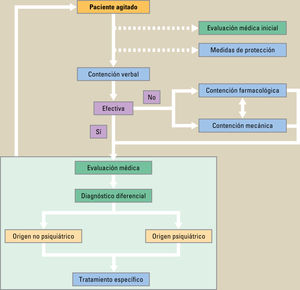
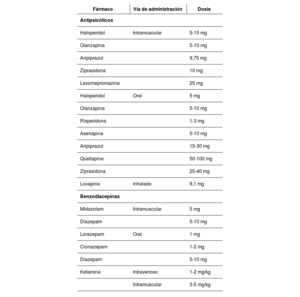
El paciente agitado es un síndrome psiquiátrico relevante y frecuente en los servicios de urgencias que requiere una atención inmediata. El tratamiento inicial se basa en la sospecha diagnóstica, e irá dirigido a la contención del episodio de agitación y a establecer medidas de seguridad para evitar el daño autoagresivo o heteroagresivo. La contención verbal es el paso inicial, seguido de contención farmacológica y/o mecánica según la intensidad del cuadro y el grado de colaboración del paciente. Existen diferentes estrategias farmacológicas que incluyen el uso de antipsicóticos y benzodiacepinas, si bien hay otros agentes farmacológicos más novedosos y de uso menos extendido, no por ello menos efectivos, como la ketamina.

Palabras clave
Agitación
Contención verbal
Contención farmacológica
Abstract

Agitation in patients is an important, common psychiatric syndrome in emergency departments that requires immediate attention. The initial treatment is based on diagnostic suspicion and is aimed at containing the episode of agitation and establishing safety measures to avoid self-aggressive or hetero-aggressive harm. Verbal de-escalation is the first step, followed by chemical and/or mechanical restraint according to the intensity of symptoms and the degree of patient collaboration. There are different pharmacological strategies which include the use of antipsychotics and benzodiazepines. There are also other newer pharmacological agents whose use is not as widespread, though they are no less effective, such as ketamine.

Keywords
Agitation
Verbal de-escalation
Chemical restraint

Identifíquese

¿Aún no es suscriptor de la revista?
Comprar el acceso al artículo

Comprando el artículo el pdf del mismo podrá ser descargado

Teléfono para incidencias

De lunes a viernes de 9h a 18h (GMT+1) excepto los meses de julio y agosto que será de 9 a 15h
Llamadas desde España 932 415 960
Llamadas desde fuera de España +34 932 415 960
Bibliografía
[1]
A. Chinchilla
202309010629025008
, M. Vega Piñero, F.J. Quintero Lumbreras, J. Correas Lauffer.
Breviario de urgencias psiquiátricas.
Elsevier España, (2011),
[2]
M.M. Rice
202309010629025009
2023090106290250010
, G.P. Moore.
Management of the violent patient.
Emerg Med Clin North Am., (1991), 9 pp. 13-30
[3]
J. Richmond
2023090106290250011
2023090106290250012
, J. Berlin, A. Fishkind, G. Holloman, S. Zeller, M. Wilson, et al.
Verbal de-escalation of the agitated patient: Consensus statement of the American Association for Emergency Psychiatry Project BETA De-escalation Workgroup.
West J Emerg Med., (2012), 13 pp. 17-25
[4]
M.H. Allen
2023090106290250013
2023090106290250014
, G.W. Currier, D.H. Hughes, J.P. Docherty, D. Carpenter, R. Ross.
Treatment of behavioral emergencies: A summary of the expert consensus guidelines.
J Psychiatr Pract., (2003), 9 pp. 16-38
[5]
B. Pacciardi
2023090106290250015
2023090106290250016
, A. Calcedo, T. Messer.
Inhaled loxapine for the management of acute agitation in bipolar disorder and schizophrenia: Expert review and commentary in an era of change.
Drugs in R&D., (2019), 19 pp. 15-25
[6]
E. Vieta
2023090106290250017
2023090106290250018
, M. Garriga, L. Cardete, M. Bernardo, M. Lombraña, J. Blanch, et al.
Protocol for the management of psychiatric patients with psychomotor agitation.
BMC Psychiatry., (2017), 17 pp. 328
[7]
D. Barbic
2023090106290250019
2023090106290250020
, G. Andolfatto, B. Grunau, F.X. Scheuermeyer, B. Macewan, H. Qian, et al.
Rapid agitation control with ketamine in the Emergency Department: A blinded, randomized controlled trial.
Ann Emerg Med., (2021), 78 pp. 788-795