

Vol. 12. Núm. 72.
Páginas 4253-4256 (Febrero 2019)

Protocolos de práctica asistencial
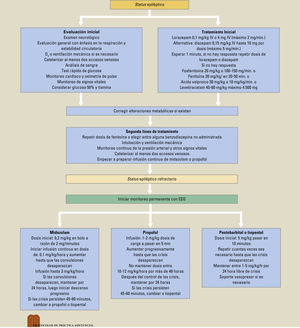
Protocolo de manejo clínico del status epiléptico

Protocol for the clinical management of status epilepticus

G. Álvarez BravoG. Carvalho MonteiroJ. Hernández Cristobal
Doi : https://10.1016/j.med.2019.02.007
Opciones
Resumen

El status epiléptico es una emergencia neurológica potencialmente mortal. Se conoce como estado epiléptico cuando la actividad convulsiva se prolonga por más de 5 minutos o cuando no hay recuperación de un adecuado nivel de conciencia entre crisis. Dada la gravedad del estado epiléptico, su manejo debe ser integral y exhaustivo, con medidas de soporte ventilatorio y hemodinámico, además de la terapia farmacológica. Los fármacos antiepilépticos deben ser cuidadosamente escogidos y dosificados para obtener una adecuada respuesta terapéutica y evitar efectos adversos que también pueden poner en riesgo la vida del paciente. Las benzodiazepinas como lorazepam o diazepam siguen siendo la primera línea farmacológica del status epiléptico. En casos de intolerancia o fracaso terapéutico con benzodiazepinas, se deben utilizar otros antiepilépticos. En casos de refractariedad, es necesario utilizar anestésicos como tiopental, propofol y/o midazolam.

Palabras clave
Status epiléptico
Antiepilépticos
Benzodiazepinas
Fenitoína
Levetiracetam
Abstract

Status epilepticus is common neurologic emergency life threatening. Status epilepticus refers to a 5min of continuous seizures or two or more discrete seizures between which there is incomplete recovery of consciousness. Given its severity, holistic and comprehensive clinical management is required. It includes support measures and drug therapy. To achieve an adequate therapeutic response, avoiding life-threatening side-effects, anti-seizure drugs must be carefully chosen and dosificated. The first line drugs remain benzodiazepines (e.g. lorazepam and diazepam). Other antiepileptic drugs should be used when benzodiazepines fail or in patients reporting benzodiazepines intolerance. In refractory cases, anesthetic treatment is required (thiopental, propofol and/or midazolam).

Keywords
Status epilepticus
Antiepileptic drugs
Benzodiazepines
Phenytoin
Levetiracetam

Identifíquese

¿Aún no es suscriptor de la revista?

Comprar el acceso al artículo

Comprando el artículo el pdf del mismo podrá ser descargado

Teléfono para incidencias

De lunes a viernes de 9h a 18h (GMT+1) excepto los meses de julio y agosto que será de 9 a 15h

Llamadas desde España 932 415 960
Llamadas desde fuera de España +34 932 415 960
Bibliografía
[1]
201902140619426558
201902140619426559
G.M. Brophy, R. Bell, J. Claassen, B. Alldredge, T.P. Bleck, T. Glauser, et al.
Guidelines for the evaluation and management of status epilepticus.
Neurocrit Care, (2012), 17 pp. 3-23
[2]
2019021406194265510
2019021406194265511
Treatment of convulsive status epilepticus. Recommendations of the Epilepsy Foundation of America's Working Group on Status Epilepticus.
JAMA, (1993), 270 pp. 854-859
[3]
2019021406194265512
2019021406194265513
L.J. Hirsch.
Intramuscular versus intravenous benzodiazepines for prehospital treatment of status epilepticus.
N Engl J Med., (2012), 366 pp. 659-660
[4]
2019021406194265514
2019021406194265515
R.C. Mundlamuri, S. Sinha, D.K. Subbakrishna, P.V. Prathyusha, M. Nagappa, P.S. Bindu, et al.
Management of generalised convulsive status epilepticus (SE): A prospective randomised controlled study of combined treatment with intravenous lorazepam with either phenytoin, sodium valproate or levetiracetam–Pilot study.
Epilepsy Res., (2015), 114 pp. 52-58
[5]
2019021406194265516
2019021406194265517
F. Brigo, N. Bragazzi, R. Nardone, E. Trinka.
Direct and indirect comparison meta-analysis of levetiracetam versus phenytoin or valproate for convulsive status epilepticus.
Epilepsy Behav., (2016), 64 pp. 110-115
[6]
2019021406194265518
2019021406194265519
R. Sutter, S. Marsch, S. Rüegg.
Safety and efficacy of intravenous lacosamide for adjunctive treatment of refractory status epilepticus: a comparative cohort study.
CNS Drugs, (2013), 27 pp. 321-329
[7]
2019021406194265520
2019021406194265521
S. Sivakumar, M. Ibrahim, D. Parker Jr., G. Norris, A. Shah, W. Mohamed.
Clobazam: an effective add-on therapy in refractory status epilepticus.
Epilepsia, (2015), 56 pp. e83-e89
[8]
2019021406194265522
2019021406194265523
O.C. Cockerell, J. Rothwell, P.D. Thompson, C.D. Marsden, S.D. Shorvon, et al.
Clinical and physiological features of epilepsia partialis continua. Cases ascertained in the UK.
Brain., (1996), 119 pp. 393-407
[9]
2019021406194265524
2019021406194265525
E.F. Wijdicks, J.E. Parisi, F.W. Sharbrough.
Prognostic value of myoclonus status in comatose survivors of cardiac arrest.
Ann Neurol., (1994), 35 pp. 239-243
[10]
2019021406194265526
2019021406194265527
J. Claassen, L.J. Hirsch, R.G. Emerson, S.A. Mayer.
Treatment of refractory status epilepticus with pentobarbital, propofol, or midazolam: a systematic review.
Epilepsia, (2002), 43 pp. 146-153