

Vol. 13. Núm. 79.
Páginas 4699-4702 (Mayo 2023)

Protocolos de práctica asistencial
Protocolo diagnóstico de la proteinuria

Diagnostic protocol for proteinuria

J.K. Peña-EsparragozaaR. GimenaaJ. Mancha RamosaP. Rodríguez Doyágüezb
Doi : https://10.1016/j.med.2023.05.006
Opciones
Resumen

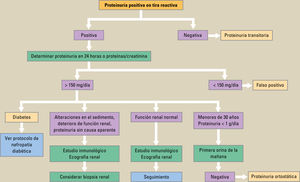
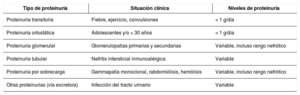
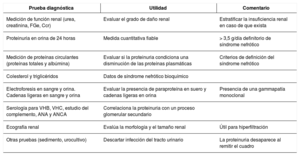
La presencia de una cantidad de proteínas en la orina mayor a 150mg al día se considera patológica y debe ser motivo de estudio. La proteinuria puede ser de origen glomerular, tubular o deberse a una sobrecarga de proteínas filtradas. El mejor método de evaluación es la cuantificación de proteínas en orina de 24 horas. En necesaria una evaluación completa del paciente, con pruebas de laboratorio dirigidas a filiar la causa, siendo necesaria en ocasiones la realización de una biopsia renal.

Palabras clave
Proteinuria
Orina de 24 horas
Abstract

The presence of an amount of protein in the urine greater than 150mg per day is considered pathogenic and should be a cause for study. Proteinuria can be of glomerular or tubular origin or due to an overload of filtered proteins. The best evaluation method is a 24-hour urine protein quantification. A comprehensive evaluation of the patient is necessary, with laboratory tests aimed at determining the cause. On occasion, a renal biopsy is needed.

Keywords
Proteinuria
24-hour urine test

Identifíquese

¿Aún no es suscriptor de la revista?
Comprar el acceso al artículo

Comprando el artículo el pdf del mismo podrá ser descargado

Teléfono para incidencias

De lunes a viernes de 9h a 18h (GMT+1) excepto los meses de julio y agosto que será de 9 a 15h
Llamadas desde España 932 415 960
Llamadas desde fuera de España +34 932 415 960
Bibliografía recomendada
[1]
J.R. Brandt, A. Jacobs, H.H. Raissy, F.M. Kelly, A.O. Staples, E. Kaufman, et al.
Orthostatic proteinuria and the spectrum of diurnal variability of urinary protein excretion in healthy children.
Pediatr Nephrol., (2010), 25 pp. 1131-1137
[2]
J.L. Carter
202305231130308318
202305231130308319
, C.R. Tomson, P.E. Stevens, E.J. Lamb.
Does urinary tract infection cause proteinuria or microalbuminuria?. A systematic review.
Nephrol Dial Transplant., (2006), 21 pp. 3031-3037
[3]
J.M. Halimi
2023052311303083110
, S. Hadjadj, V. Aboyans, F.A. Allaert, J.Y. Artigou, M. Beaufils, et al.
Microalbuminuria and urinary albumin excretion: French guidelines.
Ann Biol Clin (Paris)., (2008), 66 pp. 277-284
[4]
A. Ishani
2023052311303083111
2023052311303083112
, G.A. Grandits, R.H. Grimm, K.H. Svendsen, A.J. Collins, R.J. Prineas, et al.
Association of single measurements of dipstick proteinuria, estimated glomerular filtration rate, and hematocrit with 25-year incidence of end-stage renal disease in the multiple risk factor intervention trial.
J Am Soc Nephrol., (2006), 17 pp. 1444-1452
[5]
W.G. Miller
2023052311303083113
, D.E. Bruns, G.L. Hortin, S. Sandberg, K.M. Aakre, M.J. McQueen, et al.
Current issues in measurement and reporting of urinary albumin excretion.
Clin Chem., (2009), 55 pp. 24-38
[6]
K.L. Heathcote
2023052311303083114
, M.P. Wilson, D.W. Quest, T.W. Wilson.
Prevalence and duration of exercise induced albuminuria in healthy people.
Clin Invest Med., (2009), 32 pp. E261-E265
[7]
E.R. Smith
2023052311303083115
, M.M. Cai, L.P. McMahon, D.A. Wright, S.G. Holt.
The value of simultaneous measurements of urinary albumin and total protein in proteinuric patients.
Nephrol Dial Transplant., (2012), 27 pp. 1534-1541