
Vol. 11. Núm. 91.
Páginas 5467-5471 (Noviembre 2015)

Protocolos de práctica asistencial
Protocolo diagnóstico del vértigo

Vertigo diagnostic protocol

A. NietoN. PulidoT. Rivera
Doi : https://10.1016/j.med.2015.11.018
Opciones
Resumen

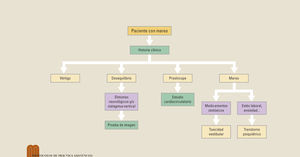
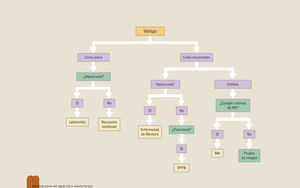
El vértigo es una ilusión de movimiento provocada por la disfunción del sistema vestibular. El manejo del paciente vertiginoso constituye un reto para el médico de atención primaria (MAP), por ser un motivo frecuente de consulta y porque, a menudo, no es fácil diferenciar, por las explicaciones del paciente, si estamos ante un paciente con vértigo o un paciente con otra sintomatología como: mareo, desequilibrio o presíncope. Aunque la mayoría de las veces obedece a una patología no grave, puede entrañar un riesgo vital. Tiene una importante repercusión social y económica. Si tenemos en cuenta que más de la mitad de los pacientes con mareo/vértigo son manejados clínicamente en atención primaria, resulta imprescindible que el MAP conozca las principales entidades clínicas, sea capaz de realizar una correcta anamnesis y exploración física del paciente, así como las principales opciones de tratamiento a su alcance. Todo ello le permitirá realizar la atención correcta del paciente y la adecuada derivación hacia atención especializada. En este protocolo se repasan los principales cuadros vertiginosos haciendo énfasis en su diagnóstico diferencial al tiempo que se ofrecen los algoritmos diagnósticos del paciente con mareo y vértigo.

Palabras clave
Vértigo periférico
Vértigo central
Nistagmus
Abstract

Vertigo is an illusion of movement caused by the dysfunction of the vestibular system. Management of the patient with vertigo is a challenge for the primary care physician (PCP), because of being a frequent complaint and is often difficult to differentiate, by the patient explanations, if we are faced with a patient with vertigo or a patient with other symptoms such as: dizziness, imbalance or presyncope. Although most of the times is due to a non-serious disease may be a life-threatening condition. It has significant social and economic impact. If we consider that more than half of patients with dizziness/vertigo are managed clinically in primary care it is essential that PCP know the main clinical entities, and be able to perform a correct anamnesis and clinical examination of the patient, as well as main treatment options available. All this should allow PCP to render adequate care to the patient and appropriate referral to specialized care. In this chapter main causes of vertigo are reviewed with emphasis in their differential diagnosis, while diagnostic algorithms for patients with dizziness and vertigo are offered.

Keywords
Peripheral vertigo
Central vertigo
Nystagmus

Identifíquese

¿Aún no es suscriptor de la revista?

Comprar el acceso al artículo

Comprando el artículo el pdf del mismo podrá ser descargado

Teléfono para incidencias

De lunes a viernes de 9h a 18h (GMT+1) excepto los meses de julio y agosto que será de 9 a 15h

Llamadas desde España 932 415 960
Llamadas desde fuera de España +34 932 415 960
Bibliografía
[1]
K. Hanley, T. O’Dowd, N. Cosidine.
A systematic review of vertigo in primary care.
Br J Gen Pract., (2001), 51 pp. 666-671
[2]
Branch WTJr, Barton JJS, Aminoff MJ, Deschler D, Wilterdink J. Approach to the patient with dizziness. UpToDate 2014. [Consultado 26 de febrero de 2015). Disponible en: www.uptodate.com.
[3]
H.K. Neuhauser, A. Radtke, M. von Brevern, F. Lezius, M. Feldmann, T. Lempert.
Burden of dizziness and vertigo in the community.
Arch Intern Med, (2008), 168 pp. 2118-2124
[4]
Y. Agrawal, J.P. Carey, C.C. Della Santina, M.C. Schubert, L.B. Minor.
Disorders of balance and vestibular function in US adults: data from the Nacional Health and Nutrition Examination Survey, 2001-2004.
Arch Intern Med., (2009), 169 pp. 938-944
[5]
Calvo Bonacho E. Duración de la incapacidad temporal asociada a diferentes patologías en trabajadores españoles. Jun 2010. [Consultado 26 de febrero de 2015]. Disponible en: www.seg-social.es/prdi00/groups/public/documents/binario/146662.pdf.
[6]
S.M. Scappert, C.W. Burt.
Ambulatory care visits to physician offices, hospital outpatient departments, and emergency departments.
Vital Health Stat 13., (2006), 159 pp. 1-66
[7]
K. Kroenke, C.A. Lucas, M.L. Rosemberg, B. Scherokman, J.E. Herbers, P.A. Wehrle, et al.
Causes of persistent dizziness. A prospective study of 100 patients in ambulatory care.
Ann Intern Med., (1992), 117 pp. 898-904
[8]
H. Lee, S.I. Sohn, Y.W. Cho.
Cerebellar infarction presenting isolated vertigo: frequency and vascular topographical patterns.
Neurology., (2006), 67 pp. 1178-1183
[9]
G. Cianfrone, D. Pentangelo, F. Cianfrone.
Pharmacological drugs inducing ototoxicity, vestibular symptoms and tinnitus: a reasoned and updated guide.
Eur Rev Med Phar Sci., (2011), 15 pp. 601-636
[10]
J. Wipperman.
Dizziness and vertigo.
Prim Care Clin Office Pract., (2014), 41 pp. 115-131
[11]
K. Hanley, T. O’Dowd.
Symptoms of vertigo in general practice: a prospective study of diagnosis.
Br J Gen Pract., (2002), 52 pp. 809-812
[12]
M. Cherchi, T.C. Hain.
Migraine-associated vertigo.
Otolaryngol Clin North Am., (2011), 44 pp. 367-375
[13]
H.K. Neuhauser, A. Radtke, M. von Brevern, M. Feldmann, F. Lezius, T. Ziese, et al.
Migrainous vertigo: prevalence and impact on quality of life.
Neurology., (2006), 67 pp. 1028-1033
[14]
J.M. Furman, D.A. Marcus, C.D. Balaban.
Vestibular migraine: clinical aspects and pathophysiolgy.
Lancet Neurol., (2013), 12 pp. 706-715
[15]
M. Von Brevern, H.K. Neuhauser.
Epidemiological evidence for a link between vertigo and migraine.
J Vestib Res., (2011), 21 pp. 299-304
[16]
Headache Classification Comité of the Internacional Headache Society (IHS). The International Classification of Headache Disorders. 3rd ed. Cephalalgia. 2013; 33:629-808.
[17]
T.H. Alexander, J.P. Harris.
Current epidemiology of Menere's síndrome.
Otolayngol Clin North Am., (2010), 43 pp. 965-970
[18]
Comité on Hearing and Equilibrium guidelines for the diagnosis and evaluation of therapy in Meniere's disease. American Academy of Otolaryngology-Head and Neck Foundation, Inc. Otolaryngol Head Neck Surg. 1995; 113:181-5. in press.