

Vol. 13. Núm. 65.
Páginas 3858-3860 (Octubre 2022)

Protocolos de práctica asistencial
Protocolo diagnóstico y terapéutico del asma de difícil control

Diagnostic and treatment protocol for difficult-to-control asthma

M. Alonso VillaresA. Ruiz PeñaS. Sánchez GonzálezS. Sánchez Fraga
Doi : https://10.1016/j.med.2022.10.007
Opciones
Resumen

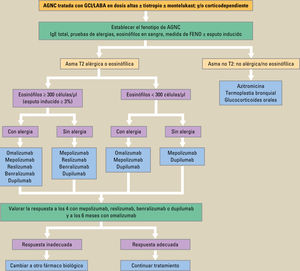
El asma grave de difícil control o no controlada viene determinada por la imposibilidad de controlar síntomas y exacerbaciones pese a emplear glucocorticoides inhalados en dosis altas y un agonista beta-2 de acción larga el año previo o glucocorticoides orales durante 6 o más meses en el último año sin llegar a controlarse. El primer paso que se debe dar en estos pacientes es descartar otras enfermedades concomitantes, comprobar que cumplen la pauta de tratamiento y diferenciar cuál es su fenotipo (asma T2 alérgica o eosinofílica, o asma no T2) según sus características clínicas y analíticas. En función de dicho fenotipo, se podrá administrar un tratamiento biológico mediante anticuerpos monoclonales anti-IgE (omalizumab), anti-IL-5 (mepolizumab, reslizumab y benralizumab) o anti-IL-4/IL-13 (dupilumab) en los subtipos de asma T2. Para tratar el tipo no T2 puede considerarse la termoplastia endobronquial, los corticoides sistémicos e incluso la azitromicina.

Palabras clave
Asma de difícil control
Fenotipo
Anticuerpos monoclonales
Abstract

Severe difficult-to-control or uncontrolled asthma is defined as the impossibility of controlling symptoms and exacerbations despite using high-dose inhaled corticosteroids and a long-acting beta2-agonist in the previous year, or oral glucocorticoids for six months or more of the last year. The first step to take with these patients is to rule out other concomitant diseases, verify their compliance with the indicated treatment, and differentiate which phenotype they have (T2 allergic or eosinophilic asthma or non-T2 asthma) according to their clinical and blood test characteristics. Based on said phenotype, biologic treatment can be administered via anti-IgE (omalizumab), anti-IL-5 (mepolizumab, reslizumab, and benralizumab), or anti-IL-4/IL-13 (dupilumab) monoclonal antibodies in T2 asthma subtypes. To treat non-T2 type asthma, bronchial thermoplasty, systemic glucocorticoids, or even azithromycin can be considered.

Keywords
Difficult-to-control asthma
Phenotype
Monoclonal antibodies

Identifíquese

¿Aún no es suscriptor de la revista?

Comprar el acceso al artículo

Comprando el artículo el pdf del mismo podrá ser descargado

Teléfono para incidencias

De lunes a viernes de 9h a 18h (GMT+1) excepto los meses de julio y agosto que será de 9 a 15h

Llamadas desde España 932 415 960
Llamadas desde fuera de España +34 932 415 960
Bibliografía
[1]
GEMA
202210150552423928
202210150552423929
5.1. Guía española para el manejo del asma. [Consultado Feb 2022]. Disponible en: https://www.gemasma.com.
[2]
P.-P.W. Hekking
2022101505524239210
2022101505524239211
, R.R. Wener, M. Amelink, A.H. Zwinderman, M.L. Bouvy, E.H. Bel.
The prevalence of severe refractory asthma.
J Allergy Clin Immunol., (2015), 135 pp. 896-902
[3]
A. Alhossan
2022101505524239212
2022101505524239213
, C.S. Lee, K. MacDonald, I. Abraham.
Real-life” Effectiveness studies of omalizumab in adult patients with severe allergic asthma: Meta-analysis.
J Allergy Clin Immunol Pract., (2017), 5
[4]
S.W. Yancey
2022101505524239214
2022101505524239215
, H.G. Ortega, O.N. Keene, B. Mayer, N.B. Gunsoy, C.E. Brightling, et al.
Meta-analysis of asthma-related hospitalization in mepolizumab studies of severe eosinophilic asthma.
J Allergy Clin Immunol., (2017), 139
[5]
P.G. Gibson
2022101505524239216
2022101505524239217
, C.M. Prazma, G.L. Chupp, E.S. Bradford, M. Forshag, S.A. Mallett, et al.
Mepolizumab improves clinical outcomes in patients with severe asthma and comorbid conditions.
Respir Res., (2021), 22 pp. 171
[6]
M. Castro
2022101505524239218
2022101505524239219
, J. Zangrilli, M.E. Wechsler, E.D. Bateman, G.G. Brusselle, P. Bardin, et al.
Reslizumab for inadequately controlled asthma with elevated blood eosinophil counts: results from two multicentre, parallel, double-blind, randomised, placebo-controlled, phase 3 trials.
Lancet Respir Med., (2015), 3 pp. 355-366
[7]
W.W. Busse
2022101505524239220
2022101505524239221
, E.R. Bleecker, J.M. FitzGerald, G.T. Ferguson, P. Barker, L. Brooks, et al.
Benralizumab for adolescent patients with severe, eosinophilic asthma: Safety and efficacy after 3 years of treatment.
J Allergy Clin Immunol., (2021), 148
[8]
M. Castro
2022101505524239222
2022101505524239223
, J. Corren, I.D. Pavord, J. Maspero, S. Wenzel, K.F. Rabe, et al.
Dupilumab efficacy and safety in moderate-to-severe uncontrolled asthma.
N Engl J Med., (2018), 378 pp. 2486-2496
[9]
P.G. Gibson
2022101505524239224
2022101505524239225
, I.A. Yang, J.W. Upham, P.N. Reynolds, S. Hodge, A.L. James, et al.
Efficacy of azithromycin in severe asthma from the AMAZES randomised trial.
ERJ Open Res., (2019), 5