
Vol. 12. Núm. 24.
Páginas 1388-1397 (Enero 2017)

Actualización
Respuesta inmune innata y sus implicaciones fisiopatológicas

Innate immune response and their pathophysiological implications

D. Díaz MartínabM. Úbeda CanteraaA. López SuárezaM. Álvarez de Mon Sotoc*
Doi : https://10.1016/j.med.2016.12.009
Opciones
Resumen
Generalidades

La inmunidad innata o natural constituye la primera línea de defensa contra los microorganismos. El término “innato” hace referencia a que los sensores implicados en el reconocimiento de los patógenos están codificados por genes en línea germinal que no sufren reordenamiento somático para generar variantes.

Componentes de la inmunidad innata

Las armas del sistema inmune innato incluyen mecanismos de defensa celulares y moleculares que existen antes de que tenga lugar una infección, lo que les permite responder frente a ella con rapidez. Los sensores de la inmunidad innata son específicos de las estructuras comunes a grupos de patógenos relacionados, pero no pueden distinguir diferencias sutiles entre ellos.

Receptores de la inmunidad innata

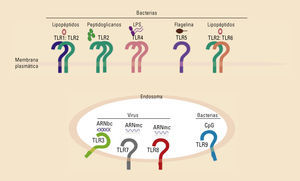
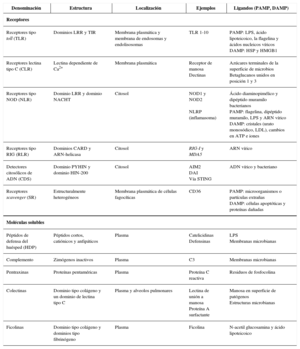
En el primer bloque analizamos los receptores que utiliza la inmunidad innata para identificar moléculas características de grupos de patógenos, así como de daño y estrés celular, que se denominan en su conjunto receptores de patrones moleculares.

Moléculas de la inmunidad innata

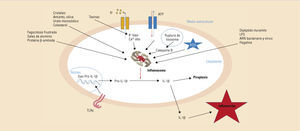
En el segundo bloque examinamos en profundidad las moléculas solubles que median la inmunidad innata. Estas moléculas actúan rápidamente contra patógenos extracelulares de tres maneras importantes: como opsoninas, como agentes líticos y como agentes proinflamatorios.

Palabras clave
Receptores de reconocimiento de patrones
Patrones moleculares asociados a patógenos
Patrones moleculares asociados a daño
Abstract
Overview

Innate or natural immunity is the first line of defense against microorganisms. The term “innate” refers to the sensors involved in the pathogen recognition are encoded by genes in germline suffering non-somatic rearrangement to generate variants

Components of the innate immunity

The weapons of the innate immune system include molecular and cellular defense mechanisms that exist before an infection takes place, allowing them to respond to it quickly. Sensors of the innate immunity are specific structures common to groups of related pathogens, however they cannot distinguish subtle differences between them.

Receptors of the innate immunity

The first block analyzes receptors used by the innate immunity to identify characteristic molecules of groups of pathogens, as well as damaged and stressed cells, named pattern recognition receptors.

Molecules of the innate immunity

The second block examines in depth the soluble molecules that mediate innate immunity. These molecules act quickly against extracellular pathogens in three important ways: as opsonins, lytic agents and as pro-inflammatory agents.

Keywords
Pattern recognition receptors
Pathogen-associated molecular patterns
Damage associated molecular patterns

Identifíquese

¿Aún no es suscriptor de la revista?
Comprar el acceso al artículo

Comprando el artículo el pdf del mismo podrá ser descargado

Teléfono para incidencias

De lunes a viernes de 9h a 18h (GMT+1) excepto los meses de julio y agosto que será de 9 a 15h
Llamadas desde España 932 415 960
Llamadas desde fuera de España +34 932 415 960
Bibliografía
[1]
201701080010489768
R. Medzhitov, C.A. Janeway Jr..
Decoding the patterns of self and nonself by the innate immune system.
Science, (2002), 296 pp. 298-300
[2]
201701080010489769
H. Kumar, T. Kawai, S. Akira.
Pathogen recognition by the innate immune system.
Int Rev Immunol, (2011), 30 pp. 16-34
[3]
2017010800104897610
C.A. Janeway Jr..
Approaching the asymptote?. Evolution and revolution in immunology.
Cold Spring Harb Symp Quant Biol., (1989), 54 pp. 1-13
[4]
2017010800104897611
2017010800104897612
S.W. Brubaker, K.S. Bonham, I. Zanoni, J.C. Kagan.
Innate immune pattern recognition: a cell biological perspective.
Annu Rev Immunol, (2015), 33
257-90
[5]
2017010800104897613
V. Deretic, T. Saitoh, S. Akira.
Autophagy in infection, inflammation and immunity.
Nat Rev Immunol., (2013), 13
722-37
[6]
M. Lamkanfi, V.M. Dixit.
Mechanisms and functions of inflammasomes.
[7]
2017010800104897614
2017010800104897615
P. Broz, D.M. Monack.
Newly described pattern recognition receptors team up against intracellular pathogens.
Nat Rev Immunol., (2013), 13
551-65
[8]
M.E. Bianchi.
DAMPs, PAMPs and alarmins: all we need to know about danger.
J Leukoc Biol., (2007), 81 pp. 1-5
[9]
F. Osorio, E. Reis, C. Sousa.
Myeloid C-type lectin receptors in pathogen recognition and host defence.
Immunity., (2011),
651-64
[10]
2017010800104897616
G.D. Brown.
Dectin-1: a signalling non-TLR pattern-recognition receptor.
Nat Rev Immunol., (2006), 6 pp. 33-43
[11]
E. Elinav, T. Trowig, J. Henao-Mejia, R.A. Flavell.
Regulation of the antimicrobial response by NLR proteins.
Immunity., (2011), 34
665-79
[12]
2017010800104897617
2017010800104897618
D.J. Philpott, M.T. Sorbara, S.J. Robertson, K. Croitoru, S.E. Girardin.
NOD proteins: regulators of inflammation in health and disease.
Nat Rev Immunol., (2014), 14 pp. 9-23
[13]
2017010800104897619
2017010800104897620
J. Tschopp, F. Martinon, K. Burns.
NALPs: a novel protein family involved in inflammation.
Nat Rev Mol Cell Biol., (2003), 4 pp. 95-104
[14]
M. Yoneyama, M. Kikuchi, K. Matsumoto, T. Imaizumi, M. Miyagishi, K. Taira, et al.
Shared and unique functions of the DExD/H-box helicases RIG-I, MDA5, and LGP2 in antiviral innate immunity.
J Immunol., (2005), 175
2851-8
[15]
L. Unterholzner.
The interferon response to intracellular DNA: why so many receptors?.
1312-21
[16]
2017010800104897621
2017010800104897622
J. Canton, D. Neculai, S. Grinstein.
Scavenger receptors in homeostasis and immunity.
Nat Rev Immunol., (2013), 13
621-34
[17]
2017010800104897623
2017010800104897624
R.E. Hancock, E.F. Haney, E.E. Gill.
The immunology of host defence peptides: beyond antimicrobial activity.
Nat Rev Immunol., (2016), 16
321-34
[18]
2017010800104897625
A. Nijnik, R.E.W. Hancock.
The roles of cathelicidin LL-37 in immune defences and novel clinical applications.
Curr Opin Hematol., (2009), 16
41-7
[19]
2017010800104897626
L. Hazlett, M. Wu.
Defensins in innate immunity.
Cell Tissue Res., (2011), 343
175-88
[20]
F. Semple, J.R. Dorin.
β-Defensins: multifunctional modulators of infection, inflammation and more?.
J Innate Immun., (2012), 4
337-48
[21]
J. Winter, A. Pantelis, R. Reich, M. Martini, D. Kraus, S. Jepsen, et al.
Human β-defensin-1, –2, and –3 exhibit opposite effects on oral squamous cell carcinoma cell proliferation.
Cancer Invest., (2011), 29 pp. 196-201
[22]
F. Lecaille, G. Lalmanach, P.M. Andrault.
Antimicrobial proteins and peptides in human lung diseases: a friend and foe partnership with host proteases.
Biochimie., (2016), 122
151-68
[23]
J.M. Kahlenberg, M.J. Kaplan.
Little peptide, big effects: the role of LL-37 in inflammation and autoimmune disease.
4895-901
[24]
2017010800104897627
2017010800104897628
V.M. Holers.
Complement and its receptors: new insights into human disease.
Annu Rev Immunol., (2014), 32
433-59
[25]
P.J. Lachmann, N.C. Hughes-Jones.
Initiation of complement activation.
Springer Semin Immunopathol., (1984), 7
143-62
[26]
H.J. Muller-Eberhard.
Molecular organization and function of the complement system.
Annu Rev Biochem., (1988), 57
321-47
[27]
K.B.M. Reid, M.W. Turner.
Mammalian lectins in activation and clearance mechanisms involving the complement system.
Springer Semin Immunopathol., (1994), 15
307-25
[28]
R.A. Wetsel.
Structure, function and cellular expression of complement anaphylatoxin receptors.
Curr Opin Immunol., (1995), 7 pp. 48-53
[29]
2017010800104897629
S.C. Christiaans, B.M. Wagener, C.T. Esmon, J.F. Pittet.
Protein C and acute inflammation: a clinical and biological perspective.
Am J Physiol Lung Cell Mol Physiol., (2013), 305
L455-66
[30]
2017010800104897630
2017010800104897631
B. Bottazzi, A. Inforzato, M. Messa, M. Barbagallo, E. Magrini, C. Garlanda, et al.
The pentraxins PTX3 and SAP in innate immunity, regulation of inflammation and tissue remodelling.
[31]
2017010800104897632
S.S. Foo, P.C. Reading, S. Jaillon, A. Mantovani, S. Mahalingam.
Pentraxins and collectins: friend or foe during pathogen invasion?.
Trends Microbiol, (2015), 23 pp. 799-811
[32]
2017010800104897633
Y. Endo, M. Matsushita, T. Fujita.
Role of ficolin in innate immunity and its molecular basis.
Immunobiology, (2007), 212
371-9
[33]
V.J. Laine, D.S. Grass, T.J. Nevalainen.
Protection by group II phospholipase A2 against Staphylococcus aureus.
J Immunol., (1999), 162
7402-8
[34]
K.S. Hoek, J.M. Milne, P.A. Grieve, D.A. Dionysius, R. Smith.
Antibacterial activity in bovine lactoferrin-derived peptides.
Antimicrob Agents Chemother, (1997), 41
54-9
[35]
H.A. McKenzie, F.H. White.
Lysozyme and alpha-lactalbumin: structure, function, and interrelationships.
Adv. Protein Chem., (1991), 41 pp. 173-315