

Vol. 13. Núm. 37.
Páginas 2134-2144 (Junio 2021)

Actualización
Tratamiento farmacológico del síndrome coronario crónico

Pharmacological treatment of chronic coronary syndrome

S. García RivasJ.M. Viéitez FlórezJ.M. MonteagudoJ.L. Zamorano Gómez
Doi : https://10.1016/j.med.2021.06.021
Opciones
Resumen

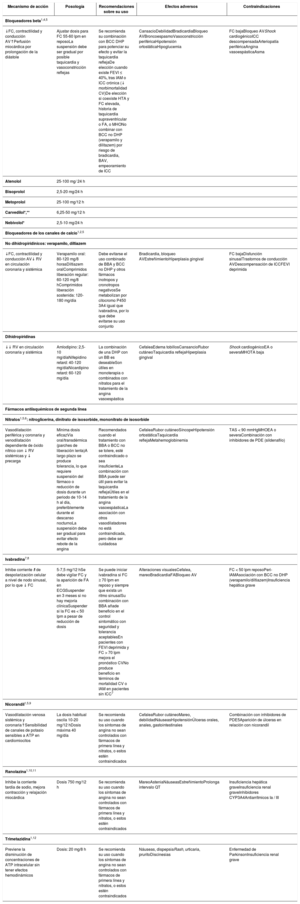
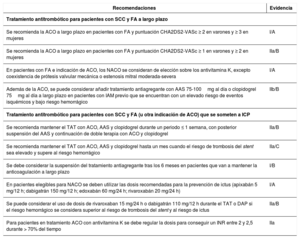
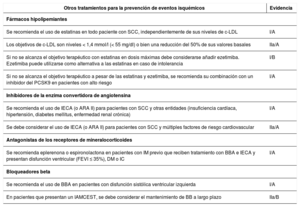
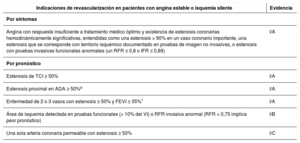
La estrategia farmacológica en pacientes con angina estable y síndrome coronario crónico tiene como objetivos principales el control de los síntomas y la prevención de eventos cardiovasculares. En la prevención de la angina a largo plazo, muchas veces es necesaria la asociación de fármacos antiisquémicos de primera y segunda línea, y la elección del tratamiento debe dirigirse de forma individualizada, teniendo en cuenta las comorbilidades del paciente y el mecanismo subyacente a la isquemia. El tratamiento antitrombótico constituye el pilar fundamental en la prevención de eventos, siendo necesaria una doble terapia antiagregante en determinados escenarios clínicos, especialmente en la prevención de trombosis del stent tras revascularización percutánea. El tratamiento hipolipemiante, así como otra serie de fármacos que se han asociado con un beneficio en la morbimortalidad cardiovascular, forman también parte de la estrategia terapéutica en estos pacientes. Por último, la revascularización percutánea o quirúrgica debe considerarse cuando persisten síntomas importantes, a pesar del tratamiento médico, y cuando se considera un beneficio pronóstico de la misma.

Palabras clave
Síndrome coronario crónico
Angina estable
Fármacos antiisquémicos
Antiagregantes
Hipolipemiantes
Revascularización
Abstract

The primary objectives of the pharmacological strategy in patients with stable angina and chronic coronary syndrome are to control symptoms and prevent cardiovascular events. In the long-term prevention of angina, it is often necessary to combine first- and second-line anti-ischaemic drugs and the choice of treatment should be tailored to the patient, taking comorbidities into account and the underlying mechanism of the ischaemia. Anti-thrombotic therapy is the mainstay to prevent events, and dual anti-platelet therapy is necessary in certain clinical scenarios, especially in the prevention of stent thrombosis after percutaneous revascularisation. Lipid-lowering therapy and other drugs associated with cardiovascular morbidity and mortality benefit also form part of the therapeutic strategy in these patients. Finally, percutaneous, or surgical revascularisation should be considered when significant symptoms persist, despite medical treatment, and when considered of prognostic benefit.

Keywords
Chronic coronary syndrome
Stable angina
Anti-ischaemic drugs
Anti-aggregants
Lipid-lowering drugs
Revascularisation

Identifíquese

¿Aún no es suscriptor de la revista?

Comprar el acceso al artículo

Comprando el artículo el pdf del mismo podrá ser descargado

Teléfono para incidencias

De lunes a viernes de 9h a 18h (GMT+1) excepto los meses de julio y agosto que será de 9 a 15h

Llamadas desde España 932 415 960
Llamadas desde fuera de España +34 932 415 960
Bibliografía
[1]
J. Knuuti
202106271406114768
202106271406114769
, W. Wijns, A. Saraste, D. Capodanno, E. Barbato, C. Funck-Brentano, et al.
2019 ESC Guidelines for the diagnosis and management of chronic coronary syndromes. The Task Force for the diagnosis and management of chronic coronary syndromes of the European Society of Cardiology (ESC).
Eur Heart J., (2020), 41 pp. 407-477
[2]
Stable
2021062714061147610
2021062714061147611
angina: management [Internet]. London: National Institute for Health and Care Excellence (UK); 2016 [cited 2020 Dec 8]. (National Institute for Health and Care Excellence: Clinical Guidelines). Disponible en: http://www.ncbi.nlm.nih.gov/books/NBK555181/.
[3]
U. Thadani
2021062714061147612
2021062714061147613
.
Management of stable angina - current guidelines: a critical appraisal.
Cardiovasc Drugs Ther., (2016), 30 pp. 419-426
[4]
J. López-Sendón
2021062714061147614
, K. Swedberg, J. McMurray, J. Tamargo, A.P. Maggioni, H. Dargie, et al.
Documento de consenso de expertos sobre bloqueadores de los receptores β-adrenérgicos.
Rev Esp Cardiol., (2005), 58 pp. 65-90
[5]
R. Ferrari
2021062714061147615
, P.G. Camici, F. Crea, N. Danchin, K. Fox, A.P. Maggioni, et al.
A “diamond” approach to personalized treatment of angina.
Nat Rev Cardiol., (2018), 15 pp. 120-132
[6]
E. López de Sá, Á. Estévez, J. Onaindía, R. Rubio, J. López-Sendón.
Papel de los nitratos en el tratamiento de la enfermedad cardiovascular.
Rev Esp Cardiol., (2006), 6 pp. 41A-50A
[7]
K. Fox, I. Ford, P.G. Steg, J.-C. Tardif, M. Tendera, R. Ferrari, et al.
Ivabradine in stable coronary artery disease without clinical heart failure.
N Engl J Med., (2014), 371 pp. 1091-1099
[8]
K. Fox
2021062714061147616
, I. Ford, P.G. Steg, M. Tendera, R. Ferrari.
BEAUTIFUL Investigators. Ivabradine for patients with stable coronary artery disease and left-ventricular systolic dysfunction (BEAUTIFUL): a randomised, double-blind, placebo-controlled trial.
[9]
J. Jiang
2021062714061147617
, Y. Li, Y. Zhou, X. Li, H. Li, B. Tang, et al.
Oral nicorandil reduces ischemic attacks in patients with stable angina: A prospective, multicenter, open-label, randomized, controlled study.
Int J Cardiol., (2016), 224 pp. 183-187
[10]
S.R. Wilson
2021062714061147618
, B.M. Scirica, E. Braunwald, S.A. Murphy, E. Karwatowska-Prokopczuk, J.L. Buros, et al.
Efficacy of ranolazine in patients with chronic angina: observations from the randomized, double-blind, placebo-controlled MERLIN–TIMI (Metabolic Efficiency With Ranolazine for Less Ischemia in Non–ST-Segment Elevation Acute Coronary Syndromes) 36 Trial.
J Am Coll Cardiol., (2009), 53 pp. 1510-1516
[11]
M. Kosiborod
2021062714061147619
, S.V. Arnold, J.A. Spertus, D.K. McGuire, Y. Li, P. Yue, et al.
Evaluation of ranolazine in patients with type 2 diabetes mellitus and chronic stable angina: results from the TERISA randomized clinical trial (Type 2 Diabetes Evaluation of Ranolazine in Subjects With Chronic Stable Angina).
J Am Coll Cardiol., (2013), 61 pp. 2038-2045
[12]
C.P. McCarthy, K.V. Mullins, D.M. Kerins.
The role of trimetazidine in cardiovascular disease: beyond an anti-anginal agent.
Eur Heart J Cardiovasc Pharmacother., (2016), 2 pp. 266-272
[13]
E. Vidal-Petiot, I. Ford, N. Greenlaw, R. Ferrari, K.M. Fox, J.-C. Tardif, et al.
Cardiovascular event rates and mortality according to achieved systolic and diastolic blood pressure in patients with stable coronary artery disease: an international cohort study.
Lancet, (2016), 388 pp. 2142-2152
[14]
M.R. Law
2021062714061147620
, J.K. Morris, N.J. Wald.
Use of blood pressure lowering drugs in the prevention of cardiovascular disease: meta-analysis of 147 randomised trials in the context of expectations from prospective epidemiological studies.
BMJ., (2009), 338 pp. b1665
[15]
K. Swedberg
2021062714061147621
, M. Komajda, M. Böhm, J.S. Borer, I. Ford, A. Dubost-Brama, et al.
Ivabradine and outcomes in chronic heart failure (SHIFT): a randomised placebo-controlled study.
Lancet., (2010), 376 pp. 875-885
[16]
P. Ponikowski
2021062714061147622
2021062714061147623
, A.A. Voors, S.D. Anker, H. Bueno, J.G.F. Cleland, A.J.S. Coats, et al.
2016 ESC Guidelines for the diagnosis and treatment of acute and chronic heart failure: The Task Force for the diagnosis and treatment of acute and chronic heart failure of the European Society of Cardiology (ESC). Developed with the special contribution of the Heart Failure Association (HFA) of the ESC.
Eur J Heart Fail., (2016), 18 pp. 891-975
[17]
B.M. Scirica
2021062714061147624
, D.A. Morrow, H. Hod, S.A. Murphy, L. Belardinelli, C.M. Hedgepeth, et al.
Effect of ranolazine, an antianginal agent with novel electrophysiological properties, on the incidence of arrhythmias in patients with non ST-segment elevation acute coronary syndrome: results from the Metabolic Efficiency With Ranolazine for Less Ischemia in Non ST-Elevation Acute Coronary Syndrome Thrombolysis in Myocardial Infarction 36 (MERLIN-TIMI 36) randomized controlled trial.
Circulation., (2007), 116 pp. 1647-1652
[18]
N. Danchin
2021062714061147625
, M. Marzilli, A. Parkhomenko, J.P. Ribeiro.
Efficacy comparison of trimetazidine with therapeutic alternatives in stable angina pectoris: a network meta-analysis.
Cardiology., (2011), 120 pp. 59-72
[19]
Antithrombotic
2021062714061147626
Trialists’ Collaboration.
Collaborative meta-analysis of randomised trials of antiplatelet therapy for prevention of death, myocardial infarction, and stroke in high risk patients.
[20]
C. Patrono
2021062714061147627
, F. Bachmann, C. Baigent, C. Bode, R. De Caterina, B. Charbonnier, et al.
Expert consensus document on the use of antiplatelet agents.
Rev Esp Cardiol., (2004), 57 pp. 963-980
[21]
A randomised
2021062714061147628
, blinded, trial of clopidogrel versus aspirin in patients at risk of ischaemic events (CAPRIE). Lancet. 1996;348(9038):1329-39.
[22]
S. Schüpke
2021062714061147629
, F.-J. Neumann, M. Menichelli, K. Mayer, I. Bernlochner, J. Wöhrle, et al.
Ticagrelor or prasugrel in patients with acute coronary syndromes.
N Engl J Med., (2019), 381 pp. 1524-1534
[23]
M. Valgimigli
2021062714061147630
2021062714061147631
, H. Bueno, R.A. Byrne, J.P. Collet, F. Costa, A. Jeppsson, et al.
ESC Scientific Document Group; ESC Committee for Practice Guidelines (CPG); ESC National Cardiac Societies. 2017 ESC focused update on dual antiplatelet therapy in coronary artery disease developed in collaboration with EACTS: The Task Force for dual antiplatelet therapy in coronary artery disease of the European Society of Cardiology (ESC) and of the European Association for Cardio-Thoracic Surgery (EACTS).
Eur Heart J., (2018), 39 pp. 213-260
[24]
T. Palmerini
2021062714061147632
, U. Benedetto, L. Bacchi-Reggiani, D.D. Riva, G. Biondi-Zoccai, F. Feres, et al.
Mortality in patients treated with extended duration dual antiplatelet therapy after drug-eluting stent implantation: a pairwise and Bayesian network meta-analysis of randomised trials.
Lancet, (2015), 385 pp. 2371-2382
[25]
R.W. Yeh
2021062714061147633
, D.J. Kereiakes, P.G. Steg, S. Windecker, M.J. Rinaldi, A.H. Gershlick, et al.
Benefits and risks of extended duration dual antiplatelet therapy after PCI in patients with and without acute myocardial infarction.
J Am Coll Cardiol., (2015), 65 pp. 2211-2221
[26]
J.-P. Collet
2021062714061147634
2021062714061147635
, H. Thiele, E. Barbato, O. Barth élémy, J. Bauersachs, D.L. Bhatt, et al.
2020 ESC Guidelines for the management of acute coronary syndromes in patients presenting without persistent ST-segment elevation.
Eur Heart J., (2021), 42 pp. 1289-1367
[27]
F. Mach
2021062714061147636
2021062714061147637
, C. Baigent, A.L. Catapano, K.C. Koskinas, M. Casula, L. Badimon, et al.
2019 ESC/EAS Guidelines for the management of dyslipidaemias: lipid modification to reduce cardiovascular risk.
Eur Heart J., (2020), 41 pp. 111-188
[28]
R.P. Giugliano
2021062714061147638
, C.P. Cannon, M.A. Blazing, J.C. Nicolau, R. Corbal án, J. Špinar, et al.
Benefit of adding ezetimibe to statin therapy on cardiovascular outcomes and safety in patients with versus without diabetes mellitus: results from IMPROVE-IT (Improved Reduction of Outcomes: Vytorin Efficacy International Trial).
Circulation, (2018), 137 pp. 1571-1582
[29]
F.-J. Neumann
2021062714061147639
2021062714061147640
, M. Sousa-Uva, A. Ahlsson, F. Alfonso, A.P. Banning, U. Benedetto, et al.
2018 ESC/EACTS Guidelines on myocardial revascularization.
Eur Heart J., (2019 07), 40 pp. 87-165
[30]
D.J. Maron
2021062714061147641
, J.S. Hochman, H.R. Reynolds, S. Bangalore, S.M. O’Brien, W.E. Boden, et al.
Initial invasive or conservative strategy for stable coronary disease.
New Engl J Med., (2020), 382 pp. 1395-1407