

Vol. 12. Núm. 11.
Páginas 617-626 (Mayo 2016)

Actualización
Ascitis, insuficiencia renal aguda y encefalopatía hepática

Ascites, acute renal failure and hepatic encephalopathy

R. García-Martínez
Doi : https://10.1016/j.med.2016.05.012
Opciones
Resumen
Ascitis

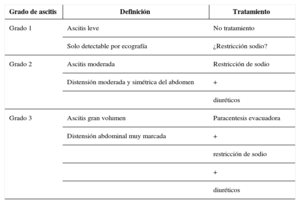
Es la complicación de la cirrosis más frecuente tras el hepatocarcinoma. El tratamiento de la ascitis no complicada se centra en incrementar la excreción renal de sodio con diuréticos. La ascitis refractaria requiere de paracentesis evacuadoras periódicas con reposición de albúmina. La derivación portosistémica percutánea intrahepática puede ser adecuada en casos bien seleccionados.

Síndrome hepatorrenal

El diagnóstico del síndrome hepatorrenal ha sido recientemente revisado, eliminándose los puntos de corte previamente establecidos. Esto favorece que los pacientes sean tratados de manera más precoz.

Encefalopatía hepática

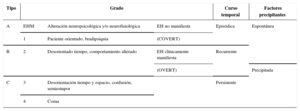
Es un síndrome neuropsiquátrico que aparece en pacientes con alteraciones hepáticas muy diversas. Su diagnóstico se basa en manifestaciones clínicas sugestivas, la demostración de enfermedad hepática subyacente y la exclusión de otras causas. Su manejo requiere la búsqueda sistemática y la corrección de factores precipitantes y el uso de medidas hipoamoniémicas, siendo los disacáridos no absorbibles los fármacos de elección.

Trasplante hepático

Estas complicaciones de la cirrosis tienen mal pronóstico, por lo que los pacientes deben ser considerados para trasplante hepático.

Palabras clave
Cirrosis
Ascitis
Síndrome hepatorrenal
Encefalopatía hepática
Abstract
Ascites

Ascites is the most common complication of cirrhosis after hepatocarcinoma. The treatment of uncomplicated ascites focuses on increasing the renal excretion of sodium with diuretics. Refractory ascites requires periodic evacuative paracentesis with albumin replenishment. Percutaneous intrahepatic portosystemic shunts can be appropriate in properly selected cases.

Hepatorenal syndrome

The diagnosis of hepatorenal syndrome has been recently reviewed, eliminating the previously established cut-off points, which helps treat patients earlier.

Hepatic encephalopathy

Hepatic encephalopathy is a neuropsychiatric syndrome that occurs in patients with highly diverse hepatic disorders. Its diagnosis is based on suggestive clinical manifestations, the demonstration of underlying liver disease and the ruling out of other causes. Its management requires the systematic search and correction of triggers and the use of hypoammonaemic measures, with nonabsorbable disaccharides the drugs of choice.

Liver transplantation

Patients with these complications of cirrhosis have a poor prognosis and should therefore be considered for liver transplantation.

Keywords
Cirrhosis
Ascites
Hepatorenal syndrome
Hepatic encephalopathy

Identifíquese

¿Aún no es suscriptor de la revista?

Comprar el acceso al artículo

Comprando el artículo el pdf del mismo podrá ser descargado

Teléfono para incidencias

De lunes a viernes de 9h a 18h (GMT+1) excepto los meses de julio y agosto que será de 9 a 15h

Llamadas desde España 932 415 960
Llamadas desde fuera de España +34 932 415 960
Bibliografía
[1]
C. Ripoll, R. Groszmann, G. García-Tsao, N. Grace, A. Burroughs, R. Planas, et al.
Hepatic venous pressure gradient predicts clinical decompensation in patients with compensated cirrhosis.
Gastroenterology, (2007), 133 pp. 481-488
[2]
P. Gines, E. Quintero, V. Arroyo, J. Terés, M. Bruguera, A. Rimola, et al.
Compensated cirrhosis: natural history and prognostic factors.
Hepatology, (1987), 7 pp. 12228
[3]
P. Gines, A. Cardenas, V. Arroyo, J. Rodes.
Management of cirrhosis and ascites.
N Engl J Med, (2004), 350 pp. 1646-1654
[4]
B.A. Runyon.
Management of adult patients with ascites due to cirrhosis: an update.
Hepatology, (2009), 49 pp. 2087-2107
[5]
J.
201605270040141338
Fernández, M. Navasa, R. Planas, S. Montoliu, D. Monfort, G. Soriano, et al.
Primary prophylaxis of spontaneous bacterial peritonitis delays hepatorenal syndrome and improves survival in cirrhosis.
Gastroenterology, (2007), 133 pp. 818-824
[6]
201605270040141339
EASL clinical practice guidelines on the management of ascites, spontaneous bacterial peritonitis, and hepatorenal syndrome in cirrhosis. J Hepatol. 2010;53(3):397-417.
[7]
R. García-Martínez, P. Caraceni, M. Bernardi, P. Gines, V. Arroyo, R. Jalan.
Albumin: pathophysiologic basis of its role in the treatment of cirrhosis and its complications.
Hepatology, (2013), 58 pp. 1836-1846
[8]
O. Riggio, S. Angeloni, F.M. Salvatori, A. De Santis, F. Cerini, A. Farcomeni, et al.
Incidence, natural history, and risk factors of hepatic encephalopathy after transjugular intrahepatic portosystemic shunt with polytetrafluoroethylene-covered stent grafts.
Am J Gastroenterol, (2008), 103 pp. 2738-2746
[9]
T.D.
2016052700401413310
Boyer, Z.J. Haskal.
The role of transjugular intrahepatic portosystemic shunt (tips) in the management of portal hypertension: update 2009.
Hepatology, (2010), 51 pp. 306
[10]
E. Sola, H. Watson, I. Graupera, F. Turón, R. Barreto, E. Rodríguez, et al.
Factors related to quality of life in patients with cirrhosis and ascites: relevance of serum sodium concentration and leg edema.
J Hepatol, (2012), 57 pp. 1199-1206
[11]
P.
2016052700401413311
Angeli, P. Gines, F. Wong, M. Bernardi, T.D. Boyer, A. Gerbes, et al.
Diagnosis and management of acute kidney injury in patients with cirrhosis: revised consensus recommendations of the International Club of Ascites.
J Hepatol, (2015), 62 pp. 968-974
[12]
R. Moreau, D. Lebrec.
The use of vasoconstrictors in patients with cirrhosis: type 1 HRS and beyond.
Hepatology, (2006), 43 pp. 385-394
[13]
H.
2016052700401413312
2016052700401413313
Vilstrup, P. Amodio, J. Bajaj, J. Cordoba, P. Ferenci, K.D. Mullen, et al.
Hepatic encephalopathy in chronic liver disease: 2014 Practice Guideline by the American Association for the Study of Liver Diseases and the European Association for the Study of the Liver.
Hepatology, (2014), 60 pp. 715-735
[14]
J. Cordoba, R. García-Martinez.
Hepatic encephalopathy and alterations of cerebral function. Clinical Gastroenterology: Chronic Liver Failure.
Springer Science+Business Media, (2011), pp. 171-187
[15]
J. Cordoba, B. Minguez.
Hepatic encephalopathy.
Semin Liver Dis, (2008), 28 pp. 70-80
[16]
S.W. Olde Damink, R. Jalan, N.E. Deutz, D.N. Redhead, C.H. Dejong, P. Hynd, et al.
The kidney plays a major role in the hyperammonemia seen after simulated or actual GI bleeding in patients with cirrhosis.
Hepatology, (2003), 37 pp. 1277-1285
[17]
D.L. Shawcross, N.A. Davies, R. Williams, R. Jalan.
Systemic inflammatory response exacerbates the neuropsychological effects of induced hyperammonemia in cirrhosis.
J Hepatol, (2004), 40 pp. 247-254
[18]
J. Cordoba, M. Ventura-Cots, M. Simon-Talero, À. Amorós, M. Pavesi, H. Vilstrup, et al.
Characteristics, risk factors, and mortality of cirrhotic patients hospitalized for hepatic encephalopathy with and without acute-on-chronic liver failure (ACLF).
J Hepatol, (2014), 60 pp. 275-281
[19]
P.
2016052700401413314
Amodio, C. Bemeur, R. Butterworth, J. Cordoba, A. Kato, S. Montagnese, et al.
The nutritional management of hepatic encephalopathy in patients with cirrhosis: International Society for Hepatic Encephalopathy and Nitrogen Metabolism Consensus.
Hepatology, (2013), 58 pp. 325-336
[20]
N.M. Bass, K.D. Mullen, A. Sanyal, F. Poordad, G. Neff, C.B. Leevy, et al.
Rifaximin treatment in hepatic encephalopathy.
N Engl J Med, (2010), 362 pp. 1071-1081
[21]
W.
2016052700401413315
Laleman, M. Simon-Talero, G. Maleux, M. Pérez, K. Ameloot, G. Soriano, et al.
Embolization of large spontaneous portosystemic shunts for refractory hepatic encephalopathy: a multicenter survey on safety and efficacy.
Hepatology, (2013), 57 pp. 2448-2457