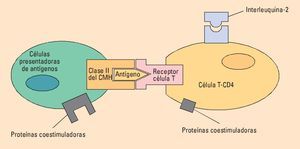
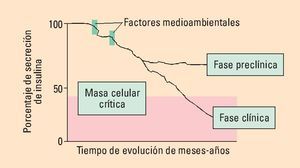
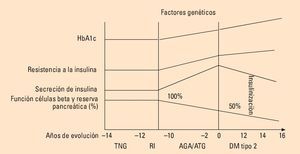

La diabetes mellitus es un conjunto heterogéneo de síndromes que cursan con hiperglucemia como resultado de un defecto en la secreción y/o acción de la insulina. Su diagnóstico se basa en la presencia de una de las tres anomalías siguientes: alteración de la glucosa plasmática en ayunas, elevación ocasional de la glucemia siempre que se acompañe de síntomas cardinales y alteraciones a las dos horas en el test de sobrecarga oral de glucosa. En la patogenia de ambos tipos de diabetes intervienen factores genéticos y ambientales, pero mientras que en la tipo 1 la causante de la enfermedad es una reacción autoinmune contra el páncreas, en la tipo 2 es la resistencia a la insulina, su secreción alterada en respuesta al estímulo de la glucosa y la producción aumentada de glucosa endógena lo que da lugar a la enfermedad. Sus formas de presentación son variables haciéndolo por lo general la tipo 1 de forma más brusca que la tipo 2, que puede permanecer silente durante años. Como prevención primaria de la tipo 2 es fundamental el seguimiento de pacientes con prediabetes o con síndrome metabólico.
Identifíquese
¿Aún no es suscriptor de la revista?
Comprar el acceso al artículo
Comprando el artículo el pdf del mismo podrá ser descargado
Teléfono para incidencias
De lunes a viernes de 9h a 18h (GMT+1) excepto los meses de julio y agosto que será de 9 a 15h
Llamadas desde España
932 415 960
Llamadas desde fuera de España
+34 932 415 960
Bibliografía
[1]
UK Prospective Diabetes Study 6..
Complications in newly diagnosed type 2 diabetic patients and their association with different clinical and biochemical risk factors..
Diabetes Res, (1990), 13 pp. 1-11
[2]
The World Health Report: life in the 21st century, a vision for all. Geneva: OMS; 1998.
[3]
The World Health Report: Conquering suffering, enriching humanity. Geneva: OMS; 1997.
[4]
Diagnosis and Classification of Diabetes Mellitus. Diabetes Care. 2008;31 Suppl 1:S55-60.
[5]
Report of the Expert Committee on the Diagnosis and Classification of Diabetes Mellitus..
Diabetes Care, (2003), 26 pp. S5-20
[6]
The Expert Committee on the Diagnosis and Classification of Diabetes Mellitus..
Follow up Report on the Diagnosis of Diabetes Mellitus..
Diabetes Care, (2003), 26 pp. 3160-7
[7]
Standards of Medical Care in Diabetes-2008. Diabetes Care. 2008;31 Suppl 1:12-54.
[8]
American Diabetes Association: Type 2 diabetes in children and adolescents..
Consensus Statement..
Diabetes Care, (2000), 23 pp. 381-9
[9]
Serrano M, Godoy A, Martínez T..
Migrant population and the incidence of type 1 diabetes mellitus: an overview of the literatura with a focus on Spanish-heritage countries in Latin America..
Diabetes Metab Res Rev, (1999), 15 pp. 113-32
[10]
Diabetes mellitus. Concepto, clasificación y mecanismos etiopatogénicos. Medicine. 2004;9 (16):963-70.
[11]
Diabetes mellitus en la edad pediátrica: diabetes tipo 1, diabetes tipo 2 y MODY. Endocrinol Nutr. 2004;51 Supl 2:31-7.
[12]
Todd JA, Walker NM, Cooper JD, Smyth DJ, Downes K, Plagnol V, et al..
Robust associations of four new chromosome regions from genome-wide analyses of type 1 diabetes..
Nat Genet, (2007), 39 pp. 857-64
[13]
Rowe RE, Leech NJ, Nepom GT, McCulloch DK..
High genetic risk for IDDM in the Pacific Northwest: first report from the Washington States Diabetes Prediction Study..
Diabetes, (1994), 43 pp. 87-94
[14]
Barker JM, Barriga KJ, Yu L, Miao D, Erlich HA, Norris JM, et al; Diabetes Autoimmunity Study in the Young..
Prediction of autoantibody positivity and progression to type 1 diabetes. Diabetes Autoimmunity Study in the Young (DAISY)..
J Clin Endocrinol Metab, (2004), 89 pp. 3896-902
[15]
Baschal EE, Aly TA, Babu SR, Fernando MS, Yu L, Miao D, et al..
HLA-DPB1*0402 protects against type 1A diabetes autoimmunity in the highest risk DR3-DQB1*0201/DR4-DQB1*0302 DAISY population..
Diabetes, (2007), 56 pp. 2405-9
[16]
Smyth D, Cooper JD, Collins JE, Heward JM, Franklyn JA, Howson JM, et al..
Replication of an association between the lymphoid tyrosine phosphatase locus (LYP/PTPN22) with type 1 diabetes, and evidence for its role as a general autoimmunity locus..
Diabetes, (2007), 56 pp. 2405-9
[17]
Martin S, Wolf-Eichbaum D, Duinkerken G, Scherbaum WA, Kolb H, Noordzij JG, et al..
Development of type 1 diabetes despite severe hereditary B-lymphocyte deficiency..
N Engl J Med, (2001), 345 pp. 1036-40
[18]
A role of the TRAIL-TRAIL receptor system in the pathogenesis of diabetes. Acta Biomed. 2007;78 Suppl 1:262-7.
[19]
Dahlquist GG, Patterson C, Soltesz G..
Perinatal risk factors for childhood type 1 diabetes in Europe. The EURODIAB Substudy 2 Study Group..
Diabetes Care, (1999), 22 pp. 1698-702
[20]
Cainelli F, Manzaroli D, Renzini C, Casali F, Concia E, Vento S..
Coxsackie B virus-induced autoimmunity to GAD does not lead to type 1 diabetes..
Diabetes Care, (2000), 23 pp. 1021-2
[21]
Like AA, Guberski DL, Butler L..
Influence of environmental viral agents of frequency and tempo of diabetes mellitus in BB/Wor rats..
Diabetes, (1991), 40 pp. 259-62
[22]
VVirtanen SM, Saukkonen T, Savilahti E, Ylönen K, Räsänen L, Aro A, et al..
Diet, cow's milk protein antibodies and the risk of IDDM in Finnish children. Childhood Diabetes in Finland Study Group..
Diabetologia, (1994), 37 pp. 381-7
[23]
Elliott RB, Harris DP, Hill JP, et al..
Type I (insulin-dependent) diabetes mellitus and cow milk: casein variant consumption..
Diabetologia, (1999), 42 pp. 292-6
[24]
Norris JM, Barriga K, Hoffenberg EJ, Taki I, Miao D, Haas JE, et al..
Risk of celiac disease autoimmunity and timing of gluten introduction in the diet of infants at increased risk of disease..
JAMA, (2005), 293 pp. 2343-51
[25]
Parslow RC, McKinney PA, Law GR, Staines A, Williams R, Bodansky HJ..
Incidence of childhood diabetes mellitus in Yorkshire, northern England, is associated with nitrate in drinking water:an ecological analysis.Diabetologia, (1997), 40 pp. 550-6
[26]
Diabetes mellitus tipo 1. Historia natural y manifestaciones clínicas. Medicine. 2004;(16):971-80.
[27]
Alba A, Verdaguer J, Vives-Pi M..
Diabetes mellitus tipo 1: autoinmunidad frente a la célula beta..
Endocrinol Nutr, (2004), 51 pp. 121-5
[28]
Impaired glucose tolerance as a disorder of insulin action. Longitudinal and cross-sectional studies in Pima Indians. N Engl J Med. 1988;318(19):1217-25.
[29]
Stern MP, Williams K, González-Villalpando C, Hunt KJ, Haffner SM..
diabetes and/or cardiovascular disease? Diabetes Care, (2004), 11 pp. 2676-81
[30]
Artola Menéndez S, González Sarmiento E, Sánchez-Ledesma M, Sánchez Rodríguez A..
Fisiopatología y patogenia del síndrome metabólico. Documento de consenso sobre el síndrome metabólico de la Sociedad Española de Medicina Interna y de la Sociedad Española de Medicina de Familia y Comunitaria..
Med Clin Monogr (Barc), (2006), 7 pp. 13-22
[31]
The importance of the beta-cell in the pathogenesis of type 2 diabetes mellitus. Am J Med. 2000;108 Suppl 6a:2S-8S.
[32]
Weyer C, Bogardus C, Mott DM, Pratley RE..
The natural history of insulin secretory dysfunction and insulin resistance in the pathogenesis of type 2 diabetes mellitus..
J Clin Invest, (1999), 104 pp. 787-94
[33]
Poitout V, Robertson RP..
Glucolipotoxicity: fuel excess and beta-cell dysfunction..
Endocr Rev, (2008), 29 pp. 351-66
[34]
Standars of medical care in diabetes. Diabetes Care. 2005; 28 Suppl 1:S4-S36.
[35]
Stumvoll M, Goldstein BJ, Haeften TW..
Type 2 diabetes: principles of pathogenesis and therapy..
Lancet, (2005), 365 pp. 1333-46
[36]
Froguel P, Zouali H, Vionnet N, Velho G, Vaxillaire M, Sun F, et al..
Familial hyperglycaemia due to mutations in glucokinase: definition of a new subtype of non-insulin-dependent (type 2) diabetes..
N Engl J Med, (1993), 328 pp. 697-702
[37]
Martínez Calatrava MJ, Martínez Larrad MT, Serrano Ríos M..
Síndrome de resistencia insulínica y síndrome metabólico: similitudes y diferencias. Síndrome metabólico: concepto, fisiopatología y epidemiología..
Cardiovascular RBK Factores, (2003), 12 pp. 89-95
[38]
Taylor SI, Cama A, Accili D, Barbetti F, Quon MJ, Sierra ML, et al..
Mutations in the insulin receptor gene..
Endocr Rev, (1992), 13 pp. 566-95
[39]
Zierath JR, Krook A, Wallberg-Henriksson H..
Insulin action and insulin resistance in human skeletal muscle..
Diabetologia, (2000), 43 pp. 821-35
[40]
Eizirik DL, Cardozo AK, Cnop M..
The role for endoplasmic reticulum stress in diabetes mellitus..
Endocr Rev, (2008), 29 pp. 42-61
[41]
Velho G, Froguel P, Clement K, Pueyo ME, Rakotoambinina B, Zouali H, et al..
Primary pancreatic beta-cell secretory defect caused by mutations in glucokinase gene in kindreds of maturity onset diabetes of the young..
Lancet, (1992), 340 pp. 444-8
[42]
The epidemiology of non-insulin dependent diabetes-non obese and obese. En: Alberti KGMM, DeFronzo R, Keen H, Zimmet P, editors. International Textbook of Diabetes Mellitus. London: Wiley; 1992. p. 147-76.
[43]
Bell GI, Xiang KS, Newman MV, Wu S-H, Wright LG, Fajans SS, et al..
Gene for noninsulin-dependent diabetes mellitus (maturity-onset diabetes of the young subtype) is linked to DNA polymorphism on human chromosome 20q..
Proc Natl Acad Sci USA, (1991), 88 pp. 1484-8
[44]
Mutations in the hepatocyte nuclear factor-1alpha gene in maturity-onset diabetes of the young (MODY3). Nature. 1996 5;384(6608):455-8.
[45]
Mutations in the hepatocyte nuclear factor-4alpha gene in maturity-onset diabetes of the young (MODY1). Nature. 1996; 384(6608):458-60.
[46]
Frayling TM, Bulamn MP, Ellard S, Appleton M, Dronsfield MJ, Mackie AD, et al..
Mutations in the hepatocyte nuclear factor-1alpha gene are a common cause of maturity-onset diabetes of the young in the U.K..
Diabetes, (1997), 46 pp. 720-5
[47]
Genetics of type 2 diabetes mellitus. Diabetes Res Clin Pract. 2005;68 Suppl 1:S10-21.
[48]
Harding AH, Williams DE, Hennings SH, Mitchell J, Wareham NJ..
Is the Association between dietary fat intake and insulin resistance modified by physical activity? Metabolism, (2001), 50 pp. 1186-92
[49]
Salmeron J, Hu FB, Manson JE..
Dietary fat intake and risk of type 2 diabetes in women..
Am J Clin Nutr, (2001), 73 pp. 1019-27
[50]
Prevention of Type 2 diabetes: fact or fiction? Expert Opin Pharmacother. 2007;8(18):3147-58.
[51]
Yates T, Khunti K, Bull F, Gorely T, Davies MJ..
The role of physical activity in the management of impaired glucose tolerance: a systematic review..
Diabetologia, (2007), 50 pp. 1116-26
[52]
Expert Committee on the Diagnosis and Classification of Diabetes Mellitus..
Report of the Expert Committee on the Diagnosis and Classification of Diabetes Mellitus..
Diabetes Care, (1997), 20 pp. 1183-97
[53]
Standards of Medical Care in Diabetes-2007..
American Diabetes Association..
Diabetes Care, (2007), 30 pp. S4-S41