

Vol. 14. Núm. 16.
Páginas 923-932 (Septiembre 2024)

Actualización
Eje hipotálamo-hipofisario. Regulación neurohormonal, implicaciones patológicas, pruebas funcionales hipofisarias, indicaciones e interpretación

Hypothalamic-pituitary axis. Neurohormonal regulation; pathologic implications; pituitary function tests, indications, and interpretation

A. Galdón Sanz-PastorM. Gómez-GordoA. López GuerraO. González-Albarrán
Doi : https://10.1016/j.med.2024.08.010
Opciones
Resumen

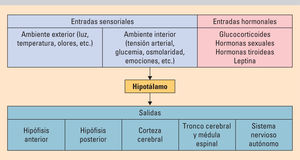
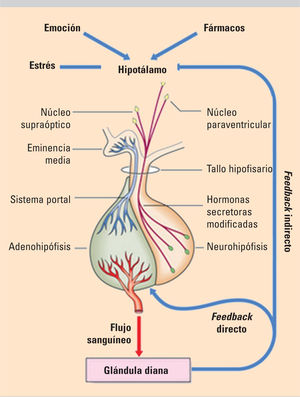
El eje hipotálamo-hipofisario es un sistema crucial para mantener la homeostasis al integrar entradas y salidas hormonales y neuronales. Casi todas las funciones corporales están reguladas directa o indirectamente por este eje. El hipotálamo, una región cerebral pequeña pero vital, monitoriza diversas entradas y mantiene los puntos de ajuste fisiológicos mediante la secreción hormonal, coordinándose con la glándula hipofisaria. Esta regulación implica múltiples mecanismos de retroalimentación e interacciones con otras áreas cerebrales.

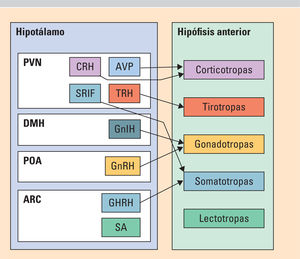
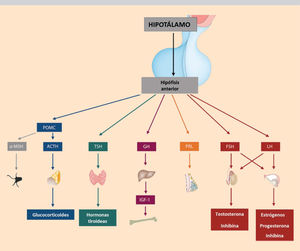
El hipotálamo está anatómicamente dividido en varias regiones y núcleos, cada uno con funciones específicas. Produce diversas hormonas, como la hormona liberadora de la hormona del crecimiento, la hormona liberadora de corticotropina, la hormona liberadora de tirotropina y la hormona liberadora de gonadotropina. Estas hormonas regulan la secreción de las hormonas correspondientes de la glándula hipofisaria anterior, que controlan varios procesos fisiológicos, incluidos el crecimiento, el metabolismo, la reproducción y la respuesta al estrés.

Las implicaciones patológicas de las disfunciones del eje hipotálamo-hipofisario incluyen trastornos endocrinos como la hiperprolactinemia, la deficiencia de hormona del crecimiento y el hipogonadismo. Además, el daño hipotalámico puede llevar a problemas neurológicos y conductuales como alteraciones del sueño y la termorregulación.

Palabras clave
Eje hipotálamo-hipofisario
Homeostasis
Hipotálamo
Abstract

The hypothalamic-pituitary axis is a crucial system for maintaining homeostasis by integrating hormonal and neuronal inputs and outputs. Almost all bodily functions are regulated directly or indirectly by this axis. The hypothalamus, a small but vital brain region, monitors various inputs and maintains physiological set points through hormonal secretion, coordinating with the pituitary gland. This regulation involves multiple feedback mechanisms and interactions with other brain areas.

The hypothalamus is anatomically divided into several regions and nuclei, each with specific functions. It produces a variety of hormones, including growth hormone-releasing hormone, corticotropin-releasing hormone, thyrotropin-releasing hormone, and gonadotropin-releasing hormone. These hormones regulate the secretion of corresponding hormones from the anterior pituitary gland, which control several physiological processes, including growth, metabolism, reproduction, and stress response.

Pathological implications of hypothalamic-pituitary axis dysfunctions include endocrine disorders such as hyperprolactinemia, growth hormone deficiency, and hypogonadism. In addition, hypothalamic damage can lead to neurological and behavioral problems such as sleep disturbances and thermoregulation.

Keywords
Hypothalamic-pituitary axis
Homeostasis
Hypothalamus

Identifíquese

¿Aún no es suscriptor de la revista?
Comprar el acceso al artículo

Comprando el artículo el pdf del mismo podrá ser descargado

Teléfono para incidencias

De lunes a viernes de 9h a 18h (GMT+1) excepto los meses de julio y agosto que será de 9 a 15h
Llamadas desde España 932 415 960
Llamadas desde fuera de España +34 932 415 960
Bibliografía
[1]
L.J. Rohrbasser fx1 fx4, H. Alsaffar, J. Blair.
The hypothalamus–pituitary axis.
Principles of endocrinology and hormone action [Internet], Springer International Publishing, pp. 1-35
[2]
G. Álvarez-Bolado fx1 fx4, V. Grinevich, L. Puelles.
Development of the hypothalamus.
Front Neuroanat., (2015), 9 pp. 83
[3]
I.J. Clarke fx1 fx4.
Hypothalamus as an endocrine organ.
Compr Physiol., (2015), 5 pp. 217-253
[4]
A. Caix fx1 fx6.
Síndromes hipotalámicos de repercusión endocrinológica. En: Manual Sociedad Española de Endocrinología y Nutrición.
SEEN, (2019),
[5]
Melmed fx2 S. Williams.
Tratado de endocrinología.
14ª ed, Elsevier, (2021),
[6]
Kumar fx1 fx4 A, Kulandhasamy M, Kumari C, Sharma V, Sesham K, Mochan S. Endocrine system [Internet]. Clinical Gate. 2015 [Consultado 23 Feb 2024]. Disponible en: https://clinicalgate.com/system-15/.
[7]
C. Fajardo fx2 fx6, E. Mollá, P. Riesgo.
Diagnóstico por imagen en la hipófisis. En: Manual Sociedad Española de Endocrinología y Nutrición.
SEEN, (2019),
[8]
U. Feldt-Rasmussen fx1 fx4, G. Effraimidis, M. Klose.
The hypothalamus-pituitary-thyroid (HPT)-axis and its role in physiology and pathophysiology of other hypothalamus-pituitary functions.
Mol Cell Endocrinol., (2021), 525 pp. 111173
[9]
S.L. Asa fx1 fx4, O. Mete.
What's new in pituitary pathology?.
Histopathology., (2018), 72 pp. 133-141
[10]
S. Santos fx1 fx6, E. Santos, S. Gaztambide, J. Salvador.
Diagnóstico y diagnóstico diferencial del síndrome de Cushing.
Endocrinol Nutri., (2009), 56 pp. 71-84
[11]
A. Abad fx1 fx6, J. Aller, L. Armengod.
Síndrome de Cushing. En: Manual de Endocrinología y Nutrición.
SEEN, (2019),
[12]
P.de Miguel Novoa fx2 fx6, E. Torres Vela, N. Palacios García, M. Moreira Rodríguez, I. Solache Guerras, M.A. Martínez de Salinas Santamaría, et al.
Guía para el diagnóstico y tratamiento de la insuficiencia suprarrenal en el adulto.
Endocrinol Nutr Ed Impr., (2014), pp. 1-35
[13]
S. Samarasinghe fx2 fx4, F. Meah, V. Singh, A. Basit, N. Emanuele, M.A. Emanuele, et al.
Biotin interference with routine clinical immunoassays: Understand the causes and mitigate the risks.
Endocr Pract., (2017), 23 pp. 989-998
[14]
J. López-Fernández fx2 fx6, J.G. Oliva, B. Gómez.
Hipopituitarismo En: Manual de endocrinología y nutrición.
SEEN, (2019),
[15]
B.R. Javorsky fx2 fx4, H. Raff, T.B. Carroll, A. Algeciras-Schimnich, R.J. Singh, J.M. Colón-Franco, et al.
New cutoffs for the biochemical diagnosis of adrenal insufficiency after ACTH stimulation using specific cortisol assays.
J Endocr Soc., (2021), 5 pp. bvab022
[16]
C. Díaz fx1 fx6, R. Villar, I. Bernabéu.
Hipersecreción de hormona de crecimiento: acromegalia y gigantismo. En: Manual de Endocrinología y Nutrición.
SEEN, (2019),
[17]
Bichet fx1 fx4 DG. Evaluation of patients with polyuria -UpToDate [Internet]. [Consultado 4 Feb de 2024]. Disponible en: https://www.uptodate.com/contents/evaluation-of-patients-with-.
Copyright © 2024. Elsevier España, S.L.U. Todos los derechos reservados