

Vol. 14. Núm. 8.
Páginas 426-432 (Abril 2024)

Actualización
Enfermedad de Crohn

Crohn's disease

H. Martínez-LozanoI. Payeras OteroI. Marín-Jiménez
Doi : https://10.1016/j.med.2024.04.014
Opciones
Resumen

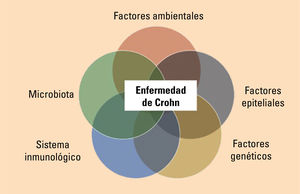
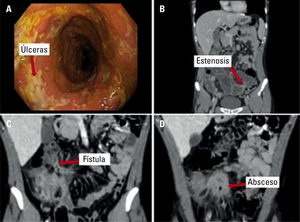
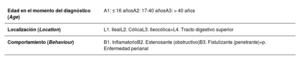
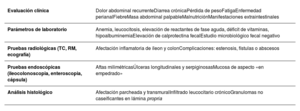
La enfermedad de Crohn (EC) es un tipo de enfermedad inflamatoria intestinal de etiología desconocida que provoca un impacto en la calidad de vida de los pacientes. La inflamación es transmural, asimétrica y segmentaria, y puede afectar a cualquier parte del tracto gastrointestinal, más comúnmente el íleon. La patogenia implica una compleja interacción entre factores genéticos, ambientales, microbianos, epiteliales y del sistema inmunológico que provoca una respuesta inflamatoria descontrolada. La EC es heterogénea y se clasifica en diferentes fenotipos en base a la edad en el momento del diagnóstico, la localización anatómica de la inflamación y el comportamiento de la enfermedad. Las manifestaciones clínicas más frecuentes son el dolor abdominal, la diarrea y la pérdida de peso. Otras manifestaciones son derivadas de complicaciones, como el desarrollo de estenosis, fístulas, abscesos intraabdominales y malnutrición. Además, pueden aparecer manifestaciones extraintestinales, principalmente en articulaciones, ojos y piel. El diagnóstico se basa en la combinación de criterios clínicos, bioquímicos, endoscópicos, histológicos y radiológicos. La EC es una entidad compleja que requiere una atención multidisciplinar. Por ello, tanto médicos de familia como otros especialistas deberían estar familiarizados con esta enfermedad.

Palabras clave
Enfermedad inflamatoria intestinal
Enfermedad de Crohn
Diagnóstico
Abstract

Crohn's disease (CD) is a type of inflammatory bowel disease of unknown etiology that impacts patients’ quality of life. The inflammation is transmural, asymmetrical, segmental, and can affect any part of the gastrointestinal tract, but most commonly affects the ileum. The pathogenesis involves a complex interaction among genetic, environmental, microbial, epithelial, and immune system factors that trigger an uncontrolled inflammatory response. CD is heterogeneous and is classified into different phenotypes based on age at diagnosis, anatomic location of the inflammation, and disease behavior. The most frequent clinical manifestations are abdominal pain, diarrhea, and weight loss. Other manifestations arise from complications, such as the development of stenosis, fistulas, intra-abdominal abscesses, and malnutrition. In addition, extraintestinal manifestations may appear, mainly in the joints, eyes, and skin. A diagnosis is based on a combination of clinical, biochemical, endoscopic, histological, and radiological criteria. CD is a complex entity that requires multidisciplinary care. Therefore, both primary care physicians and other specialists should be familiar with this disease.

Keywords
Inflammatory bowel disease
Crohn's disease
Diagnosis

Identifíquese

¿Aún no es suscriptor de la revista?
Comprar el acceso al artículo

Comprando el artículo el pdf del mismo podrá ser descargado

Teléfono para incidencias

De lunes a viernes de 9h a 18h (GMT+1) excepto los meses de julio y agosto que será de 9 a 15h
Llamadas desde España 932 415 960
Llamadas desde fuera de España +34 932 415 960
Bibliografía
[1]
J. Torres
202405010519215028
202405010519215029
, S. Mehandru, J.F. Colombel, L. Peyrin-Biroulet.
Crohn's disease.
Lancet., (2017), 389 pp. 1741-1755
[2]
M.S. Silverberg
2024050105192150210
, J. Satsangi, T. Ahmad, I.D.R. Arnott, C.N. Bernstein, S.R. Brant, et al.
Toward an integrated clinical, molecular and serological classification of inflammatory bowel disease: report of a Working Party of the 2005 Montreal World Congress of Gastroenterology.
Can J Gastroenterol., (2005), pp. 19SupplA
[3]
F.T. Moller
2024050105192150211
, V. Andersen, J. Wohlfahrt, T. Jess.
Familial risk of inflammatory bowel disease: a population-based cohort study 1977-2011.
Am J Gastroenterol., (2015), 110 pp. 564-571
[4]
Y. Ogura, D.K. Bonen, N. Inohara, D.L. Nicolae, F.F. Chen, R. Ramos, et al.
A frameshift mutation in NOD2 associated with susceptibility to Crohn's disease.
Nature., (2001), 411 pp. 603-606
[5]
J.T. Chang
2024050105192150212
2024050105192150213
.
Pathophysiology of inflammatory bowel diseases.
N Engl J Med., (2020), 383 pp. 2652-2664
[6]
E. Klement
2024050105192150214
, J. Lysy, M. Hoshen, M. Avitan, E. Goldin, E. Israeli.
Childhood hygiene is associated with the risk for inflammatory bowel disease: a population-based study.
Am J Gastroenterol., (2008), 103 pp. 1775-1782
[7]
K.W.J. Van Der Sloot
2024050105192150215
, M. Amini, V. Peters, G. Dijkstra, B.Z. Alizadeh.
Inflammatory bowel diseases: Review of known environmental protective and risk factors involved.
Inflamm Bowel Dis., (2017), 23 pp. 1499-1509
[8]
K.W.J. Van Der Sloot
2024050105192150216
, R.K. Weersma, B.Z. Alizadeh, G. Dijkstra.
Identification of environmental risk factors associated with the development of inflammatory bowel disease.
J Crohns Colitis., (2020), 14 pp. 1662-1671
[9]
P.F. Van Rheenen
2024050105192150217
, M. Aloi, A. Assa, J. Bronsky, J.C. Escher, U.L. Fagerberg, et al.
The medical management of paediatric Crohn's disease: an ECCO-ESPGHAN Guideline Update.
J Crohns Colitis., (2020), 15 pp. 171-194
[10]
M. Peeters
2024050105192150218
, S. Joossens, S. Vermeire, R. Vlietinck, X. Bossuyt, P. Rutgeerts.
Diagnostic value of anti-Saccharomyces cerevisiae and antineutrophil cytoplasmic autoantibodies in inflammatory bowel disease.
Am J Gastroenterol., (2001), 96 pp. 730-734
[11]
A.K. Degruttola
2024050105192150219
, D. Low, A. Mizoguchi, E. Mizoguchi.
Current understanding of dysbiosis in disease in human and animal models.
Inflamm Bowel Dis., (2016), 22 pp. 1137-1150
[12]
E. Quévrain, M.A. Maubert, C. Michon, F. Chain, R. Marquant, J. Tailhades, et al.
Identification of an anti-inflammatory protein from Faecalibacterium prausnitzii, a commensal bacterium deficient in Crohn's disease.
[13]
V. Pascal, M. Pozuelo, N. Borruel, F. Casellas, D. Campos, A. Santiago, et al.
A microbial signature for Crohn's disease.
[14]
E.K. Wright
2024050105192150220
, M.A. Kamm, S.M. Teo, M. Inouye, J. Wagner, C.D. Kirkwood.
Recent advances in characterizing the gastrointestinal microbiome in Crohn's disease: a systematic review.
Inflamm Bowel Dis., (2015), 21 pp. 1219-1228
[15]
R. Rashed
2024050105192150221
, R. Valcheva, L.A. Dieleman.
Manipulation of gut microbiota as a key target for Crohn's disease.
Front Med (Lausanne)., (2022), 9 pp. 887044
[16]
A. Bretin, C. Lucas, A. Larabi, G. Dalmasso, E. Billard, N. Barnich, et al.
AIEC infection triggers modification of gut microbiota composition in genetically predisposed mice, contributing to intestinal inflammation.
[17]
G.R. Lichtenstein
2024050105192150222
2024050105192150223
, E.V. Loftus, K.L. Isaacs, M.D. Regueiro, L.B. Gerson, B.E. Sands.
ACG clinical guideline: Management of Crohn's disease in adults.
Am J Gastroenterol., (2018), 113 pp. 481-517
[18]
B.E. Sands.
From symptom to diagnosis: Clinical distinctions among various forms of intestinal inflammation.
Gastroenterology., (2004), 126 pp. 1518-1532
[19]
M.M. Boscá
2024050105192150224
, R. Alós, N. Maroto, J.P. Gisbert, B. Beltrán, M. Chaparro, et al.
Recommendations of the Crohn's disease and Ulcerative Colitis Spanish Working Group (GETECCU) for the treatment of perianal fistulas of Crohn's disease.
Gastroenterol Hepatol., (2020), 43 pp. 155-168
[20]
C. Loras
2024050105192150225
, M. Mañosa, X. Andújar, V. Sánchiz, M. Martí-Gallostra, Y. Zabana, et al.
Position Statement. Recommendations of the Spanish Group on Crohn's Disease and Ulcerative Colitis (GETECCU) on the treatment of strictures in Crohn's disease.
Gastroenterol Hepatol, (2022), 45 pp. 315-334
[21]
W.A. Bemelman
2024050105192150226
, J. Warusavitarne, G.M. Sampietro, Z. Serclova, O. Zmora, G. Luglio, et al.
ECCO-ESCP Consensus on Surgery for Crohn's Disease.
J Crohns Colitis., (2018), 12 pp. 1-16
[22]
C. Maaser
2024050105192150227
, A. Sturm, S.R. Vavricka, T. Kucharzik, G. Fiorino, V. Annese, et al.
ECCO-ESGAR Guideline for Diagnostic Assessment in IBD Part 1: Initial diagnosis, monitoring of known IBD, detection of complications.
J Crohns Colitis., (2019), 13 pp. 144-164
[23]
M. Adamina
2024050105192150228
, K. Gerasimidis, R. Sigall-Boneh, O. Zmora, A. De Buck Van Overstraeten, M. Campmans-Kuijpers, et al.
Perioperative dietary therapy in inflammatory bowel disease.
J Crohns Colitis., (2020), 14 pp. 431-444
[24]
A. Lin
2024050105192150229
2024050105192150230
, D. Micic.
Nutrition considerations in inflammatory bowel disease.
Nutr Clin Pract., (2021), 36 pp. 298-311
[25]
J.E. Lennard-Jones.
Classification of inflammatory bowel disease.
Scand J Gastroenterol Suppl., (1989), 170 pp. 2-6
[26]
M.P. Ballester Ferré
2024050105192150231
, M.M. Boscá-Watts, M. Mínguez Pérez.
Crohn's disease.
Med Clin (Barc)., (2018), 151 pp. 26-33
[27]
X. Bossuyt
2024050105192150232
.
Serologic markers in inflammatory bowel disease.
Clin Chem., (2006), 52 pp. 171-181
[28]
M. Mylonaki, L. Langmead, A. Pantes, F. Johnson, D.S. Rampton.
Enteric infection in relapse of inflammatory bowel disease: importance of microbiological examination of stool.
Eur J Gastroenterol Hepatol., (2004), 16 pp. 775-778
[29]
P.F. van Rheenen
2024050105192150233
, E. Van de Vijver, V. Fidler.
Faecal calprotectin for screening of patients with suspected inflammatory bowel disease: diagnostic meta-analysis.
BMJ., (2010), 341 pp. c3369
[30]
J. Guardiola
2024050105192150234
2024050105192150235
, T. Lobatón, E. Cerrillo, R. Ferreiro-Iglesias, J.P. Gisbert, E. Domènech, et al.
Recommendations of the Spanish Working Group on Crohn's Disease and Ulcerative Colitis (GETECCU) on the utility of the determination of faecal calprotectin in inflammatory bowel disease.
Gastroenterol Hepatol., (2018), 41 pp. 514-529
[31]
V. Annese
2024050105192150236
, M. Daperno, M.D. Rutter, A. Amiot, P. Bossuyt, J. East, et al.
European evidence based consensus for endoscopy in inflammatory bowel disease.
J Crohns Colitis., (2013), 7 pp. 982-1018
[32]
F. Magro
2024050105192150237
, C. Langner, A. Driessen, A. Ensari, K. Geboes, G.J. Mantzaris, et al.
European consensus on the histopathology of inflammatory bowel disease.
J Crohns Colitis., (2013), 7 pp. 827-851