

Vol. 14. Núm. 13.
Páginas 727-737 (Junio 2024)

Actualización
Hiperaldosteronismo primario

Primary hyperaldosteronism

M. Araujo-CastroaE. Pascual-CorralesaA. Ortiz-FloresaH.F. Escobar-Morrealeabc
Doi : https://10.1016/j.med.2024.06.012
Opciones
Resumen

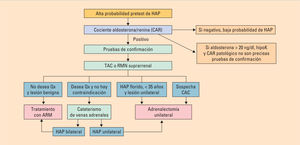
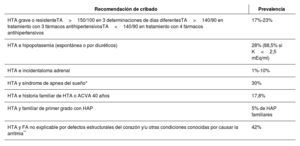
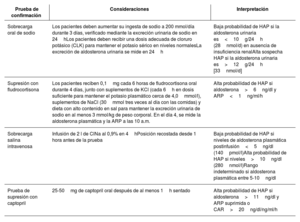
El hiperaldosteronismo primario (HAP) es la causa más frecuente de hipertensión arterial (HTA) secundaria. Además, se asocia con un mayor riesgo cardiometabólico y de mortalidad que el observado en pacientes con HTA esencial. Se recomienda realizar el cribado de HAP mediante la determinación del cociente aldosterona/renina en pacientes con HTA grave y/o resistente, HTA con hipopotasemia, HTA e incidentaloma adrenal, HTA y antecedentes familiares de primer grado de HAP y en HTA asociada con fibrilación auricular no explicable por otras causas. Si se confirma un cociente de aldosterona/renina patológico se deben realizar pruebas dinámicas para establecer el diagnóstico de confirmación; habitualmente la prueba de sobrecarga salina o la prueba de captopril. Estas pruebas pueden obviarse en pacientes con HAP franco (aldosterona plasmática superior a 20 ng/dl, renina suprimida e hipopotasemia). El último paso en el diagnóstico es el estudio de localización, siendo la tomografía computarizada (TC) de suprarrenales la prueba inicial de elección. No obstante, en la mayoría de los pacientes en los que se plantee una cirugía suprarrenal, será necesario realizar un cateterismo de las venas adrenales (CVA) para establecer la lateralidad del HAP. No se considera necesario el CVA en casos de sospecha de carcinoma adrenocortical productor de aldosterona y/o HAP en paciente menores de 35 años con una lesión unilateral clara en la TC/resonancia magnética (RM). El tratamiento del HAP depende de los resultados del estudio de localización: en las formas unilaterales el tratamiento de elección es la adrenalectomía unilateral y en las formas bilaterales lo serán los antagonistas del receptor de mineralocorticoides.

Palabras clave
Hiperaldosteronismo primario
Aldosterona
Renina
Adrenalectomía
Abstract

Primary hyperaldosteronism (PHA) is the most frequent cause of secondary hypertension (HT). Furthermore, it is associated with greater cardiometabolic and mortality risk than the observed in patients with essential HT. It is recommended to screen for PHA by determining the aldosterone-to-renin ratio in patients with severe and/or resistant HT, HT with hypokalemia, HT and adrenal incidentaloma, HT and a first-degree family history of PHA, and in HT associated with atrial fibrillation that cannot be explained by other causes. If a pathological aldosterone-to-renin ratio is confirmed, dynamic tests should be performed to establish a confirmatory diagnosis; these are usually a saline infusion test or captopril challenge test. These tests can be omitted in patients with overt PHA (plasma aldosterone greater than 20 ng/dl, suppressed renin, and hypokalemia). The last step in the diagnosis is the localization study, being the computed tomography (CT) scan of the adrenal glands the initial test of choice. Nevertheless, in most patients in whom adrenal surgery is considered, adrenal vein sampling (AVS) will be necessary to establish PHA laterality. AVS is not considered necessary in cases of suspected aldosterone-producing adrenocortical carcinoma and/or PHA in patients younger than 35 years with a clear unilateral lesion on a CT/magnetic resonance imaging (MRI) test. The treatment of PHA depends on the results of the localization study: the treatment of choice is a unilateral adrenalectomy in unilateral forms and mineralocorticoid receptor antagonists in bilateral forms.

Keywords
Primary hyperaldosteronism
Aldosterone
Renin
Adrenalectomy

Identifíquese

¿Aún no es suscriptor de la revista?

Comprar el acceso al artículo

Comprando el artículo el pdf del mismo podrá ser descargado

Teléfono para incidencias

De lunes a viernes de 9h a 18h (GMT+1) excepto los meses de julio y agosto que será de 9 a 15h

Llamadas desde España 932 415 960
Llamadas desde fuera de España +34 932 415 960
Bibliografía
[1]
N.K. Hollenberg
202406280551142078
.
Aldosterone in the development and progression of renal injury.
[2]
A. Vaidya
202406280551142079
2024062805511420710
, P. Mulatero, R. Baudrand, G.K. Adler.
The expanding spectrum of primary aldosteronism: Implications for diagnosis, pathogenesis, and treatment.
Endocr Rev., (2018), 39 pp. 1057-1088
[3]
J.W. Funder
2024062805511420711
2024062805511420712
, R.M. Carey, F. Mantero, M.H. Murad, M. Reincke, H. Shibata, et al.
The management of primary aldosteronism: Case detection, diagnosis, and treatment: An endocrine society clinical practice guideline.
J Clin Endocrinol Metab., (2016), 101 pp. 1889-1916
[4]
M. Araujo-Castro
2024062805511420713
.
Treatment of primary hyperaldosteronism.
Med Clin (Barc)., (2020), 155 pp. 302-308
[5]
Y. Ohno
2024062805511420714
, M. Naruse, F. Beuschlein, F. Schreiner, M. Parasiliti-Caprino, J. Deinum, et al.
Adrenal venous sampling-guided adrenalectomy rates in primary aldosteronism: Results of an International Cohort (AVSTAT).
J Clin Endocrinol Metab., (2021), 106 pp. E1400-E1407
[6]
O. Mete
2024062805511420715
2024062805511420716
, L.A. Erickson, C.C. Juhlin, R.R. de Krijger, H. Sasano, M. Volante, et al.
Overview of the 2022 WHO Classification of Adrenal Cortical Tumors.
Endocr Pathol., (2022), 33 pp. 155-196
[7]
J.W. Conn
2024062805511420717
.
I. Painting background. II. Primary aldosteronism, a new clinical syndrome.
J Lab Clin Med, (1955), pp. 3-17
[8]
S.C. Käyser
2024062805511420718
2024062805511420719
, T. Dekkers, H.J. Groenewoud, G.J. van der Wilt, J. Carel Bakx, M.C. van der Wel, et al.
Study heterogeneity and estimation of prevalence of primary aldosteronism: A systematic review and meta-regression analysis.
J Clin Endocrinol Metab., (2016), 101 pp. 2826-2835
[9]
S. Monticone
2024062805511420720
, J. Burrello, D. Tizzani, C. Bertello, A. Viola, F. Buffolo, et al.
Prevalence and clinical manifestations of primary aldosteronism encountered in primary care practice.
J Am Coll Cardiol., (2017), 69 pp. 1811-1820
[10]
J.W. Funder
2024062805511420721
2024062805511420722
, R.M. Carey, C. Fardella, C.E. Gomez-Sanchez, F. Mantero, M. Stowasser, et al.
Case detection, diagnosis, and treatment of patients with primary aldosteronism: An endocrine society clinical practice guideline.
J Clin Endocrinol Metab., (2008), 93 pp. 3266-3281
[11]
S.C. Käyser
2024062805511420723
2024062805511420724
, T. Dekkers, H.J. Groenewoud, G.J. van der Wilt, J. Carel Bakx, M.C. van der Wel, et al.
Study heterogeneity and estimation of prevalence of primary aldosteronism: A systematic review and meta-regression analysis.
J Clin Endocrinol Metab., (2016), 101 pp. 2826-2835
[12]
A.F. Turcu
2024062805511420725
2024062805511420726
, J. Yang, A. Vaidya.
Primary aldosteronism - a multidimensional syndrome.
Nat Rev Endocrinol., (2022), 18 pp. 665-682
[13]
J. Burrello
2024062805511420727
, S. Monticone, I. Losano, G. Cavaglià, F. Buffolo, M. Tetti, et al.
Prevalence of hypokalemia and primary aldosteronism in 5100 patients referred to a tertiary hypertension unit.
Hypertension, (2020), 75 pp. 1025-1033
[14]
P. Milliez
2024062805511420728
, X. Girerd, P.F. Plouin, J. Blacher, M.E. Safar, J.J. Mourad, et al.
Evidence for an increased rate of cardiovascular events in patients with primary aldosteronism.
J Am Coll Cardiol., (2005), 45 pp. 1243-1248
[15]
E. Gkaniatsa
2024062805511420729
, T. Zverkova Sandström, A. Rosengren, P. Trimpou, D.S. Olsson, M. Lind, et al.
Mortality in Patients With Primary Aldosteronism: A Swedish Nationwide Study.
Hypertension., (2023), 80 pp. 2601-2610
[16]
M. Araujo-Castro
2024062805511420730
, E. Pascual-Corrales, P. Martín Rojas, P. Parra Ramírez.
Epidemiology and diagnosis of primary aldosteronism. What have we learned from the SPAIN-ALDO registry?.
Endocrine., (2024), 83 pp. 527-536
[17]
H.H. Loh
2024062805511420731
, N. Sukor.
Associations between primary aldosteronism and diabetes, poor bone health, and sleep apnea—what do we know so far?.
J Hum Hypertens., (2020), 34 pp. 5-15
[18]
J. Yu
2024062805511420732
, B. Xu, G. Ma, Y. Liu, Y. Yang, J. Xu, et al.
A Prospective observational study of factors affecting the change in quality of life in patients with primary aldosteronism after treatment.
Endocr Pract., (2024), 30 pp. 19-24
[19]
M. Araujo-Castro
2024062805511420733
, P. Parra-Ramírez.
Diagnosis of primary hyperaldosteronism.
Med Clin (Barc)., (2022), 158 pp. 424-430
[20]
P. Mulatero
2024062805511420734
, C. Bertello, F. Veglio, S. Monticone.
Approach to the patient on antihypertensive therapy: Screen for primary aldosteronism.
J Clin Endocrinol Metab, (2022), 107 pp. 3175-3181
[21]
M.J.E. Kempers
2024062805511420735
2024062805511420736
, J.W.M. Lenders, L. Van Outheusden, G.J. Van Der Wilt, L.J.S. Kool, A.R.M.M. Hermus, et al.
Systematic review: Diagnostic procedures to differentiate unilateral from bilateral adrenal abnormality in primary aldosteronism.
Ann Intern Med, (2009), 151 pp. 329-337
[22]
H. Umakoshi
2024062805511420737
2024062805511420738
, T. Ogasawara, Y. Takeda, I. Kurihara, H. Itoh, T. Katabami, et al.
Accuracy of adrenal computed tomography in predicting the unilateral subtype in young patients with hypokalaemia and elevation of aldosterone in primary aldosteronism.
Clin Endocrinol (Oxf)., (2018), 88 pp. 645-651
[23]
E. Gkaniatsa
2024062805511420739
2024062805511420740
, A. Sakinis, M. Palmér, A. Muth, P. Trimpou, O. Ragnarsson.
Adrenal venous sampling in young patients with primary aldosteronism. Extravagance or Irreplaceable?.
J Clin Endocrinol Metab., (2021), 106 pp. e2087-e2095
[24]
A.S. Powlson
2024062805511420741
2024062805511420742
, M. Gurnell, M. Brown.
Nuclear imaging in the diagnosis of primary aldosteronism.
Curr Opin Endocrinol Diabetes Obes., (2015), 22 pp. 150-156
[25]
M. Araujo-Castro
2024062805511420743
2024062805511420744
, M. Paja Fano, M. González Boillos, E. Pascual-Corrales, A.M. García Cano, P. Parra Ramírez, et al.
Diagnostic accuracy of adrenal iodine-131 6-beta-iodomethyl-19-norcholesterol scintigraphy for the subtyping of primary aldosteronism.
Biomedicines., (2023), 11 pp. 1934
[26]
T.H. Puar
2024062805511420745
2024062805511420746
, C.M. Khoo, C.J. Tan, A.K.T. Tong, M.C.S. Tan, A.E. Teo, Der, et al.
11C-Metomidate PET-CT versus adrenal vein sampling to subtype primary aldosteronism: a prospective clinical trial.
J Hypertens., (2022), 40 pp. 1179-1188
[27]
L. Faconti
2024062805511420747
2024062805511420748
, S. Kulkarni, C. Delles, V. Kapil, P. Lewis, M. Glover, et al.
Diagnosis and management of primary hyperaldosteronism in patients with hypertension: a practical approach endorsed by the British and Irish Hypertension Society.
J Hum Hypertens., (2024), 38 pp. 8-18
[28]
A.T. Nanba
2024062805511420749
2024062805511420750
, T. Wannachalee, J.J. Shields, J.B. Byrd, W.E. Rainey, R.J. Auchus, et al.
Adrenal vein sampling lateralization despite mineralocorticoid receptor antagonists exposure in primary aldosteronism.
J Clin Endocrinol Metab., (2018), 104 pp. 487-492
[29]
S. Monticone
2024062805511420751
2024062805511420752
, A. Viola, D. Rossato, F. Veglio, M. Reincke, C. Gómez-Sanchez, et al.
Adrenal vein sampling in primary aldosteronism: towards a standardised protocol.
Lancet Diabetes Endocrinol., (2015), 3 pp. 296-303
[30]
G.P. Rossi
2024062805511420753
2024062805511420754
.
Update in adrenal venous sampling for primary aldosteronism.
Curr Opin Endocrinol Diabetes Obes., (2018), 25 pp. 160-171
[31]
N. Daunt
2024062805511420755
.
Adrenal vein sampling: how to make it quick, easy, and successful.
Radiographics, (2005), 25 pp. S143-S158
[32]
J.J. Siracuse
2024062805511420756
, H.L. Gill, I. Epelboym, N.C. Clarke, N.K. Kabutey, I.K. Kim, et al.
The vascular surgeon's experience with adrenal venous sampling for the diagnosis of primary hyperaldosteronism.
Ann Vasc Surg., (2014), 28 pp. 1266-1270
[33]
O. Vonend
2024062805511420757
, N. Ockenfels, X. Gao, B. Allolio, K. Lang, K. Mai, et al.
Adrenal venous sampling: evaluation of the German Conn's registry.
Hypertension., (2011), 57 pp. 990-995
[34]
G.L. Hundemer
2024062805511420758
2024062805511420759
, A.A. Leung, G.A. Kline, J.M. Brown, A.F. Turcu, A. Vaidya.
Biomarkers to guide medical therapy in primary aldosteronism.
Endocr Rev., (2024), 45 pp. 69-94
[35]
M. Araujo-Castro
2024062805511420760
, E. Pascual-Corrales, P. Martín Rojas, P. Parra Ramírez.
Primary aldosteronism: Practical recommendations for treatment and follow-up.
Hipertens Riesgo Vasc., (2023), 40 pp. 215-221
[36]
M.W. Freeman
2024062805511420761
2024062805511420762
, Y.-D. Halvorsen, W. Marshall, M. Pater, J. Isaacsohn, C. Pearce, et al.
Phase 2 trial of baxdrostat for treatment-resistant hypertension.
N Engl J Med., (2023), 388 pp. 395-405
[37]
Y. Zhou
2024062805511420763
2024062805511420764
, M. Zhang, S. Ke, L. Liu.
Hypertension outcomes of adrenalectomy in patients with primary aldosteronism: a systematic review and meta-analysis.
BMC Endocr Disord., (2017), 17 pp. 61
[38]
M. Araujo-Castro
2024062805511420765
, M. Paja Fano, M. González Boillos, B. Pla Peris, E. Pascual-Corrales, A.M. García Cano, et al.
Evolution of the cardiometabolic profile of primary hyperaldosteronism patients treated with adrenalectomy and with mineralocorticoid receptor antagonists: results from the SPAIN-ALDO Registry.
Endocrine, (2022), 76 pp. 687-696
[39]
E. Fischer
2024062805511420766
, G. Hanslik, A. Pallauf, C. Degenhart, U. Linsenmaier, F. Beuschlein, et al.
Prolonged zona glomerulosa insufficiency causing hyperkalemia in primary aldosteronism after adrenalectomy.
J Clin Endocrinol Metab., (2012), 97 pp. 3965-3973
[40]
T.A. Williams
2024062805511420767
2024062805511420768
, J.W.M. Lenders, P. Mulatero, J. Burrello, M. Rottenkolber, C. Adolf, et al.
Outcomes after adrenalectomy for unilateral primary aldosteronism: an international consensus on outcome measures and analysis of remission rates in an international cohort.
Lancet Diabetes Endocrinol, (2017), 5 pp. 689-699
[41]
M. Araujo-Castro
2024062805511420769
, P. Martín Rojas-Marcos, P. Parra Ramírez.
Familial forms and molecular profile of primary hyperaldosteronism.
Hipertens y Riesgo Vasc., (2022), 39 pp. 167-173