

Vol. 13. Núm. 83.
Páginas 4875-4882 (Junio 2023)

Actualización
Hipertensión arterial y riñón

Hypertension and the kidneys

C. Rodelo HaadC. Moyano PeregrínA.I. Robles LópezR. Santamaría Olmo
Doi : https://10.1016/j.med.2023.06.017
Opciones
Resumen

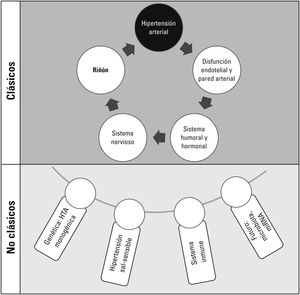
La hipertensión arterial (HTA) es la principal causa de muerte en el mundo. Su mantenimiento es posible por la disfunción de diferentes órganos y sistemas que normalmente participan en el control de la presión arterial (PA) para mantener una adecuada perfusión tisular. El riñón es el principal regulador de la PA a largo plazo. Un estricto equilibrio entre la producción y el metabolismo de sustancias vasoactivas que regulan la excreción de agua y sodio a través del sistema renina-angiotensina-aldosterona (SRAA) modula la PA. No obstante, nuevos mecanismos descritos en la última década podrían explicar la variabilidad de la PA en los pacientes. La sobrexpresión de cotransportadores de sodio a nivel renal parece escapar al efecto regulador del SRAA. Además, el sistema inmune y la microbiota intestinal parecen tener un papel importante y novedoso. La producción de algunas citoquinas inflamatorias promueve la reabsorción tubular de sodio y sobreactivación intrarrenal del SRAA. La proliferación de fermicutes, proteobacterias y Prevotella en sujetos con HTA sensible a la sal les predispone a un control más difícil de la PA. El estudio de estos nuevos mecanismos podría no solo establecer nuevas dianas de tratamiento, sino también explicar por qué la mejoría en el control de la PA no ha sido suficiente para reducir las comorbilidades y el riesgo cardiovascular asociado a HTA.

Palabras clave
Angiotensina
Células del músculo liso vascular
Presión arterial
Receptores epiteliales transportadores de sodio
Sintasa endotelial del óxido nítrico
Abstract

Hypertension (HT) is the main cause of death in the world. It is maintained thanks to the dysfunction of different organs and systems that normally take part in controlling blood pressure (BP) to ensure adequate perfusion of the tissues. The kidneys are the main regulators of BP over the long-term. A strict balance between the production and metabolism of vasoactive substance that regulate the excretion of water and sodium through the renin-angiotensin-aldosterone system (RAAS) modulates BP. Nevertheless, new mechanisms described in the last decade could also explain the variability of BP in patients. The overexpression of sodium cotransporters at renal level seems to escape from the regulatory effect of the RAAS. Moreover, the immune system and intestinal microbiota seem to play an important and newly discovered role. The production of certain inflammatory cytokines promotes the tubular reabsorption of sodium and the intrarenal over-activation of the RAAS. The proliferation of fermicutes, proteobacterias and Prevotella in subjects with salt-sensitive HT predisposes them to more difficult control of BP. Studying these new mechanisms may not only discover new treatment targets, as it may also explain why the improvement in BP control was not enough to reduce the comorbidities and cardiovascular risk associated with HT.

Keywords
Angiotensin
Vascular smooth muscle cells
Blood pressure
Sodium transporter epithelial receptors
Endothelial nitric oxide synthase

Identifíquese

¿Aún no es suscriptor de la revista?

Comprar el acceso al artículo

Comprando el artículo el pdf del mismo podrá ser descargado

Teléfono para incidencias

De lunes a viernes de 9h a 18h (GMT+1) excepto los meses de julio y agosto que será de 9 a 15h

Llamadas desde España 932 415 960
Llamadas desde fuera de España +34 932 415 960
Bibliografía
[1]
M. Gorostidi
202307030853286758
202307030853286759
, T. Gijón-Conde, A. de la Sierra, E. Rodilla, E. Rubio, E. Vinyoles, et al.
Guía práctica sobre el diagnóstico y tratamiento de la hipertensión arterial en España, 2022. Sociedad Española de Hipertensión - Liga Española para la Lucha contra la Hipertensión Arterial (SEH-LELHA).
Hipertens Riesgo Vasc., (2022), 39 pp. 174-194
[2]
B. Williams
2023070308532867510
2023070308532867511
, G. Mancia, W. Spiering, E. Agabiti Rosei, M. Azizi, M. Burnier, et al.
2018 ESC/ESH Guidelines for the management of arterial hypertension: The Task Force for the management of arterial hypertension of the European Society of Cardiology (ESC) and the European Society of Hypertension (ESH).
Eur Heart J., (2018), 39 pp. 3021-3104
[3]
Q. Gu, V.L. Burt, C.F. Dillon, S. Yoon.
Trends in antihypertensive medication use and blood pressure control among United States adults with hypertension: the National Health And Nutrition Examination Survey, 2001 to 2010.
Circulation., (2012), 126 pp. 2105-2114
[4]
K.J. Foreman, N. Márquez, A. Dolgert, K. Fukutaki, N. Fullman, M. McGaughey, et al.
Forecasting life expectancy, years of life lost, and all-cause and cause-specific mortality for 250 causes of death: reference and alternative scenarios for 2016-40 for 195 countries and territories.
Lancet Lond Engl., (2018), 392 pp. 2052-2090
[5]
V. Lahera Juliá, C. Caramelo Díaz.
Homeostasis de la presión arterial.
Hernando nefrología clínica, 4a ed, Panamericana, pp. 214-221
[6]
T. Saxena
2023070308532867512
2023070308532867513
, A.O. Ali, M. Saxena.
Pathophysiology of essential hypertension: an update.
Expert Rev Cardiovasc Ther., (2018), 16 pp. 879-887
[7]
L. Share
2023070308532867514
2023070308532867515
, J.T. Crofton.
Contribution of vasopressin to hypertension.
Hypertens Dallas Tex., (1982), 4 pp. III85-III92
[8]
C. Bleakley
2023070308532867516
2023070308532867517
, P.K. Hamilton, R. Pumb, M. Harbinson, G.E. McVeigh.
Endothelial Function in Hypertension: Victim or Culprit?.
J Clin Hypertens Greenwich Conn., (2015), 17 pp. 651-654
[9]
J. Díez
2023070308532867518
2023070308532867519
.
Arterial stiffness and extracellular matrix.
Adv Cardiol., (2007), 44 pp. 76-95
[10]
F. Inserra
2023070308532867520
2023070308532867521
, P. Forcada, A. Castellaro, C. Castellaro.
Chronic kidney disease and arterial stiffness: A two-way path.
Front Med., (2021), 8 pp. 765924
[11]
T.M. Coffman
2023070308532867522
2023070308532867523
.
The inextricable role of the kidney in hypertension.
J Clin Invest., (2014), 124 pp. 2341-2347
[12]
V.M. Campese
2023070308532867524
, J. Park.
The kidney and hypertension: over 70 years of research.
J Nephrol., (2006), 19 pp. 691-698
[13]
A.C. Guyton, T.G. Coleman, A.V. Cowley, K.W. Scheel, R.D. Manning, R.A. Norman.
Arterial pressure regulation. Overriding dominance of the kidneys in long-term regulation and in hypertension.
Am J Med., (1972), 52 pp. 584-594
[14]
L.G. Navar, L. Lewis, A. Hymel, B. Braam, K.D. Mitchell.
Tubular fluid concentrations and kidney contents of angiotensins I and II in anesthetized rats.
J Am Soc Nephrol JASN., (1994), 5 pp. 1153-1158
[15]
S.D. Crowley, S.B. Gurley, M.J. Herrera, P. Ruiz, R. Griffiths, A.P. Kumar, et al.
Angiotensin II causes hypertension and cardiac hypertrophy through its receptors in the kidney.
Proc Natl Acad Sci U S A., (2006), 103 pp. 17985-17990
[16]
J. Díez Martínez.
Fisiopatología de la pared Vascular.
Hernando nefrología clínica, 5a ed., Panamericana, pp. 315-320
[17]
F.H.H. Leenen
2023070308532867525
, M.P. Blaustein, J.M. Hamlyn.
Update on angiotensin II: new endocrine connections between the brain, adrenal glands and the cardiovascular system.
Endocr Connect., (2017), 6 pp. R131-R145
[18]
R.J. Johnson
2023070308532867526
2023070308532867527
, M.A. Lanaspa, L. Gabriela Sánchez-Lozada, B. Rodríguez-Iturbe.
The discovery of hypertension: evolving views on the role of the kidneys, and current hot topics.
Am J Physiol Renal Physiol., (2015), 308 pp. F167-F178
[19]
O. Skøtt
2023070308532867528
2023070308532867529
, B.L. Jensen.
Cellular and intrarenal control of renin secretion.
Clin Sci Lond Engl., (1993), 84 pp. 1-10
[20]
N.D.L. Fisher
2023070308532867530
, N.K. Hollenberg.
Renin inhibition: what are the therapeutic opportunities?.
J Am Soc Nephrol JASN., (2005), 16 pp. 592-599
[21]
T.W. Kurtz
2023070308532867531
2023070308532867532
, S.E. DiCarlo, M. Pravenec, R.C. Morris.
An appraisal of methods recently recommended for testing salt sensitivity of blood pressure.
J Am Heart Assoc., (2017), 6 pp. e005653
[22]
H. Wiig, A. Schröder, W. Neuhofer, J. Jantsch, C. Kopp, T.V. Karlsen, et al.
Immune cells control skin lymphatic electrolyte homeostasis and blood pressure.
J Clin Invest., (2013), 123 pp. 2803-2815
[23]
A. Machnik, W. Neuhofer, J. Jantsch, A. Dahlmann, T. Tammela, K. Machura, et al.
Macrophages regulate salt-dependent volume and blood pressure by a vascular endothelial growth factor-C-dependent buffering mechanism.
Nat Med., (2009), 15 pp. 545-552
[24]
C. Kopp, P. Linz, A. Dahlmann, M. Hammon, J. Jantsch, D.N. Müller, et al.
23Na magnetic resonance imaging-determined tissue sodium in healthy subjects and hypertensive patients.
Hypertens Dallas Tex., (2013), 61 pp. 635-640
[25]
F. Elijovich
2023070308532867533
2023070308532867534
, M.H. Weinberger, C.A.M. Anderson, L.J. Appel, M. Bursztyn, N.R. Cook, et al.
Salt sensitivity of blood pressure: A scientific statement from the American Heart Association.
Hypertens Dallas Tex., (2016), 68 pp. e7-e46
[26]
D. Maaliki
2023070308532867535
, M.M. Itani, H.A. Itani.
Pathophysiology and genetics of salt-sensitive hypertension.
Front Physiol., (2022), 13 pp. 1001434
[27]
C. Hsu, R.K. Hsu, J. Yang, J.D. Ordóñez, S. Zheng, A.S. Go.
Elevated BP after AKI.
J Am Soc Nephrol., (2016), 27 pp. 914-923
[28]
J. Buerkert, D.R. Martin, D. Trigg, E.E. Simon.
Sodium handling by deep nephrons and the terminal collecting duct in glomerulonephritis.
Kidney Int., (1991), 39 pp. 850-857
[29]
G. Parra, B. Rodríguez-Iturbe, J. Colina-Chourio, R. García.
Short-term treatment with captopril in hypertension due to acute glomerulonephritis.
Clin Nephrol., (1988), 29 pp. 58-62
[30]
M. Bao, P. Li, Q. Li, H. Chen, Y. Zhong, S. Li, et al.
Genetic screening for monogenic hypertension in hypertensive individuals in a clinical setting.
J Med Genet., (2020), 57 pp. 571-580
[31]
G.B. Ehret
2023070308532867536
2023070308532867537
, M.J. Caulfield.
Genes for blood pressure: an opportunity to understand hypertension.
Eur Heart J., (2013), 34 pp. 951-961
[32]
S. Padmanabhan
2023070308532867538
2023070308532867539
, M. Caulfield, A.F. Dominiczak.
Genetic and molecular aspects of hypertension.
Circ Res., (2015), 116 pp. 937-959
[33]
D.S. Geller, A. Farhi, N. Pinkerton, M. Fradley, M. Moritz, A. Spitzer, et al.
Activating mineralocorticoid receptor mutation in hypertension exacerbated by pregnancy.
Science., (2000), 289 pp. 119-123
[34]
P.G. Maass, A. Aydin, F.C. Luft, C. Schächterle, A. Weise, S. Stricker, et al.
PDE3A mutations cause autosomal dominant hypertension with brachydactyly.
Nat Genet., (2015), 47 pp. 647-653
[35]
W.G. McMaster, A. Kirabo, M.S. Madhur, D.G. Harrison.
Inflammation, immunity, and hypertensive end-organ damage.
Circ Res., (2015), 116 pp. 1022-1033
[36]
A.E. Norlander
2023070308532867540
2023070308532867541
, M.S. Madhur.
Inflammatory cytokines regulate renal sodium transporters: how, where, and why?.
Am J Physiol Renal Physiol., (2017), 313 pp. F141-F144
[37]
H.A. Itani, W.G. McMaster, M.A. Saleh, R.R. Nazarewicz, T.P. Mikolajczyk, A.M. Kaszuba, et al.
Activation of human T cells in hypertension: Studies of humanized mice and hypertensive humans.
Hypertens Dallas Tex 1979, (2016), 68 pp. 123-132
[38]
J.F. Ferguson, L.A. Aden, N.R. Barbaro, J.P. Van Beusecum, L. Xiao, A.J. Simmons, et al.
High dietary salt-induced dendritic cell activation underlies microbial dysbiosis-associated hypertension.
JCI Insight., (2019), 5 pp. 126241
[39]
J. Oh, S.J. Matkovich, A.E. Riek, S.M. Bindom, J.S. Shao, R.D. Head, et al.
Macrophage secretion of miR-106b-5p causes renin-dependent hypertension.
Nat Commun., (2020), 11 pp. 4798
[40]
Q. Zhu, J. Hu, L. Wang, W. Wang, Z. Wang, P.L. Li, et al.
Overexpression of microRNA-429 transgene into the renal medulla attenuated salt-sensitive hypertension in Dahl s rats.
Am J Hypertens., (2021), 34 pp. 1071-1077