

Vol. 13. Núm. 50.
Páginas 2909-2918 (Marzo 2022)

Infecciones por enterococos

Enterococcal infections

J. Calderón-ParraabcA. Díaz de SantiagoabcA. Callejas Díazabc
Doi : https://10.1016/j.med.2022.02.020
Opciones
Resumen

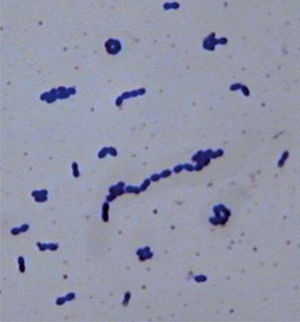
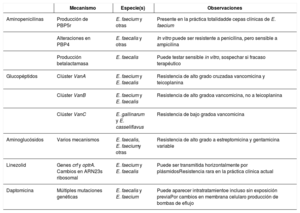
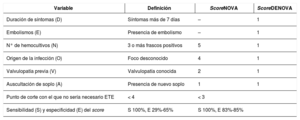
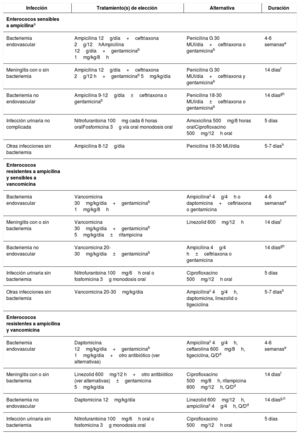
Los enterococos son bacterias grampositivas anaerobias facultativas que se disponen en cadenas o parejas. Las especies más relevantes son Enterococcus faecalis y Enterococcus faecium. Son colonizadores normales del aparato digestivo. Pueden sobrevivir en superficies y entornos hospitalarios durante tiempo prolongado. Los contactos frecuentes con hospitales, comorbilidades, antibióticos previos y presencia de dispositivos se asocian con un mayor riesgo de infección. Pueden dar lugar a múltiples síndromes clínicos, siendo más frecuentes en infecciones asociadas a cuidados sanitarios que en comunitarias. Destacan infecciones del tracto urinario, infecciones intraabdominales, bacteriemias asociadas a catéter venoso, endocarditis, meningitis e infecciones de herida quirúrgica. En toda bacteriemia enterocócica se debe valorar la presencia de endocarditis, siendo útiles para ello los scores NOVA y DENOVA. Enterococcus faecalis suele ser sensible a ampicilina y este es su tratamiento de elección. En casos de endocarditis o bacteriemia complicada, se recomienda la combinación con ceftriaxona o gentamicina. Enterococcus faecium suele ser resistente a ampicilina y su tratamiento de elección es vancomicina. El tratamiento de los enterococos resistentes a vancomicina no está bien definido y supone un reto, siendo las principales opciones daptomicina en dosis altas o linezolid. En el manejo de las infecciones enterocócicas, es fundamental el control adecuado del foco.

Palabras clave
Enterococcus faecalis
Enterococcus faecium
Enterococos resistentes a vancomicina
Abstract

Enterococci are facultative anaerobic gram-positive bacteria that are arranged in chains or pairs. The most relevant species are Enterococcus faecalis and Enterococcus faecium. They are normal colonizers of the digestive system. They can survive on surfaces and in hospital settings for an extended period of time. Frequent contact with hospitals, comorbidities, prior antibiotic use, and presence of medical devices are associated with a greater risk of infection. They can give rise to multiple clinical syndromes and are more common in healthcare-associated infections than community infections. Of note are urinary tract infections, intra-abdominal infections, venous catheter-related bacteremias, endocarditis, meningitis, and surgical wound infections. The presence of endocarditis must be evaluated in all enterococci bacteremias; the NOVA and DENOVA scores are useful for doing so. Enterococcus faecalis tend to be sensitive to ampicillin, which is the treatment of choice. In cases of endocarditis or complicated bacteremia, it is recommended to combine them with ceftriaxone or gentamicin. Enterococcus faecium tend to be resistant to ampicillin and the treatment of choice is vancomycin. Treatment of vancomycin-resistant enterococci is not well-defined and represents a challenge; the main options are daptomycin at high doses or linezolid. Adequate control of the source of the infection is fundamental in the management of enterococcal infections.

Keywords
Enterococcus faecalis
Enterococcus faecium
Vancomycin-resistant enterococci

Identifíquese

¿Aún no es suscriptor de la revista?
Comprar el acceso al artículo

Comprando el artículo el pdf del mismo podrá ser descargado

Teléfono para incidencias

De lunes a viernes de 9h a 18h (GMT+1) excepto los meses de julio y agosto que será de 9 a 15h
Llamadas desde España 932 415 960
Llamadas desde fuera de España +34 932 415 960
Bibliografía
[1]
C.A.
202203090644456788
202203090644456789
Arias, B.E. Murray.
Infecciones enterocócicas.
Harrison. Principios de Medicina Interna, 20ª ed., McGraw Hill, pp. 12
[2]
W.R.
2022030906444567810
2022030906444567811
Miller, C.A. Arias, B.E. Murray.
200 - Género Enterococcus. grupo Streptococcus gallolyticus y género Leuconostoc.
Mandell, Douglas y Bennett. Enfermedades Infecciosas. Principios y Práctica, Elsevier, pp. 2492-2506
[3]
C.A.
2022030906444567812
Arias, B.E. Murray.
The rise of the Enterococcus: beyond vancomycin resistance.
Nat Rev Microbiol., (2012), 10 pp. 266-278
[4]
W. Gao, B.P. Howden, T.P. Stinear.
Evolution of virulence in Enterococcusfaecium, a hospital-adapted opportunistic pathogen.
Curr Opin Microbiol., (2018), 41 pp. 76-82
[5]
G. Kayaoglu, D. Ørstavik.
Virulence factors of Enterococcusfaecalis: relationship to endodontic disease.
Crit Rev Oral Biol Med Off Publ Am Assoc Oral Biol., (2004), 15 pp. 308-320
[6]
T.
2022030906444567813
Lee, S. Pang, S. Abraham, G.W. Coombs.
Antimicrobial-resistant CC17 Enterococcus faecium: The past, the present and the future.
J Glob Antimicrob Resist., (2019), 16 pp. 36-47
[7]
L.
2022030906444567814
Thieme, M. Klinger-Strobel, A. Hartung, C. Stein, O. Makarewicz, M.W. Pletz.
In vitro synergism and anti-biofilm activity of ampicillin, gentamicin, ceftaroline and ceftriaxone against Enterococcus faecalis.
J Antimicrob Chemother., (2018), 73 pp. 1553-1561
[8]
J.R. Galloway-Peña, L.B. Rice, B.E. Murray.
Analysis of PBP5 of early U.S. isolates of Enterococcus faecium: sequence variation alone does not explain increasing ampicillin resistance over time.
Antimicrob Agents Chemother., (2011), 55 pp. 3272-3277
[9]
R. Leclercq, P. Courvalin.
Resistance to glycopeptides in enterococci.
Clin Infect Dis Off Publ Infect Dis Soc Am., (1997), 24 pp. 545-554
[10]
M.K.
2022030906444567815
Hayden, G.M. Trenholme, J.E. Schultz, D.F. Sahm.
In vivo development of teicoplanin resistance in a VanB Enterococcus faecium isolate.
J Infect Dis. mayo de, (1993), 167 pp. 1224-1227
[11]
J.W. Chow.
Aminoglycoside resistance in enterococci.
Clin Infect Dis Off Publ Infect Dis Soc Am., (2000), 31 pp. 586-589
[12]
J.K.
2022030906444567816
Bender, V. Cattoir, K. Hegstad, E. Sadowy, T.M. Coque, H. Westh, et al.
Update on prevalence and mechanisms of resistance to linezolid, tigecycline and daptomycin in enterococci in Europe: Towards a common nomenclature.
Drug Resist Updat Rev Comment Antimicrob Anticancer Chemother., (2018), 40 pp. 25-39
[13]
M.P. Cooper, F. Lessa, B. Brems, R. Shoulson, S. York, A. Peterson, et al.
Outbreak of Enterococcus gallinarum infections after total knee arthroplasty.
Infect Control Hosp Epidemiol., (2008), 29 pp. 361-363
[14]
2022030906444567817
SEMPSPH. Estudio EPINE-EPPS n° 30. Informe España. Prevalencia de infecciones (relacionadas con la asistencia sanitaria y comunitarias) en hospitales de agudos [Internet]. 2019. Disponible en: https://epine.es/api/documento-publico/2019%20EPINE%20Informe%20Espa%C3%B1a%2027112019.pdf/reports-esp.
[15]
M.A. Baker, K.E. Sands, S.S. Huang, K. Kleinman, E.J. Septimus, N. Varma, et al.
The Impact of COVID-19 on Healthcare-Associated Infections.
Clin Infect Dis Off Publ Infect Dis Soc Am., (2021), pp. ciab688
[16]
A. Kaya, S.Y. Kaya, I.I. Balkan, O.F. Bayramlar, B. Mete, N. Saltoglu, et al.
Risk factors for development of vancomycin-resistant enterococcal bacteremia among VRE colonizers?: A retrospective case control study.
Wien Klin Wochenschr., (2021), 133 pp. 478-483
[17]
J.M.
2022030906444567818
Pericàs, J. Ambrosioni, P. Muñoz, A. de Alarcón, M. Kestler, A. Mari-Hualde, et al.
Prevalence of colorectal neoplasms among patients with enterococcus faecalis endocarditis in the GAMES Cohort (2008-2017).
Mayo Clin Proc., (2021), 96 pp. 132-146
[18]
E.
2022030906444567819
Rosselli del Turco, M. Bartoletti, A. Dahl, C. Cervera, J.M. Pericàs.
How do I manage a patient with enterococcal bacteraemia?.
Clin Microbiol Infect Off Publ Eur Soc Clin Microbiol Infect Dis., (2021), 27 pp. 364-371
[19]
W.S. Oh, J.-A. Hur, E.S. Kim, K.-H. Park, H.K. Choi, C. Moon, et al.
Factors associated with specific uropathogens in catheter-associated urinary tract infection: developing a clinical prediction model.
J Int Med Res., (2014), 42 pp. 1335-1347
[20]
V. Magri, E. Marras, G. Perletti.
Chronic bacterial prostatitis: enterococcal disease?.
Clin Infect Dis Off Publ Infect Dis Soc Am., (2011), 53 pp. 1306-1307
[21]
S. Harbarth, I. Uckay.
Are there patients with peritonitis who require empiric therapy for enterococcus?.
Eur J Clin Microbiol Infect Dis Off Publ Eur Soc Clin Microbiol., (2004), 23 pp. 73-77
[22]
R.J.
2022030906444567820
2022030906444567821
Burnett, D.C. Haverstock, E.P. Dellinger, H.H. Reinhart, J.M. Bohnen, O.D. Rotstein, et al.
Definition of the role of enterococcus in intraabdominal infection: analysis of a prospective randomized trial.
Surgery., (1995), 118 pp. 716-721
[23]
A.-C. Morvan, B. Hengy, M. Garrouste-Orgeas, S. Ruckly, J.-M. Forel, L. Argaud, et al.
Impact of species and antibiotic therapy of enterococcal peritonitis on 30-day mortality in critical care-an analysis of the OUTCOMEREA database.
Crit Care Lond Engl., (2019), 23 pp. 307
[24]
L.E. Wee, S.W.K. Hnin, Z. Xu, L.S.-U. Lee.
Strongyloides hyperinfection associated with Enterococcus faecalis bacteremia, meningitis, ventriculitis and gas-forming spondylodiscitis: A case report.
Trop Med Infect Dis., (2020), 5 pp. E44
[25]
I. Khanum, S. Anwar, A. Farooque.
Enterococcal meningitis/ventriculitis: A tertiary care experience.
Asian J Neurosurg., (2019), 14 pp. 102-105
[26]
J.M.
2022030906444567822
Pericàs, J. Llopis, P. Muñoz, J. Gálvez-Acebal, M. Kestler, M. Valerio, et al.
A contemporary picture of enterococcal endocarditis.
J Am Coll Cardiol., (2020), 75 pp. 482-494
[27]
E.
2022030906444567823
Bouza, M. Kestler, T. Beca, G. Mariscal, M. Rodríguez-Créixems, J. Bermejo, et al.
The NOVA score: a proposal to reduce the need for transesophageal echocardiography in patients with enterococcal bacteremia.
Clin Infect Dis Off Publ Infect Dis Soc Am., (2015), 60 pp. 528-535
[28]
A.
2022030906444567824
Berge, A. Krantz, H. Östlund, P. Nauclér, M. Rasmussen.
The DENOVA score efficiently identifies patients with monomicrobial Enterococcus faecalis bacteremia where echocardiography is not necessary.
Infection., (2019), 47 pp. 45-50
[29]
N.
2022030906444567825
Fernández-Hidalgo, B. Almirante, J. Gavaldà, M. Gurgui, C. Peña, A. de Alarcón, et al.
Ampicillin plus ceftriaxone is as effective as ampicillin plus gentamicin for treating enterococcus faecalis infective endocarditis.
Clin Infect Dis Off Publ Infect Dis Soc Am., (2013), 56 pp. 1261-1268
[30]
S.C.
2022030906444567826
2022030906444567827
Peterson, T.T.Y. Lau, M.H.H. Ensom.
Combination of ceftriaxone and ampicillin for the treatment of enterococcal endocarditis: A qualitative systematic review.
Ann Pharmacother., (2017), 51 pp. 496-503
[31]
A. Ramos-Martínez, J.M. Pericàs, A. Fernández-Cruz, P. Muñoz, M. Valerio, M. Kestler, et al.
Four weeks versus six weeks of ampicillin plus ceftriaxone in Enterococcus faecalis native valve endocarditis: A prospective cohort study.
PloS One., (2020), 15 pp. e0237011
[32]
D.
2022030906444567828
Lebeaux, N. Fernández-Hidalgo, B. Pilmis, P. Tattevin, J.-L. Mainardi.
Aminoglycosides for infective endocarditis: time to say goodbye?.
Clin Microbiol Infect Off Publ Eur Soc Clin Microbiol Infect Dis., (2020), 26 pp. 723-728
[33]
G.E.
2022030906444567829
Stein, T. Babinchak.
Tigecycline: an update.
Diagn Microbiol Infect Dis., (2013), 75 pp. 331-336
[34]
Y.P. Chong, S.-O. Lee, E.H. Song, E.J. Lee, E.-Y. Jang, S.-H. Kim, et al.
Quinupristin-dalfopristin versus linezolid for the treatment of vancomycin-resistant Enterococcus faecium bacteraemia: efficacy and development of resistance.
Scand J Infect Dis., (2010), 42 pp. 491-499
[35]
I.J. Abbott, E. van Gorp, A. van der Meijden, R.A. Wijma, J. Meletiadis, J.A. Roberts, et al.
Oral fosfomycin treatment for enterococcal urinary tract infections in a dynamic in vitro model.
Antimicrob Agents Chemother., (2020), 64 pp. e00342-e420
[36]
T. Morrisette, M.A. Miller, B.T. Montague, G.R. Barber, R.B. McQueen, M. Krsak.
On- and off-label utilization of dalbavancin and oritavancin for Gram-positive infections.
J Antimicrob Chemother., (2019), 74 pp. 2405-2416
[37]
B. Bai, K. Hu, H. Li, W. Yao, D. Li, Z. Chen, et al.
Effect of tedizolid on clinical Enterococcus isolates: in vitro activity, distribution of virulence factor, resistance genes and multilocus sequence typing.
FEMS Microbiol Lett., (2018), 365