

Vol. 14. Núm. 63.
Páginas 3900-3907 (Octubre 2026)

Actualización
Insuficiencia respiratoria: concepto, etiopatogenia, clasificación y diagnóstico

Respiratory failure: Concept, etiopathogenesis, classification, and diagnosis

B. RomeroabD. CorchadoabD. VelascoabC. PradosabA. Pérez-Figueraab
Doi : https://10.1016/j.med.2026.10.003
Opciones
Resumen

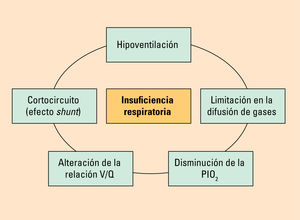
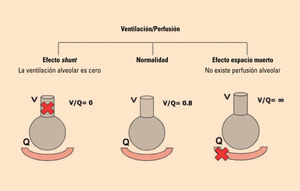
La insuficiencia respiratoria es un síndrome clínico fisiopatológico caracterizado por una alteración del intercambio gaseoso que conduce a hipoxemia, hipercapnia o ambas, y se define por una presión arterial de oxígeno (PaO2) menor de 60mm Hg y/o una presión arterial de anhídrido carbónico (PaCO2) superior a 45mm Hg en condiciones basales y al nivel del mar. Su origen se relaciona con alteraciones en los principales mecanismos de la fisiología respiratoria, incluyendo el desequilibrio ventilación/perfusión, el cortocircuito intrapulmonar, la hipoventilación alveolar, la limitación de la difusión y la disminución de la presión inspirada de oxígeno. Desde una perspectiva fisiopatológica, se clasifica en formas hipoxémicas e hipercápnicas, con presentaciones agudas, crónicas y agudas sobre crónicas, cada una con implicaciones pronósticas y terapéuticas específicas. La gasometría arterial constituye el estándar de referencia para el diagnóstico, la estratificación de la gravedad y la evaluación del equilibrio ácido-base. Un abordaje integrado, basado en la evaluación clínica y fisiológica, resulta fundamental para el reconocimiento precoz, la toma de decisiones terapéuticas individualizadas y la optimización de los resultados clínicos.

Palabras clave
Insuficiencia respiratoria
Hipoxemia
Hipercapnia
Alteración ventilación/perfusión
Hipoventilación alveolar
Gasometría arterial
Evaluación clínica
Abstract

Respiratory failure is a clinical pathophysiological syndrome characterized by impaired gas exchange that leads to hypoxemia, hypercapnia, or both. It is defined by an arterial oxygen pressure (PaO2) below 60mm Hg and/or an arterial carbon dioxide pressure (PaCO2) above 45mm Hg under baseline conditions at sea level. Its origin is related to abnormalities in the main mechanisms of respiratory physiology, including ventilation/perfusion imbalance, intrapulmonary shunting, alveolar hypoventilation, diffusion limitation, and decreased fraction of inspired oxygen pressure. From a pathophysiological perspective, it is classified into hypoxemic and hypercapnic forms with acute, chronic, and acute-on-chronic presentations, each with specific prognostic and therapeutic implications. Arterial blood gas analysis is the gold standard for diagnosis, severity stratification, and assessment of acid-base balance. An integrated approach based on a clinical and physiological evaluation is essential for early recognition, individualized decision making regarding treatment, and optimization of clinical outcomes.

Keywords
Respiratory failure
Hypoxemia
Hypercapnia
Ventilation/perfusion imbalance
Alveolar hypoventilation
Arterial blood gas analysis
Clinical evaluation

Identifíquese

¿Aún no es suscriptor de la revista?
Comprar el acceso al artículo

Comprando el artículo el pdf del mismo podrá ser descargado

Teléfono para incidencias

De lunes a viernes de 9h a 18h (GMT+1) excepto los meses de julio y agosto que será de 9 a 15h
Llamadas desde España 932 415 960
Llamadas desde fuera de España +34 932 415 960
Bibliografía
[1]
M. Lagina
202610160414568318
202610160414568319
, T.S. Valley.
Diagnosis and management of acute respiratory failure.
Crit Care Clin., (2024), 40 pp. 235-253
[2]
L. Chen
2026101604145683110
, C.R. Rackley.
Diagnosis and epidemiology of acute respiratory failure.
Crit Care Clin., (2024), 40 pp. 221-233
[3]
Murray & Nadel's textbook of respiratory medicine, 7th ed., Elsevier,
[4]
Manual SEPAR de Neumología y Cirugía Torácica, 4th ed., SEPAR,
[5]
E.A. Gorman
2026101604145683112
2026101604145683113
, C.M. O’Kane, D.F. McAuley.
Acute respiratory distress syndrome in adults: diagnosis, outcomes, long-term sequelae, and management.
Lancet., (2022), 400 pp. 1157-1170
[6]
D. Adler
2026101604145683114
, J.P. Janssens.
The pathophysiology of respiratory failure: control of breathing, respiratory load, and muscle capacity.
Respiration., (2019), 97 pp. 93-104
[7]
J.B. West, A.M. Luks.
West. Fisiología respiratoria. Fundamentos.
10th ed., Lippincott Williams & Wilkins, (2016),
[8]
Y. Chung, F.L. Garden, G.B. Marks, H. Vedam.
Causes of hypercapnic respiratory failure and associated in-hospital mortality.
Respirology., (2023), 28 pp. 176-182
[9]
R. Dezube, R.K. Albert.
Exchanging oxygen and carbon dioxide.
MSD Manuals, (2025),
[10]
L.H. Sterling
2026101604145683115
, S.M. Fernando, P.R. Lawler, S. Price, E. Fan, E. Goligher, et al.
Navigating hypoxemic respiratory failure in critically ill cardiac patients.
[11]
L. Munshi, J. Mancebo, L.J. Brochard.
Noninvasive respiratory support for adults with acute respiratory failure.
N Engl J Med., (2022), 387 pp. 1688-1698
[12]
M.M. Cloutier.
Respiratory physiology..
Elsevier Health Sciences, (2018),
[13]
C.R. Osadnik
2026101604145683116
, V.S. Tee, K.V. Carson-Chahhoud, J. Picot, J.A. Wedzicha, B.J. Smith.
Non-invasive ventilation for the management of acute hypercapnic respiratory failure due to exacerbation of chronic obstructive pulmonary disease.
Cochrane Database Syst Rev., (2017), 7 pp. CD004104
[14]
A.C. Davidson
2026101604145683117
, S. Banham, M. Elliott, D. Kennedy, C. Gelder, A. Glossop, et al.
BTS/ICS guideline for the ventilatory management of acute hypercapnic respiratory failure in adults.
Thorax., (2016), 71Suppl2 pp. ii1-ii35
[15]
M. Luján, Ó. Peñuelas, C. Cinesi Gómez, A. García-Salido, J. Moreno Hernando, A. Romero Berrocal, et al.
Summary of recommendations and key points of the consensus of Spanish scientific societies on the use of non-invasive ventilation and high-flow oxygen therapy with nasal cannulas in adult, pediatric and neonatal patients with severe acute respiratory failure.
Arch Bronconeumol., (2020), 56Suppl2 pp. 11-18
[16]
M. González Martínez
2026101604145683118
, R. Agüero Balbín.
Insuficiencia respiratoria aguda. Síndrome del distrés respiratorio agudo. Manual SEPAR de Neumología y Cirugía Torácica.
4th ed., SEPAR, (2021),
[17]
West's pulmonary pathophysiology: the essentials, 10th ed., Wolters Kluwer,
[18]
S.A.M.C. Venegas
2026101604145683119
, M.J.A. Cortés, L.E.N. Flores, J. Colín Rodríguez.
Correlación de SpO2/FiO2 versus PaO2/FiO2 para monitoreo de la oxigenación en pacientes con trauma de tórax.
Med Crit., (2018), 32 pp. 201-207
[19]
A. Arnedillo Muñoz, C. García Polo, J.D. García Jiménez.
Valoración del paciente con insuficiencia respiratoria aguda y crónica.
Manual de diagnóstico y terapéutica en neumología, 2nd ed., Neumosur,