

Vol. 12. Núm. 17.
Páginas 971-981 (Septiembre 2016)

Actualización
Neuropatía diabética y pie diabético

Diabetic neuropathy and diabetic foot

F. Vázquez San MiguelaD. Mauricio PuentebJ. Viadé Juliàc
Doi : https://10.1016/j.med.2016.09.004
Opciones
Resumen
Introducción

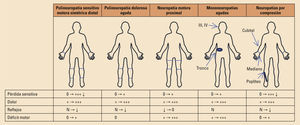
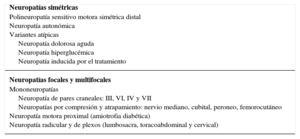
La neuropatía diabética puede que sea la complicación más frecuente de la diabetes y engloba a un grupo de alteraciones funcionales con diversas manifestaciones clínicas, algunas de las cuales pueden coexistir en el mismo individuo.

Clínica

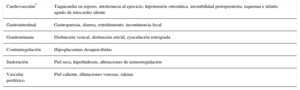
La forma clínica más frecuente, la polineuropatía distal sensorimotora, es responsable de una gran morbilidad, mortalidad y deterioro de la calidad de vida. Los síntomas pueden variar desde la ausencia de clínica, con pies sin sensibilidad con riesgo de ulceración, hasta la presencia de un dolor neuropático insoportable. La neuropatía autonómica puede afectar a muchos sistemas (gastrointestinal, genitourinario, cardiovascular) y su presencia se asocia a una mayor mortalidad sobre todo de origen cardiovascular.

Diagnóstico

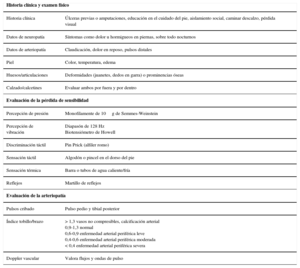
El diagnóstico de la neuropatía es de exclusión, existen procedimientos de diagnóstico y cribado sencillos y estandarizados que deben llevar a cabo de manera regular para prevenir la ulceración y la amputación.

Tratamiento

Al no haber un tratamiento específico, solo podemos utilizar el control óptimo de la glucemia, los tratamientos sintomáticos y las estrategias de prevención de la ulceración. Una vez que la úlcera aparece en el pie, la descarga de presión, la evaluación vascular y el tratamiento de la infección si la hay en el seno de un programa de atención al pie diabético son vitales para prevenir amputaciones.

Palabras clave
Complicaciones de la diabetes
Neuropatía diabética
Pie diabético
Abstract
Background

Diabetic neuropathies may be the most common complication of diabetes and include a group of disorders with diverse clinical manifestations some of which can coexist in the same individual.

Clinical practice

The most frequent clinical presentation, diabetic distal symmetric sensorimotor polyneuropathy is responsible for substantial morbidity, increased mortality and impaired quality of life. Symptoms may range from asymptomatic numb feet at risk of ulceration to excruciating neuropathic pain. Autonomic neuropathy affects many systems (gastrointestinal, genitourinary and cardiovascular) and is associated with an increase in mortality mainly cardiovascular.

Diagnostic

Diabetic neuropathy is a diagnosis of exclusion, there are very simple standardized diagnostic and screening procedures that should be carried out regularly to prevent ulceration and amputation.

Treatment

Since there is no specific treatment we can only implement good glycemic control, symptomatic treatment and strategies for ulcer prevention. Once a foot ulcer is present, offloading, vascular evaluation, treatment of infection if present within an organized diabetes foot care are vital to prevent amputation.

Keywords
Diabetic complications
Diabetic neuropathy
Diabetic foot

Identifíquese

¿Aún no es suscriptor de la revista?

Comprar el acceso al artículo

Comprando el artículo el pdf del mismo podrá ser descargado

Teléfono para incidencias

De lunes a viernes de 9h a 18h (GMT+1) excepto los meses de julio y agosto que será de 9 a 15h

Llamadas desde España 932 415 960
Llamadas desde fuera de España +34 932 415 960
Bibliografía
[1]
Textbook of diabetes., 2nd ed., Blackwell Science,
[2]
201611050029475598
S. Tesfaye, L.K. Stevens, J.M. Stephenson, J.H. Fuller, M. Plater, C. Ionescu-Tirgoviste, et al.
Prevalence of diabetic peripheral neuropathy and its relation to glycaemic control and potential risk factors: the EURODIAB IDDM Complications Study.
Diabetologia., (1996), 39 pp. 1377-1384
[3]
C.L. Martin, J.W. Albers, R. Pop-Busui, DCCT/EDIC Research Group.
Neuropathy and related findings in the diabetes control and complications trial/epidemiology of diabetes interventions and complications study.
Diabetes Care., (2014), 37 pp. 31-38
[4]
201611050029475599
J. Cabezas-Cerrato, The prevalence of clinical diabetic polyneuropathy in Spain: a study in primary care and hospital clinic groups. Neuropathy Spanish Study Group of the Spanish Diabetes Society (SDS).
Diabetologia, (1998), 41 pp. 1263-1269
[5]
Joslin's Diabetes Mellitus., 14th ed., Lippincot William and Wilkins,
[6]
2016110500294755910
S. Tesfaye, A.J. Boulton, P.J. Dyck, R. Freeman, M. Horowitz, P. Kempler, Toronto Diabetic Neuropathy Expert Group, et al.
Diabetic neuropathies: update on definitions, diagnostic criteria, estimation of severity, and treatments.
Diabetes Care., (2010), 33 pp. 2285-2293
[7]
P.J. Dyck, J.W. Albers, H. Andersen, J.C. Arezzo, G.J. Biessels, V. Bril, Toronto Expert Panel on Diabetic Neuropathy.
Diabetic polyneuropathies: update on research definition, diagnostic criteria and estimation of severity.
Diabetes Metab Res Rev., (2011), 27 pp. 620-628
[8]
American Diabetes Association Standards of medical care.
9 Microvascular Complications and Foot Care. American Diabetes Association.
Diabetes Care., (2016), 39Suppl1 pp. S72-S80
[9]
M.H. Pourmemari, R. Shiri.
Diabetes as a risk factor for carpal tunnel syndrome: a systematic review and meta-analysis.
Diabet Med., (2016), 33 pp. 10-16
[10]
V. Spallone, D. Ziegler, R. Freeman, L. Bernardi, S. Frontoni, R. Pop-Busui, Toronto Consensus Panel on Diabetic Neuropathy.
Cardiovascular autonomic neuropathy in diabetes: clinical impact, assessment, diagnosis, and management.
Diabetes Metab Res Rev., (2011), 27 pp. 639-653
[11]
P. Valensi, J. Pariès, J.R. Attali, French Group for Research and Study of Diabetic Neuropathy.
Cardiac autonomic neuropathy in diabetic patients: influence of diabetes duration, obesity, and microangiopathic complications--the French multicenter study.
Metabolism., (2003), 52 pp. 815-820
[12]
D.J. Ewing, I.W. Campbell, B.F. Clarke.
Assessment of cardiovascular effects in diabetic autonomic neuropathy and prognostic implications.
Ann Intern Med., (1980), 92 pp. 308-311
[13]
2016110500294755911
R.E. Maser, B.D. Mitchell, A.I. Vinik, R. Freeman.
The association between cardiovascular autonomic neuropathy and mortality in individuals with diabetes: a meta-analysis.
Diabetes Care., (2003), 26 pp. 1895-1901
[14]
2016110500294755912
2016110500294755913
A.I. Vinik, R.E. Maser, B.D. Mitchell, R. Freeman.
Diabetic autonomic neuropathy.
Diabetes Care., (2003), 26 pp. 1553-1579
[15]
D.J. Brotman, L.D. Bash, R. Qayyum, D. Crews, E.A. Whitsel, B.C. Astor, et al.
Heart rate variability predicts ESRD and CKD-related hospitalization.
J Am Soc Nephrol., (2010), 21 pp. 1560-1570
[16]
M. Ellenberg.
Development of urinary bladder dysfunction in diabetes mellitus.
Ann Intern Med., (1980), 92 pp. 321-323
[17]
V. Spallone, R. Morganti, C. D’Amato, C. Greco, L. Cacciotti, G.A. Marfia.
Validation of DN4 as a screening tool for neuropathic pain in painful diabetic polyneuropathy.
Diabet Med., (2012), 29 pp. 578-585
[18]
A.J. Boulton, D.G. Armstrong, S.F. Albert, R.G. Frykberg, R. Hellman, M.S. Kirkman, American Diabetes Association; American Association of Clinical Endocrinologists. Comprehensive foot examination and risk assessment: a report of the task force of the foot care interest group of the American Diabetes Association, with endorsement by the American Association of Clinical Endocrinologists.
Diabetes Care., (2008), 31 pp. 1679-1685
[19]
2016110500294755914
K. Bakker, J. Apelqvist, N.C. Schaper, International Working Group on Diabetic Foot Editorial Board.
Practical guidelines on the management and prevention of the diabetic foot 2011.
Diabetes Metab Res Rev., (2012), 28Suppl1 pp. 225-231
[20]
2016110500294755915
Diabetic Foot Problems: Prevention and, Management.
Editors Internal Clinical Guidelines team.
National Institute for Health and Care Excellence (UK), (2015),
Disponible en: nice.orguk/guidance/ng/19
[21]
2016110500294755916
Grupo de trabajo de la Guía de Práctica Clínica sobre Diabetes tipo 2..
Guía de Práctica Clínica sobre Diabetes tipo 2.
Plan Nacional para el SNS del MSC. Agencia de Evaluación de Tecnologías Sanitarias del País Vasco, (2008),
Guías de Práctica Clínica en el SNS: OSTEBA N° 2006/08
[22]
J.M. Carrasco Gimeno, M.J. Vicente Edo, J.I. Martín Sánchez, S. García Rodríguez, I. Muñoz Guajardo, et al.
Complicaciones de la diabetes. Neuropatía diabética. Plan de Calidad para el Sistema Nacional de Salud del Ministerio de Sanidad, Política Social e igualdad.
Instituto Aragonés de Ciencias de la Salud, (2010),
Informes de Evaluación de Tecnologías Sanitarias: I+CS N° 2007/06-3
[23]
A.I. Vinik, D. Ziegler.
Diabetic cardiovascular autonomic neuropathy.
Circulation., (2007), 115 pp. 387-397
[24]
Diabetes Control and Complications Trial Research Group.
The effect of intensive diabetes therapy on measures of autonomic nervous system function in the Diabetes Control and Complications Trial (DCCT).
Diabetologia., (1998), 41 pp. 416-423
[25]
P. Gaede, P. Vedel, N. Larsen, G.V. Jensen, H.H. Parving, O. Pedersen.
Multifactorial intervention and cardiovascular disease in patients with type 2 diabetes.
N Engl J Med., (2003), 348 pp. 383-393
[26]
M.C. Riddle, W.T. Ambrosius, D.J. Brillon, J.B. Buse, R.P. Byington, R.M. Cohen, Action to Control Cardiovascular Risk in Diabetes Investigators, et al.
Epidemiologic relationships between A1C and all-cause mortality during a median 3.4-year follow-up of glycemic treatment in the ACCORD trial.
Diabetes Care., (2010), 33 pp. 983-990
[27]
2016110500294755917
B.C. Callaghan, A.A. Little, E.L. Feldman, R.A. Hughes.
Enhanced glucose control for preventing and treating diabetic neuropathy.
Cochrane Database Syst Rev., (2012), 6
CD007543
[28]
K.E. Schemmel, R.S. Padiyara, J.J. D'Souza.
Aldose reductase inhibitors in the treatment of diabetic peripheral neuropathy: a review.
J Diabetes Complications., (2010), 24 pp. 354-360
[29]
D. Ziegler, H. Nowak, P. Kempler, P. Vargha, P.A. Low.
Treatment of symptomatic diabetic polyneuropathy with the antioxidant alpha-lipoic acid: a meta-analysis.
Diabet Med., (2004), 21 pp. 114-121
[30]
D. Ziegler, P.A. Low, W.J. Litchy, A.J. Boulton, A.I. Vinik, R. Freeman, et al.
Efficacy and safety of antioxidant treatment with α-lipoic acid over 4 years in diabetic polyneuropathy: the NATHAN 1 trial.
Diabetes Care., (2011), 34 pp. 2054-2060
[31]
V. Bril, J. England, G.M. Franklin, M. Backonja, J. Cohen, D. Del Toro, et al.
Evidence-based guideline: Treatment of painful diabetic neuropathy. Report of the American Academy of Neurology, the American Association of Neuromuscular and Electrodiagnostic Medicine, and the American Academy of Physical Medicine and Rehabilitation.
PMR, (2011), 3 pp. 345-352
[32]
W.J. Jeffcoate, W.H. van Houtum.
Amputation as a marker of the quality of foot care in diabetes.
Diabetologia., (2004), 47 pp. 2051-2058
[33]
A. López-de-Andres, R. Jiménez-García, J. Aragón-Sánchez, I. Jiménez-Trujillo, V. Hernández-Barrera, M. Méndez-Bailón, et al.
National trends in incidence and outcomes in lower extremity amputations in people with and without diabetes in Spain, 2001-2012.
Diabetes Res Clin Pract., (2015), 108 pp. 499-507
[34]
2016110500294755918
B.A. Lipsky, A.R. Berendt, P.B. Cornia, J.C. Pile, E.J. Peters, D.G. Armstrong, Infectious Diseases Society of America, et al.
2012 Infectious Diseases Society of America clinical practice guideline for the diagnosis and treatment of diabetic foot infections.
Clin Infect Dis., (2012), 54 pp. e132-e173