

Vol. 14. Núm. 18.
Páginas 1055-1063 (Octubre 2024)

Actualización
Objetivos del tratamiento de la diabetes mellitus tipo 1

Treatment goals for type 1 diabetes mellitus

A. Bayona CebadaabcdJ.B. Quiñones SilvaaH.F. Escobar-MorrealebcdL. Nattero Chávezabc
Doi : https://10.1016/j.med.2024.10.002
Opciones
Resumen

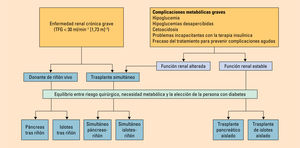
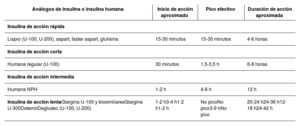
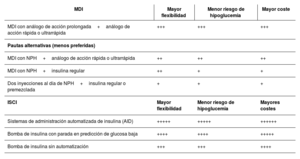
Existen tres maneras de evaluar el control glucémico en la diabetes tipo 1 (DM1): la hemoglobina glicada (HbA1c, objetivo general menor o igual al 7%), el TER 70-180mg/dl (objetivo general 70% o superior) y la glucemia capilar. La educación diabetológica es un elemento fundamental para lograr el automanejo de la enfermedad, y se basa en tres pilares fundamentales: alimentación; terapia insulínica y manejo de la tecnología aplicada a la diabetes (sensores, bombas de insulina, bolígrafos conectados y aplicaciones móviles). El tratamiento farmacológico de la DM1 consiste en la terapia insulínica intensiva mediante múltiples dosis de insulina (MDI) o infusión subcutánea continua de insulina (ISCI). La elección de la pauta de tratamiento debe hacerse en función de las características del paciente y otras consideraciones clínicas (por ejemplo, embarazo, presencia de hipoglucemias desapercibidas o requerimientos variables de insulina). Actualmente no existe ningún otro tratamiento adyuvante de la insulina que esté aprobado para su uso en la DM1, aunque se han utilizado fármacos de la DM2 como los análogos de GLP-1 o los inhibidores de SGLT2 que pueden aportar beneficios en el control glucémico o la pérdida ponderal. El trasplante de páncreas-riñón o de islotes pancreáticos se plantea como última opción en pacientes con enfermedad renal crónica terminal de manera conjunta o posterior al trasplante renal, o en individuos con hipoglucemias desapercibidas o graves de repetición que no responden a la optimización del manejo.

Palabras clave
Control glucémico
Educación diabetológica
Terapia insulínica intensiva
Múltiples dosis de insulina
Bomba de insulina
Fármacos adyuvantes
Abstract

There are three ways to assess blood glucose control in type 1 diabetes (DM1): glycated hemoglobin (HbA1c, general target less than or equal to 7%), time in the 70–180mg/dl range (general target 70% or higher), and capillary blood glucose. Diabetes education is a fundamental element in achieving self-management of the disease. It is based on three fundamental pillars: nutrition, insulin therapy, and management of diabetes technology (sensors, insulin pumps, smart insulin pens, and mobile applications). Drug treatment for DM1 consists of intensive insulin therapy using multiple dose injection (MDI) or continuous subcutaneous insulin infusion (CSII). The choice of treatment regimen should be based on patient characteristics and other clinical considerations (e.g., pregnancy, presence of undetected hypoglycemia, or variable insulin requirements). There are currently no other insulin adjuvant therapies approved for use in DM1, although DM2 drugs such as GLP-1 analogs or SGLT2 inhibitors that may provide benefits in blood glucose control or weight loss have been used. Kidney-pancreas or pancreatic islet transplantation is considered a final option in patients with end-stage chronic kidney disease together with or following renal transplantation or in individuals with undetected or severe recurrent hypoglycemia that does not respond to optimized management.

Keywords
Blood glucose control
Diabetes education
Intensive insulin therapy
Multiple dose injection
Insulin pump
Adjuvant drugs

Identifíquese

¿Aún no es suscriptor de la revista?
Comprar el acceso al artículo

Comprando el artículo el pdf del mismo podrá ser descargado

Teléfono para incidencias

De lunes a viernes de 9h a 18h (GMT+1) excepto los meses de julio y agosto que será de 9 a 15h
Llamadas desde España 932 415 960
Llamadas desde fuera de España +34 932 415 960
Bibliografía
[1]
R.W. Beck
202410140632020068
202410140632020069
, K.M. Miller, N.C. Foster.
The T1D exchange clinic network and registry: 10 years of enlightenment on the state of type 1 diabetes in the UnitedStates.
Diabetes Technol Ther., (2019), 21 pp. 310
[2]
T. Battelino
2024101406320200610
2024101406320200611
, T. Danne, R.M. Bergenstal, S.A. Amiel, R. Beck, T. Biester, et al.
Clinical targets for continuous glucose monitoring data interpretation: Recommendations from the International Consensus on Time in Range.
Diabetes Care., (2019), 42 pp. 1593-1603
[3]
N. Wei
2024101406320200612
2024101406320200613
, H. Zheng, D.M. Nathan.
Empirically establishing blood glucose targets to achieve HbA1c goals.
Diabetes Care., (2014), 37 pp. 1048
[4]
R.W. Beck, R.M. Bergenstal, P. Cheng, C. Kollman, A.L. Carlson, M.L. Johnson, et al.
The relationships between time in range, hyperglycemia metrics, and HbA1c.
J Diabetes Sci Technol., (2019), 13 pp. 614-626
[5]
American
2024101406320200614
2024101406320200615
Diabetes Association Professional Practice Committee.
6. Glycemic goals and hypoglycemia: Standards of care in diabetes-2024.
Diabetes Care, (2024), 47Suppl1 pp. S111-S125
[6]
E. Toschi
2024101406320200616
2024101406320200617
, C. Slyne, K. Sifre, R. O’Donnell, J. Greenberg, A. Atakov-Castillo, et al.
The relationship between CGM-derived metrics, A1C, and risk of hypoglycemia in older adults with type 1 diabetes.
Diabetes Care., (2020), 43 pp. 2349-2354
[7]
Weinstoch
2024101406320200618
RS. Management of blood glucose in adults with type 1 diabetes mellitus. Uptodate. Disponible en: www.uptodate.com. Última actualización 2 Ene 2024.
[8]
K.J. Bell
2024101406320200619
2024101406320200620
, E. Toschi, G.M. Steil, H.A. Wolpert.
Optimized mealtime insulin dosing for fat and protein in type 1 diabetes: Application of a model-based approach to derive insulin doses for open-loop diabetes management.
Diabetes Care., (2016), 39 pp. 1631-1634
[9]
American
2024101406320200621
2024101406320200622
Diabetes Association Professional Practice Committee.
9. Pharmacologic approaches to glycemic treatment: Standards of care in diabetes-2024.
Diabetes Care, (2024), 47Suppl1 pp. S158-S178
[10]
V. Zoffmann
2024101406320200623
2024101406320200624
, D. Vistisen, M. Due-Christensen.
A cross-sectional study of glycaemic control, complications and psychosocial functioning among 18- to 35-year-old adults with type 1 diabetes.
Diabet Med., (2014), 31 pp. 493-499
[11]
The Diabetes
2024101406320200625
2024101406320200626
Control Complications Trial Research Group.
Effect of intensive therapy on residual beta-cell function in patients with type 1 diabetes in the diabetes control and complications trial. A randomized, controlled trial.
[12]
I. Bebu
2024101406320200627
2024101406320200628
, D. Schade, B. Braffett, M. Kosiborod, M. Lopes-Virella, E.Z. Soliman, et al.
DCCT/EDIC Research Group. Risk factors for first and subsequent CVD events in type 1 diabetes: The DCCT/EDIC Study.
Diabetes Care., (2020), 43 pp. 867-874
[13]
R.I.G. Holt
2024101406320200629
2024101406320200630
, J.H. DeVries, A. Hess-Fischl, I.B. Hirsch, M.S. Kirkman, T. Klupa, et al.
The management of type 1 diabetes in adults. A consensus report by the American Diabetes Association (ADA) and the European Association for the Study of Diabetes (EASD).
Diabetes Care., (2021), 44 pp. 2589-2625
[14]
A. Hamann
2024101406320200631
2024101406320200632
, S. Matthaei, C. Rosak, L. Silvestre, HOE901/4007 Study Group.
A randomized clinical trial comparing breakfast, dinner, or bedtime administration of insulin glargine in patients with type 1 diabetes.
Diabetes Care., (2003), 26 pp. 1738-1744
[15]
A.C. Tricco
2024101406320200633
2024101406320200634
, H.M. Ashoor, J. Antony, J. Beyene, A.A. Veroniki, W. Isaranuwatchai, et al.
Safety, effectiveness, and cost effectiveness of long acting versus intermediate acting insulin for patients with type 1 diabetes: systematic review and network meta-analysis.
BMJ., (2014), 349 pp. g5459
[16]
R. Aronson
2024101406320200635
2024101406320200636
, T. Biester, J. Leohr, R. Pollom, H. Linnebjerg, E.S. LaBell, et al.
Ultra rapid lispro showed greater reduction in postprandial glucose versus Humalog in children, adolescents and adults with type 1 diabetes mellitus.
Diabetes Obes Metab., (2023), 25 pp. 1964-1972
[17]
D. Russell-Jones
2024101406320200637
2024101406320200638
, B.W. Bode, C. De Block, E. Franek, S.R. Heller, C. Mathieu, et al.
Fast-acting insulin aspart improves glycemic control in basal-bolus treatment for type 1 diabetes: Results of a 26-week multicenter, active-controlled, treat-to-target, randomized, parallel-group trial (onset 1).
Diabetes Care., (2017), 40 pp. 943-950
[18]
W. Lane
2024101406320200639
2024101406320200640
, T.S. Bailey, G. Gerety, J. Gumprecht, A. Philis-Tsimikas, C.T. Hansen, et al.
Effect of insulin degludec vs insulin glargine u100 on hypoglycemia in patients with type 1 diabetes: The SWITCH 1 Randomized Clinical Trial.
JAMA., (2017), 318 pp. 33-44
[19]
A. Peters
2024101406320200641
2024101406320200642
, L. Laffel, J.L. Chiang.
The American Diabetes Association/JDRF type 1 diabetes Sourcebook.
1ª ed, American Diabetes Association, (2013),
[20]
J.L. Chiang, M.S. Kirkman, L.M. Laffel, A.L. Peters.
Type 1 diabetes sourcebook authors. Type 1 diabetes through the life span: a position statement of the American Diabetes Association.
Diabetes Care., (2014), 37 pp. 2034-2054
[21]
H.C. Yeh
2024101406320200643
2024101406320200644
, T.T. Brown, N. Maruthur, P. Ranasinghe, Z. Berger, Y.D. Suh, et al.
Comparative effectiveness and safety of methods of insulin delivery and glucose monitoring for diabetes mellitus: a systematic review and meta-analysis.
Ann Intern Med., (2012), 157 pp. 336-347
[22]
L. Pala
2024101406320200645
2024101406320200646
, I. Dicembrini, E. Mannucci.
Continuous subcutaneous insulin infusion vs modern multiple injection regimens in type 1 diabetes: an updated meta-analysis of randomized clinical trials.
Acta Diabetol., (2019), 56 pp. 973
[23]
G. Sindelka
2024101406320200647
2024101406320200648
, L. Heinemann, M. Berger, W. Frenck, E. Chantelau.
Effect of insulin concentration, subcutaneous fat thickness and skin temperature on subcutaneous insulin absorption in healthy subjects.
Diabetologia., (1994), 37 pp. 377-380
[24]
G.P. Forlenza
2024101406320200649
2024101406320200650
, Z. Li, B.A. Buckingham, J.E. Pinsker, E. Cengiz, R.P. Wadwa, et al.
Predictive low-glucose suspend reduces hypoglycemia in adults, adolescents, and children with type 1 diabetes in an at-home randomized crossover study: Results of the PROLOG Trial.
Diabetes Care., (2018), 41 pp. 2155-2161
[25]
Y.C. Qiao
2024101406320200651
2024101406320200652
, W. Ling, Y.H. Pan, Y.L. Chen, D. Zhou, Y.M. Huang, et al.
Efficacy and safety of pramlintide injection adjunct to insulin therapy in patients with type 1 diabetes mellitus: a systematic review and meta-analysis.
Oncotarget., (2017), 8 pp. 66504-66515
[26]
H. Meng
2024101406320200653
2024101406320200654
, A. Zhang, Y. Liang, J. Hao, X. Zhang, J. Lu.
Effect of metformin on glycaemic control in patients with type 1 diabetes: A meta-analysis of randomized controlled trials.
Diabetes Metab Res Rev., (2018), 34 pp. e2983
[27]
J.R. Petrie
2024101406320200655
2024101406320200656
, N. Chaturvedi, I. Ford, M.C.G.J. Brouwers, N. Greenlaw, T. Tillin, et al.
REMOVAL Study Group. Cardiovascular and metabolic effects of metformin in patients with type 1 diabetes (REMOVAL): a double-blind, randomised, placebo-controlled trial.
Lancet Diabetes Endocrinol., (2017), 5 pp. 597-609
[28]
C. Mathieu
2024101406320200657
2024101406320200658
, B. Zinman, J.U. Hemmingsson, V. Woo, P. Colman, E. Christiansen, et al.
ADJUNCT ONE Investigators. Efficacy and safety of liraglutide added to insulin treatment in type 1 diabetes: The ADJUNCT ONE Treat-To-Target Randomized Trial.
Diabetes Care., (2016), 39 pp. 1702-1710
[29]
L. Rao
2024101406320200659
2024101406320200660
, C. Ren, S. Luo, C. Huang, X. Li.
Sodium-glucose cotransporter 2 inhibitors as an add-on therapy to insulin for type 1 diabetes mellitus: Meta-analysis of randomized controlled trials.
Acta Diabetol., (2021), 58 pp. 869-880
[30]
T. Danne
2024101406320200661
2024101406320200662
, S. Garg, A.L. Peters, J.B. Buse, C. Mathieu, J.H. Pettus, et al.
International consensus on risk management of diabetic ketoacidosis in patients with type 1 diabetes treated with sodium-glucose cotransporter (SGLT) Inhibitors.
Diabetes Care., (2019), 42 pp. 1147-1154
[31]
K.C. Herold
2024101406320200663
2024101406320200664
, B.N. Bundy, S.A. Long, J.A. Bluestone, L.A. DiMeglio, M.J. Dufort, et al.
Type 1 Diabetes TrialNet Study Group. An Anti-CD3 antibody, teplizumab, in relatives at risk for type 1 diabetes.
N Engl J Med., (2019), 381 pp. 603-613
[32]
J.M. Lachin
2024101406320200665
2024101406320200666
, P. McGee, J.P. Palmer, DCCT/EDIC. Research Group.
Impact of C-peptide preservation on metabolic and clinical outcomes in the Diabetes Control and Complications Trial.
Diabetes., (2014), 63 pp. 739-748
[33]
P.G. Dean
2024101406320200667
2024101406320200668
, A. Kukla, M.D. Stegall, Y.C. Kudva.
Pancreas transplantation.
BMJ, (2017), 357 pp. j1321