

Vol. 12. Núm. 16.
Páginas 909-914 (Septiembre 2016)

Actualización
Osteomalacia

Osteomalacia

A. Quesada MorenoM.D. Sánchez GonzálezC. Hidalgo CallejaC. Montilla MoralesJ. del Pino-Montes
Doi : https://10.1016/j.med.2016.07.004
Opciones
Resumen
Etiología

Osteomalacia y raquitismo son entidades relacionadas con un defecto de la mineralización ósea. La causa más frecuente es el déficit severo de vitamina D que en nuestro medio se da en situaciones de exclusión social o malabsorción. Menos frecuentes son las alteraciones congénitas o adquiridas del metabolismo de la vitamina D, diversos tipos de hipofosfatemia o la presencia de inhibidores de la mineralización. Existe una forma paraneoplásica de osteomalacia relacionada con tumores que expresan FGF-23, hormona fosfatúrica.

Manifestaciones clínicas

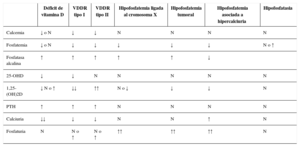
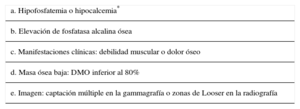
El cuadro clínico suele ser asintomático, pero puede haber dolores óseos y debilidad muscular. La tetania se observa en casos con hipocalcemia severa. En las formas muy evolucionadas la radiología muestra vértebras bicóncavas o deformidad de los huesos largos con pseudofracturas de Looser. Cuando hay déficit de vitamina D, los niveles sanguíneos de 25(OH)2D, calcio, fósforo y la calciuria están descendidos, mientras la fosfatasa alcalina y la PTH en sangre están elevadas.

Diagnóstico y tratamiento

Se confirma por histomorfometría ósea. Es importante tratar la causa de la osteomalacia, si fuera posible. En caso de déficit de vitamina D, se corregirá la deficiencia asegurando una adecuada ingesta de calcio. En algunas ocasiones se necesitarán dosis muy elevadas de vitamina D.

Palabras clave
Osteomalacia
Mineralización
Vitamina D
FGF-23
Abstract
Aetiology

Osteomalacia and rickets are entities related to a bone mineralisation defect. The most common cause is severe vitamin D deficiency, which in Spain takes place in conditions of social exclusion and malabsorption. Less common causes include congenital and acquired vitamin D metabolism abnormalities, various types of hypophosphataemia and the presence of mineralisation inhibitors. There is a paraneoplastic form of osteomalacia related to tumours that express the phosphaturic hormone FGF-23.

Clinical manifestations

The clinical condition is usually asymptomatic but can include bone pain and muscle weakness. Tetany is observed in cases with severe hypocalcaemia. In highly progressed forms, radiology shows biconcave vertebra or long bone deformation with Looser's zones (pseudofractures). When there is a vitamin D deficiency, blood levels of 25(OH)2D, calcium, phosphorus and calciuria are decreased, while blood phosphatase alkaline and PTH levels are high.

Diagnosis and treatment

The diagnosis is confirmed by bone histomorphometry. It is important to treat the cause of the osteomalacia, if possible. For vitamin D deficiency, the deficit is corrected by ensuring a proper intake of calcium. Very high doses of vitamin D are sometimes necessary.

Keywords
Osteomalacia
Mineralisation
Vitamin D
FGF-23

Identifíquese

¿Aún no es suscriptor de la revista?

Comprar el acceso al artículo

Comprando el artículo el pdf del mismo podrá ser descargado

Teléfono para incidencias

De lunes a viernes de 9h a 18h (GMT+1) excepto los meses de julio y agosto que será de 9 a 15h

Llamadas desde España 932 415 960
Llamadas desde fuera de España +34 932 415 960
Bibliografía
[1]
201609080019551078
L.A. Russell.
Osteoporosis and osteomalacia.
Rheum Dis Clin North Am., (2010), 36 pp. 665-680
[2]
201609080019551079
A. Bhan, A.D. Rao, D.S. Rao.
Osteomalacia as a result of vitamin D deficiency.
Rheum Dis Clin North Am, (2012), 38 pp. 81-91
[3]
TDfx4fx1TD P. Lips, N.M.Van Schoor, N. Bravenboer.
Vitamin D – related disorders.
Primer on the metabolic bone diseases and disorders of mineral metabolism, 8ª ed., Wiley-Blackwell, pp. 613-623
[4]
2016090800195510710
2016090800195510711
S. Fukumoto, Y. Shimizu.
Fibroblast growth factor 23 as a phosphotropic hormone and beyond.
J Bone Miner Metab, (2011), 29 pp. 507-514
[5]
J.Q. Feng, E.L. Clinkenbeard, B. Yuan, K.E. White, M.K. Drezner.
Osteocyte regulation of phosphate homeostasis and bone mineralization underlies the pathophysiology of the heritable disorders of rickets and osteomalacia.
[6]
2016090800195510712
2016090800195510713
W. Högler, C.F. Munns.
Rickets and osteomalacia: a call for action to protect immigrants and ethnic risk groups.
Lancet Glob Heal, (2016), 4 pp. e229-e230
[7]
B. Basha, D.S. Rao, Z.H. Han, A.M. Parfitt.
Osteomalacia due to vitamin D depletion: a neglected consequence of intestinal malabsorption.
Am J Med, (2000), 108 pp. 296-300
[8]
2016090800195510714
P. Peris.
Diagnóstico y tratamiento de la osteomalacia por el reumatólogo.
Reumatol Clin, (2011), 7Suppl2 pp. S22-S27
[9]
2016090800195510715
2016090800195510716
J.-Y. Reginster.
The high prevalence of inadequate serum vitamin D levels and implications for bone health.
Curr Med Res Opin, (2005), 21 pp. 579-586
[10]
S. Capelli, V. Donghi, K. Maruca, G. Vezzoli, S. Corbetta, M.L. Brandi, et al.
Clinical and molecular heterogeneity in a large series of patients with hypophosphatemic rickets.
[11]
2016090800195510717
2016090800195510718
G. Alonso, M. Varsavsky.
Tumour-induced osteomalacia: An emergent paraneoplastic syndrome.
Endocrinol Nutr., (2016), 63 pp. 181-186
[12]
2016090800195510719
P. Chiam, H.C. Tan, Y.M. Bee, M. Chandran.
Oncogenic osteomalacia -- hypophosphataemic spectrum from “benignancy” to “malignancy”.
[13]
2016090800195510720
2016090800195510721
S.K. Gupta, A.M. Anderson, R. Ebrahimi, T. Fralich, H. Graham, V. Scharen-Guivel, et al.
Fanconi syndrome accompanied by renal function decline with tenofovir disoproxil fumarate: a prospective, case-control study of predictors and resolution in HIV-infected patients.
[14]
2016090800195510722
T.P. van Staa, H. Leufkens, L. Abenhaim, C. Cooper.
Postmarketing surveillance of the safety of cyclic etidronate.
Pharmacotherapy., (1988), 18 pp. 1121-1128
[15]
2016090800195510723
2016090800195510724
M.P. Whyte.
Hypophosphatasia - aetiology, nosology, pathogenesis, diagnosis and treatment.
Nat Rev Endocrinol, (2016), 12 pp. 233-246
[16]
2016090800195510725
2016090800195510726
L. Gifre, P. Peris, A. Monegal, M.J. Martinez De Osaba, L. Alvarez, N. Guañabens.
Osteomalacia revisited: A report on 28 cases.
Clin Rheumatol, (2011), 30 pp. 639-645
[17]
2016090800195510727
AJ Reginato, G.F. Falasca, R. Pappu, B. McKnight, A. Agha.
Musculoskeletal manifestations of osteomalacia: report of 26 cases and literature review.
Semin Arthritis Rheum, (1999), 28 pp. 287-304
[18]
2016090800195510728
A.J. Reginato, J.A. Coquia.
Musculoskeletal manifestations of osteomalacia and rickets.
Best Pract Res Clin Rheumatol, (2003), 17 pp. 1063-1080
[19]
2016090800195510729
M.G. Bonilla Hernán.
Osteomalacia.
Manual de las enfermedades óseas., Editorial Médica Panamericana, pp. 381-387
[20]
2016090800195510730
M. Sundaram.
Founders lecture 2007: Metabolic bone disease: what has changed in 30 years?.
Skeletal Radiol, (2009), 38 pp. 841-853
[21]
2016090800195510731
GJR FJ Cook.
Metabolic bone diseases.
Clinical nuclear medicine, 4ª ed., CRC Press, pp. 355-363
[22]
2016090800195510732
2016090800195510733
S. Abdelrazek, P. Szumowski, F. Rogowski, A. Kociura-Sawicka, M. Mojsak, M. Szorc.
Bone scan in metabolic bone diseases.
Review Nucl Med Rev., (2012), 15 pp. 124-131
[23]
M. Saghafi, A. Azarian, K. Hashemzadeh, M. Sahebari, Z. Rezaieyazdi.
Bone densitometry in patients with osteomalacia: is it valuable?.
Clin Cases Miner Bone Metab, (2013), 10 pp. 180-182
[24]
2016090800195510734
G. Haugeberg.
Imaging of metabolic bone diseases.
Best Pract Res Clin Rheumatol, (2008), 22 pp. 1127-1139
[25]
A.M.
2016090800195510735
Parfitt, S. Qiu, D.S. Rao.
The mineralization index--a new approach to the histomorphometric appraisal of osteomalacia.
[26]
2016090800195510736
2016090800195510737
S. Fukumoto, K. Ozono, T. Michigami, M. Minagawa, R. Okazaki, T. Sugimoto, et al.
Pathogenesis and diagnostic criteria for rickets and osteomalacia--proposal by an expert panel supported by the Ministry of Health, Labour and Welfare, Japan, the Japanese Society for Bone and Mineral Research, and the Japan Endocrine Society.
J Bone Miner Metab, (2015), 33 pp. 467-473
[27]
M.J. McKenna, E. Heffernan, C. Hurson, F.E. McKiernan.
Clinician approach to diagnosis of stress fractures including bisphosphonate-associated fractures.
QJM, (2014), 107 pp. 99-105