

Vol. 14. Núm. 54.
Páginas 3319-3324 (Mayo 2026)

Protocolos de práctica asistencial
Protocolo de cribado de las enfermedades infecciosas en el trasplante

Protocol for screening for infectious diseases in transplantation

M.D. Corbacho-LoarteabM. Suárez-RoblesabD. Gayoso-CanteroabM. Rosas Cancio-SuárezabA.G. García-Ruiz de MoralesabC.M. CanoabJ. Díaz-ÁlvarezabR. Navarro-SolerabS. Morenoab
Doi : https://10.1016/j.med.2026.04.023
Opciones
Resumen

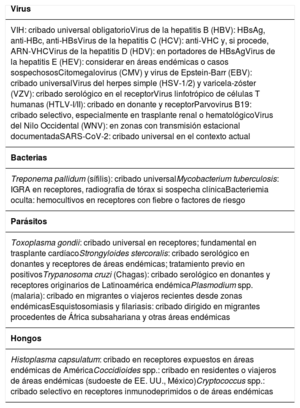
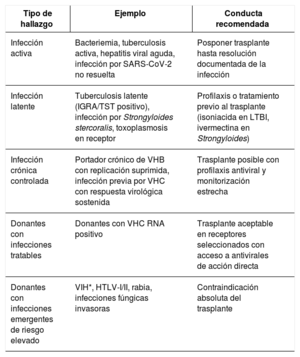
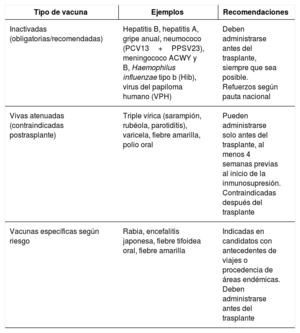
Las infecciones son complicaciones críticas en el trasplante de órganos sólidos, provocando morbilidad y mortalidad significativas. El riesgo se debe a la transmisión de patógenos y la reactivación de infecciones latentes en receptores inmunosuprimidos. La mejora de los protocolos de cribado estandarizados es vital para detectar infecciones activas y latentes, prevenir la transmisión de enfermedades y optimizar la inmunidad del receptor con vacunación. Organismos como la OMS y la AST proporcionan directrices para la práctica clínica, que incluyen evaluación epidemiológica y serologías esenciales para donantes y receptores. Las infecciones activas requieren posponer el trasplante, mientras que las latentes pueden necesitar profilaxis. Un seguimiento regular es crucial para asegurar la trazabilidad de infecciones y ajustar los protocolos. En resumen, un cribado integral y adaptado a la epidemiología local mejora la seguridad del trasplante y los resultados clínicos.

Palabras clave
Trasplante
,Cribado pretrasplante Vacunación pretrasplante
Seguridad del trasplante
Abstract

Infections are critical complications in solid organ transplantation, causing significant morbidity and mortality. The risk stems from pathogen transmission and the reactivation of latent infections in immunosuppressed recipients. Improving standardized screening protocols is vital for detecting active and latent infections, preventing disease transmission, and optimizing recipient immunity through vaccination. Organizations such as the WHO and the AST provide clinical practice guidelines, which include the essential epidemiological assessment and serology for donors and recipients. Active infections require postponing the transplant, while latent infections may require prophylaxis. Regular follow-up is crucial to ensure the traceability of infections and adjust protocols. In summary, comprehensive screening tailored to local epidemiology improves transplant safety and clinical outcomes.

Keywords
Transplant
Pre-transplant screening
Pre-transplant vaccination
Transplant safety

Identifíquese

¿Aún no es suscriptor de la revista?

Comprar el acceso al artículo

Comprando el artículo el pdf del mismo podrá ser descargado

Teléfono para incidencias

De lunes a viernes de 9h a 18h (GMT+1) excepto los meses de julio y agosto que será de 9 a 15h

Llamadas desde España 932 415 960
Llamadas desde fuera de España +34 932 415 960
Bibliografía
[1]
World Health
202605140410521968
202605140410521969
Organization (WHO).
Screening of donors and recipients in organ transplantation.
WHO, (2020),
[2]
European
2026051404105219610
2026051404105219611
Centre for Disease Prevention and Control (ECDC).
Assessing the risk of communicable diseases transmission through transplantation of substances of human origin.
ECDC, (2021),
[3]
European
2026051404105219612
2026051404105219613
Directorate for the Quality of Medicines and HealthCare (EDQM).
Guide to the quality and safety of organs for transplantation.
8th ed., Council of Europe, (2022),
[4]
M. Malinis
2026051404105219614
2026051404105219615
, H.W. Boucher, on behalf of the AST Infectious Diseases Community of Practice.
Screening of donor and candidate prior to solid organ transplantation—Guidelines from the American Society of Transplantation Infectious Diseases Community of Practice.
Clin Transplant., (2019), 33 pp. e13548
[5]
Grupo
2026051404105219616
2026051404105219617
de Estudio de la Infección en el Trasplante (GESITRA), Sociedad Española de Enfermedades Infecciosas y Microbiología Clínica (SEIMC), Organización Nacional de Trasplantes (ONT). Documento de consenso sobre cribado de infecciones en trasplante. Enferm Infecc Microbiol Clin. 2011;29Suppl1:1-28.
[6]
N. Kamar, D. Ribes, J. Izopet, L. Rostaing.
Hepatitis E virus infection and solid organ transplantation.
Transplantation., (2013), 96 pp. 206-214
[7]
J.A. Fishman
2026051404105219618
.
Overview: Donor-derived infections in solid organ transplantation.
Am J Transplant., (2017), 17 pp. 876-879
[8]
M.G. Ison
2026051404105219619
, J. Hager, E. Blumberg, J. Burdick, K. Carney, J. Cutler, et al.
Donor-derived disease transmission events in the United States: data reviewed by the OPTN/UNOS DTAC (2005-2007).
Am J Transplant., (2009), 9 pp. 1929-1935
[9]
C.N. Kotton
2026051404105219620
, D. Kumar, A.M. Caliendo, S. Huprikar, S. Chou, L. Danziger-Isakov, et al.
The Third International Consensus Guidelines on the Management of Cytomegalovirus in Solid Organ Transplantation.
Am J Transplant., (2018), 102
[10]
R.R. Razonable, A. Humar.
Cytomegalovirus in solid organ transplantation.
Am J Transplant., (2013), 13Suppl4 pp. 93-106
[11]
G. Pedreira-Robles, A. Bach-Pascual, S. Collado-Nieto, E. Padilla, C. Burballa, C. Arias-Cabrales, et al.
Cribado de infecciones tropicales e importadas en candidatos a trasplante renal migrantes desde la consulta de acceso al trasplante renal.
Nefrología., (2024), 44 pp. 549-559
[12]
C.N. Kotton
2026051404105219621
2026051404105219622
, R. on behalf of the AST Infectious Diseases Community of Practice Lattes.
Parasitic infections in solid organ transplant recipients.
Am J Transplant., (2009), 9Suppl4 pp. S234-S251
[13]
P.G. Pappas, B.D. Alexander, D.R. Andes, S. Hadley, C.A. Kauffman, A. Freifeld, et al.
Invasive fungal infections among organ transplant recipients: results of the Transplant-Associated Infection Surveillance Network (TRANSNET).
Clin Infect Dis., (2010), 50 pp. 1101-1111
[14]
L. Danziger-Isakov
2026051404105219623
2026051404105219624
, D. Kumar, American Society of Transplantation Infectious Diseases Community of Practice.
Vaccination of solid organ transplant candidates and recipients: guidelines from the American Society of Transplantation Infectious Diseases Community of Practice.
Clin Transplant., (2019), 33 pp. e13563
[15]
E. Cordero, C. Roca-Oporto, A. Bulnes-Ramos, T. Aydillo, J. Gavaldà, A. Moreno, et al.
Two doses of inactivated influenza vaccine improve immune response in solid organ transplant recipients: results of TRANSGRIPE 1-2, a randomized controlled clinical trial.
Clin Infect Dis., (2017), 64 pp. 829-838
[16]
M. Fernández-Ruiz, J.M. Aguado.
Lessons from the past: what does the future of clinical management of infection after solid organ transplantation look like?.
Expert Rev Anti Infect Ther., (2025), 23 pp. 541-559