

Vol. 12. Núm. 16.
Páginas 925-929 (Septiembre 2016)

Protocolos de práctica asistencial
Protocolo de diagnóstico y tratamiento de las fracturas vertebrales

Diagnostic and treatment protocol for vertebral fractures

L. Urpinell PalacioM. Ciria RecasensJ. Blanch-Rubió
Doi : https://10.1016/j.med.2016.07.007
Opciones
Resumen
Concepto

La fractura vertebral es una causa frecuente de dolor agudo raquídeo en pacientes con osteoporosis que repercute sobre su calidad de vida y su supervivencia.

Diagnóstico

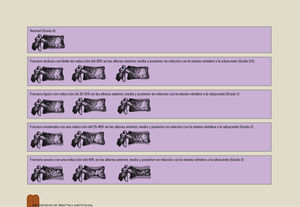
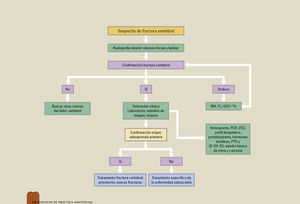
El diagnóstico suele hacerse con la radiología simple convencional de columna.

Etiología

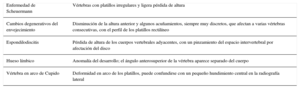
Debe valorarse su etiología, distinguiendo las fracturas osteoporóticas de las de otro origen (traumatismo, tumores, enfermedad de Paget, angiomas, osteomalacia). En caso de fracturas osteoporóticas pueden ser primarias o secundarias (hipertiroidismo, hiperparatiroidismo, hipercortisolismo, hipogonadismo, deficiencia de vitamina D, fármacos, etc.). También hay que evaluar los factores de riesgo de osteoporosis y las fracturas.

Tratamiento

El tratamiento tiene que orientarse inicialmente al control del dolor; es importante el tratamiento de la etiología de la fractura y, en caso de osteoporosis, plantear un tratamiento preventivo de nuevas fracturas con fármacos activos adecuados al perfil de riesgo del paciente. Debe considerarse la necesidad de ortesis para reducir el dolor y facilitar la movilización precoz. La vertebra/cifoplastia puede ser una opción en aquellos pacientes con dolor no controlable, con mala consolidación e inestabilidad de la fractura.

Palabras clave
Fractura vertebral
Osteoporosis
Tratamiento dolor raquídeo
Teriparatida
Vertebroplastia
Abstract
Concept

Vertebral fractures are a common cause of acute spinal pain in patients with osteoporosis and have a significant impact on their quality of life and survival.

Diagnosis

The diagnosis is usually reached with simple conventional spine radiology.

Aetiology

The aetiology of vertebral fractures should be assessed, distinguishing the osteoporotic fractures from those of other causes (trauma, tumours, Paget's disease, angiomas and osteomalacia). Osteoporotic fractures can be either primary or secondary (hyperthyroidism, hyperparathyroidism, hypercortisolism, hypogonadism, vitamin D deficiency, drugs, etc.). The risk factors for osteoporosis and fractures should also be assessed.

Treatment

The treatment should initially be directed towards controlling the pain. It is important to treat the aetiology of the fracture and, in case of osteoporosis, establish a treatment to prevent new fractures using active drugs adjusting to the patient's risk profile. The need for braces to reduce pain and facilitate early mobilisation should be considered. Vertebroplasty/kyphoplasty can be an option for patients with uncontrollable pain, poor consolidation and fracture instability.

Keywords
Vertebral fracture
Osteoporosis
Spinal pain treatment
Teriparatide
Vertebroplasty

Identifíquese

¿Aún no es suscriptor de la revista?

Comprar el acceso al artículo

Comprando el artículo el pdf del mismo podrá ser descargado

Teléfono para incidencias

De lunes a viernes de 9h a 18h (GMT+1) excepto los meses de julio y agosto que será de 9 a 15h

Llamadas desde España 932 415 960
Llamadas desde fuera de España +34 932 415 960
Bibliografía
[1]
European Prospective Osteoporosis Study (EPOS) Group, D. Felsenberg, A.J. Silman, M. Lunt, G. Armbrecht, A.A. Ismail, J.D. Finn.
Incidence of vertebral fracture in Europe: results from the European Prospective Osteoporosis Study (EPOS)..
JBMR., (2002), 17 pp. 716-724
[2]
A. Papaioannou, N.B. Watts, D.L. Kendler, C.K. Yuen, J.D. Adachi, N. Ferko.
Diagnosis and management of vertebral fractures in elderly adults.
Am J Med., (2002), 113 pp. 220-228
[3]
201609080021041098
H.K. Genant, C.Y. Wu, C. van Kiujk, M.C. Nevitt.
Vertebral fracture assessment using a semiquantitative technique.
J Bone Miner Res., (1993), 8 pp. 1137-1148
[4]
201609080021041099
2016090800210410910
Dl Kendler, D.C. Bauer, K.S. Davison, L. Dian, D.A. Hanley, S.T. Harris, et al.
Vertebral fractures: clinical importance and management.
[5]
2016090800210410911
R.M. Neer, C.D. Arnaud, J.R. Zanchetta, R. Prince, G.A. Gaich, J.Y. Reginster, et al.
Effect of parathyroid hormone (1-34) on fractures and bone mineral density in posmenopausal women with osteoporosis.
N Engl J Med., (2001), 344 pp. 1434-1441
[6]
2016090800210410912
M.C. Nevitt, P. Chen, R.K. Dore, J.Y. Reginster, D.P. Kiel, J.R. Zanchetta, et al.
Reduced risk of back pain following teriparatide treatment: a meta-analysis.
Osteoporos Int., (2006), 17 pp. 273-280
[7]
2016090800210410913
A. Martínez-Ferrer, J. Blasco, J.L.I. Carrasco, J.M. Macho, L.S. Román, A. López, et al.
Risk factors for the development of vertebral fractures after percutaneous vertebroplasty.
JBMR., (2013), 28 pp. 1821-1829
[8]
2016090800210410914
2016090800210410915
O. Lam, B. Uebelhart, B. Aubry-Rozier.
Risks and benefits of percutaneous vertebroplasty or kyphoplasty in the management of osteoporotic vertebral fractures.
Osteoporos Int., (2014), 25 pp. 807-819
[9]
T.S. Im, J.W. Lee, E. Lee, Y. Kang, J.M. Ahn, H.S. Kang.
Effects of facet joint injection reducing the need for percutaneous vertebroplasty in vertebral compression fractures.
Cardiovasc Intervent Radiol., (2006), 39 pp. 740-745