

Vol. 14. Núm. 54.
Páginas 3332-3336 (Mayo 2026)

Protocolos de práctica asistencial
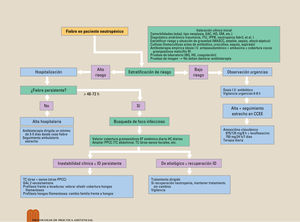
Protocolo de manejo de la neutropenia febril en el paciente oncohematológico

Management protocol for febrile neutropenia in oncohematology patients

J.J. Díaz-ÁlvarezabcC.M. CanoabcM. Suárez-RoblesabcM. Rosas Cancio-SuárezabcA.G. García-Ruiz de MoralesabcM.D. Corbacho-LoarteabcD. Gayoso-CanteroabcS. Morenoabc
Doi : https://10.1016/j.med.2026.04.025
Opciones
Resumen

La neutropenia febril es una complicación común en pacientes con neutropenia inducida por quimioterapia, debido al daño en las mucosas y la inmunosupresión. A pesar de una disminución en las infecciones gracias a antibióticos empíricos, es crucial comenzar con tratamiento antibiótico de amplio espectro ante la existencia de fiebre, dada la rápida progresión de las infecciones. La evaluación diagnóstica debe ser sistemática, incluyendo historia clínica, exploración física y hemocultivos antes del inicio del tratamiento con antibióticos. La neutropenia febril se asocia principalmente con infecciones bacterianas, prevaleciendo los cocos grampositivos. El tratamiento debe iniciarse pronto con cobertura frente a bacilos gramnegativos, ajustándose según el riesgo y los antecedentes. Tras 48-72 horas sin evidencia de infección, se puede suspender la cobertura empírica. La duración del tratamiento depende de la identificación del foco y de la recuperación del recuento neutrofílico, con estrategias de desescalada para reducir la exposición antibiótica en pacientes estables.

Palabras clave
Inmunodepresión
Neutropenia febril
Cáncer
Quimioterapia
Abstract

Febrile neutropenia is a common complication in patients with chemotherapy-induced neutropenia due to mucosal damage and immunosuppression. Despite a reduction in infections thanks to empirical antibiotics, it is crucial to initiate broad-spectrum antibiotic therapy in the presence of fever, given the rapid progression of infections. The diagnostic evaluation should be systematic, including a medical history, physical examination, and blood cultures before starting antibiotic therapy. Febrile neutropenia is primarily associated with bacterial infections, with Gram-positive cocci being the most common. Treatment should be initiated promptly with coverage against Gram-negative bacilli, adjusted according to risk and history. After 48–72hours without signs of infection, empirical coverage may be discontinued. The duration of treatment depends on identifying the source of infection and recovery of the neutrophil count, with de-escalation strategies to reduce antibiotic exposure in stable patients.

Keywords
Immunosuppression
Febrile neutropenia
Cancer
Chemotherapy

Identifíquese

¿Aún no es suscriptor de la revista?
Comprar el acceso al artículo

Comprando el artículo el pdf del mismo podrá ser descargado

Teléfono para incidencias

De lunes a viernes de 9h a 18h (GMT+1) excepto los meses de julio y agosto que será de 9 a 15h
Llamadas desde España 932 415 960
Llamadas desde fuera de España +34 932 415 960
Bibliografía
[1]
E. Culakova
202605140410564658
202605140410564659
, R. Thota, M.S. Poniewierski, N.M. Kuderer, A.F. Wogu, D.C. Dale, et al.
Patterns of chemotherapy-associated toxicity and supportive care in US oncology practice: a nationwide prospective cohort study.
Cancer Med., (2014), 3 pp. 434-444
[2]
D. Averbuch
2026051404105646510
2026051404105646511
, C. Orasch, C. Cordonnier, D.M. Livermore, M. Mikulska, C. Viscoli, et al.
European guidelines for empirical antibacterial therapy for febrile neutropenic patients in the era of growing resistance: summary of the 2011 4th European Conference on Infections in Leukemia.
Haematologica., (2013), 98 pp. 1826-1835
[3]
J. Klastersky
2026051404105646512
2026051404105646513
, J. de Naurois, K. Rolston, B. Rapoport, G. Maschmeyer, M. Aapro, et al.
Management of febrile neutropaenia: ESMO Clinical Practice Guidelines.
Ann Oncol., (2016), 27Suppl5: pp. v111-v118
[4]
A.G. Freifeld
2026051404105646514
2026051404105646515
, E.J. Bow, K.A. Sepkowitz, M.J. Boeckh, J.I. Ito, C.A. Mullen, et al.
Clinical practice guideline for the use of antimicrobial agents in neutropenic patients with cancer: 2010 Update by the Infectious Diseases Society of America.
Clin Infect Dis., (2011), 52 pp. e56-e93
[5]
J.M. Aguado
2026051404105646516
2026051404105646517
, J.J. Cruz, J.A. Virizuela, M. Aguilar, A. Carmona, J. Cassinello, et al.
Management of infection and febrile neutropenia in patients with solid cancer.
Enferm Infecc Microbiol Clin., (2017), 35 pp. 451-460
[6]
M. Aguilar-Guisado
2026051404105646518
2026051404105646519
, I. Espigado, A. Martín-Peña, C. Gudiol, C. Royo-Cebrecos, J. Falantes, et al.
Optimisation of empirical antimicrobial therapy in patients with haematological malignancies and febrile neutropenia (How Long study): an open-label, randomised, controlled phase 4 trial.
Lancet Haematol., (2017), 4 pp. e573-e583