

Vol. 13. Núm. 58.
Páginas 3445-3454 (Junio 2022)

Protocolos de práctica asistencial
Protocolo diagnóstico del síndrome febril con afectación hematológica en áreas geográficas de riesgo endémico de infecciones tropicales

Diagnostic protocol for febrile syndrome with hematological involvement in geographical areas of endemic risk of tropical infections

W. Villamil-Gómez
Doi : https://10.1016/j.med.2022.05.035
Opciones
Resumen

En las fiebres hemorrágicas víricas producidas por Arenavirus, las manifestaciones clínicas inicialmente son indistinguibles de otras fiebres hemorrágicas producidas por bacterias, parásitos y otros virus, constituyéndose esto en un problema de salud pública, por lo que se requiere realizar el diagnóstico diferencial utilizando técnicas serológicas y moleculares.

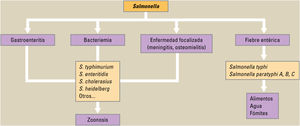
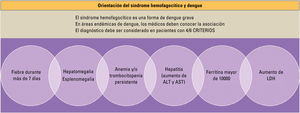
Las anomalías hematológicas son consideradas un sello distintivo de la malaria, y los análisis estadísticos han demostrado que muchos de estos valores hematológicos pueden conducir a un aumento de la sospecha clínica de malaria, iniciando así una intervención inmediata de terapia específica incluso en ausencia de un informe de frotis positivo para malaria. Durante los últimos años, el mundo ha sido testigo de epidemias de fiebre amarilla de gran importancia, como la ocurrida en África, particularmente en Angola. La fiebre tifoidea suele ser causada por S. typhi y menos por S. paratyphi y S. choleraesuis, el dengue puede presentarse con manifestaciones hemorrágicas y se convierte en un reto para el clínico porque se debe hacer un diagnóstico rápido y oportuno.

Palabras clave
Síndrome febril
Fiebre amarilla
Leptospirosis
Fiebre tifoidea
Malaria
Dengue grave
Abstract

In viral hemorrhagic fevers caused by Arenavirus, the clinical manifestations are initially indistinguishable from other hemorrhagic fevers produced by bacteria, parasites, and other viruses. It is a public health problem and therefore, a differential diagnosis must be made using serological and molecular techniques.

Hematologic abnormalities are considered a hallmark of malaria. Statistical analyses have demonstrated that many of these hematologic values can lead to an increase in clinical suspicion of malaria, thus leading to an immediate intervention with specific treatment even in the absence of a positive smear report for malaria. In recent years, the world has experienced significant yellow fever epidemics, such as the epidemic in Africa, particularly in Angola. Typhoid fever tends to be caused by S. typhi and, to a lesser extent, by S. paratyphi and S. choleraesuis. Dengue can present with hemorrhagic manifestations and is a challenge for physicians because a quick, correct diagnosis must be made.

Keywords
Febrile syndrome
Yellow fever
Leptospirosis
Typhoid fever
Malaria
Severe dengue

Identifíquese

¿Aún no es suscriptor de la revista?

Comprar el acceso al artículo

Comprando el artículo el pdf del mismo podrá ser descargado

Teléfono para incidencias

De lunes a viernes de 9h a 18h (GMT+1) excepto los meses de julio y agosto que será de 9 a 15h

Llamadas desde España 932 415 960
Llamadas desde fuera de España +34 932 415 960
Bibliografía recomendada
[1]
D. Ansong
202206110558567898
202206110558567899
, K.B. Seydel, T.E. Taylor.
Malaria.
Infections of the blood and reticuloendothelial system, Elsevier, pp. 734-753
[2]
T. Batchelor
2022061105585678910
2022061105585678911
, T. Stephenson, P.D. Brown, D. Amarakoon, M.A. Taylor.
Impact of climate variability on the incidence of leptospirosis in Jamaica.
Clim Res., (2012), 55 pp. 79-90
[3]
J.A. Cardona-Ospina
2022061105585678912
2022061105585678913
, C.E. Jiménez-Canizales, H. Vásquez-Serna, J.A. Garzón-Ramírez, J.F. Alarcón-Robayo, J.A. Cerón-Pineda, et al.
Fatal Dengue, Chikungunya and Leptospirosis: The Importance of Assessing Co-infections in Febrile Patients in Tropical Areas.
Trop Med Infect Dis., (2018), 3 pp. 123
[4]
J. Chaloemwong
2022061105585678914
2022061105585678915
, A. Tantiworawit, T. Rattanathammethee, S. Hantrakool, C. Chai-Adisaksopha, E. Rattarittamrong, et al.
Useful clinical features and hematological parameters for the diagnosis of dengue infection in patients with acute febrile illness: a retrospective study.
BMC Hematol., (2018), 18 pp. 20
[5]
N. Chaudhary
2022061105585678916
2022061105585678917
, A. Khare, S. Jain, R. Bansal, S. Nandwani.
Comparison of hematological parameters in various acute febrile illnesses.
National J Labor Med., (2016), 5 pp. 149-153
[6]
S.M. Chung
2022061105585678918
2022061105585678919
, J.Y. Song, W. Kim, M.J. Choi, J.H. Jeon, S. Kang, et al.
Dengue-associated hemophagocytic lymphohistiocytosis in an adult: A case report and literature review.
Medicine (Baltimore)., (2017), 96 pp. e6159
[7]
Dengue
2022061105585678920
2022061105585678921
.
Guía para la atención de enfermos en la región de las Américas.
(2015),
[8]
E.M. Ellis
2022061105585678922
, T.M. Sharp, J. Pérez-Padilla, L. González, B.K. Poole-Smith, E. Lebo, et al.
Incidence and risk factors for developing dengue-associated hemophagocytic lymphohistiocytosis in Puerto Rico, 2008-2013.
PLoS Negl Trop Dis., (2016), 10 pp. e0004939
[9]
Instituto
2022061105585678923
2022061105585678924
Nacional de Salud (2016). Guía de la Práctica Clínica de Dengue Basada en la Evidencia. Perú.
[10]
Z.S. Jairajpuri
2022061105585678925
2022061105585678926
, S. Rana, M.J. Hassan, F. Nabi, S. Jetley.
An analysis of hematological parameters as a diagnostic test for malaria in patients with acute febrile illness: An institutional experience.
Oman Med J., (2014), 29 pp. 12-17
[11]
T.H. Lee
2022061105585678927
2022061105585678928
, J.G. Wong, Y.S. Leo, T.L. Thein, E.L. Ng, L.K. Lee, et al.
Potential harm of prophylactic platelet transfusion in adult dengue patients.
PLoS Negl Trop Dis., (2016), 10 pp. e0004576
[12]
J. Lindo
2022061105585678929
, P.D. Brown, I. Vickers, M. Brown, S.T. Jackson, E. Lewis-Fuller.
Leptospirosis and malaria as causes of febrile illness during a dengue epidemic in Jamaica.
Pathog Glob Health., (2013), 107 pp. 329-334
[13]
D.R. MacFadden
2022061105585678930
2022061105585678931
, I.I. Bogoch, J.R. Andrews.
Advances in diagnosis, treatment, and prevention of invasive Salmonella infections.
Curr Opin Infect Dis., (2016), 29 pp. 453-458
[14]
Ministerio
2022061105585678932
2022061105585678933
de Salud de Argentina. Leptospirosis. Guía para el personal de salud. Buenos Aires, 2014.
[15]
P. Pal
2022061105585678934
, P.P. Giri, A.V. Ramanan.
Dengue associated hemophagocytic lymphohistiocytosis: a case series.
Indian Pediatr., (2014), 51 pp. 496-497
[16]
S. Pothapregada
2022061105585678935
2022061105585678936
, B. Kamalakannan, M. Thulasingam.
Role of platelet transfusion in children with bleeding in dengue fever.
J Vector Borne Dis., (2015), 52 pp. 304-308
[17]
J.J. Real Cotto
2022061105585678937
2022061105585678938
, M. González González.
Immunological response of IgM and IgG antibodies against yellow fever in Bajo Ongota - Tena.
Revista científica digital INSPILIP, (2017), 1
[18]
A.J. Rodríguez-Morales
2022061105585678939
2022061105585678940
, W.E. Villamil-Gómez.
Yellow Fever: still of concern for travelers of Colombia?.
Infectio., (2018), 22 pp. 171-172
[19]
Salud
2022061105585678941
2022061105585678942
, Ministerio de. Guía de Práctica Clínica Diagnóstico y tratamiento de la malaria. Bogotá, 2020.
[20]
Y. Sharma
2022061105585678943
2022061105585678944
, V. Arya, S. Jain, M. Kumar, L. Deka, A. Mathur.
Dengue and Typhoid Co-infection- Study from a Government Hospital in North Delhi.
J Clin Diagn Res., (2014), 8 pp. DC09-DC11
[21]
Sociedad
2022061105585678945
Venezolana de Salud Pública. Reaparece fiebre amarilla en Venezuela luego de 14 años. En Alerta Epidemiológica. 2019. p. 1-13.
[22]
E. Soto
2022061105585678946
2022061105585678947
, S. Mattar.
Fiebres hemorrágicas por Arenavirus en Latinoamérica.
Salud Uninorte., (2010), 2 pp. 298-310