
Vol. 11. Núm. 50.
Páginas 2939-2945 (Marzo 2014)

Viriasis respiratorias. Gripe

Respiratory viriasis. Influenza

A. Martín QuirósaA. Robles MarhuendacJ.R. Paño Pardoab
Doi : https://10.1016/S0304-5412(14)70720-6
Opciones
Resumen

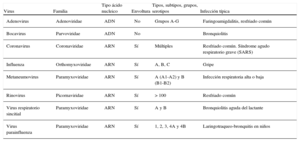
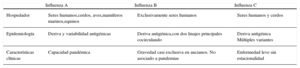
Las viriasis respiratorias son un conjunto de infecciones respiratorias agudas, la mayoría benignas, causadas por virus con una importante variabilidad serotípica. La gripe es el cuadro producido por los virus influenza A y B con periodicidad epidémica estacional y, ocasionalmente, influenza A puede producir pandemias mundiales. Las complicaciones se limitan casi exclusivamente a las edades extremas de la vida y pacientes con comorbilidades, especialmente respiratorias y cardiovasculares. El tratamiento antivírico disminuye el tiempo de los síntomas y la vacunación consigue disminuir de forma eficaz el número de infecciones. El virus respiratorio sincitial es el agente causal más frecuente de la bronquiolitis aguda del lactante. Rinovirus y coronavirus son los asociados con más frecuencia al resfriado común. Coronavirus es responsable del síndrome respiratorio agudo grave descrito en China en 2002, mientras que el virus parainfluenza lo es del crup laríngeo de los niños.

Palabras Clave
Gripe
Influenza
SARS
Viriasis respiratorias
Abstract

Respiratory viriasis are acute infectious diseases with a usually favorable course. Influenza is the disease caused by influenza viruses A and B; it could cause seasonal periodical epidemics and influenza A is implicated in worlwide pandemias. Influenza complications usually are limited to older patients and to those with comorbilities, especially those with chronic respiratory or cardiovascular diseases. Anti-influenza therapy has an effect on the duration of the symptomatic period and vaccination efficiently decreases the incidence of the infection. Respiratory syncytial virus is the more frequent cause of the acute bronchiolitis in breastfeeding patients. Rinovirus and coronavirus are implicated in the common cold. Coronavirus was the etiological agent of the severe acute respiratory syndrome, described in 2002 in China. Parainfluenza virus is the cause of the laryngeal croup in infants.

Keywords
Influenza
SARS
Respiratory viriasis

Identifíquese

¿Aún no es suscriptor de la revista?
Comprar el acceso al artículo

Comprando el artículo el pdf del mismo podrá ser descargado

Teléfono para incidencias

De lunes a viernes de 9h a 18h (GMT+1) excepto los meses de julio y agosto que será de 9 a 15h
Llamadas desde España 932 415 960
Llamadas desde fuera de España +34 932 415 960
Bibliografía
[1.]
P.F. Adams, G.E. Hendershot, M.A. Marano.
Current estimates from the National Health Interview Survey, 1996 National Center for Health Statistics.
Vital Health Stat, (1999), 10 pp. 59-66
[2.]
R.B. Turner.
The common cold.
Principles and practices of Infectious Diseases, 7th, Ed. Elsevier, pp. 809-814
[3.]
C.B. Hall.
The spread of influenza and other respiratory viruses: complexities and conjectures.
Clin Infect Dis., (2007), 45 pp. 353-359
[4.]
N.J. Cox, K. Subbarao.
Influenza.
Lancet, (1999), 354 pp. 1277-1282
[5.]
W.H. Barker, J.P. Mullooly.
Pneumonia and influenza deaths during epidemics: implications for prevention.
Arch Intern Med., (1982), 142 pp. 85-89
[6.]
N.J. Cox, Fuller f, N. Kaverin, et al.
Orthomyxoviridae.
Virus taxonomy: Seventh Report of the International Commitee on Taxonomy of Viruses, Ed. Academic Press, pp. 585-597
[7.]
P.R. Murray, K.S. Rosenthal, M.C. Pfaüer.
Orthomyxovirus.
Microbiología médica., Ed. Elsevier, pp. 609-618
[8.]
J. Treanor.
Influenza viruses including Avian Influenza and Swine Influenza.
Principles and practices of Infectious Diseases., 7th, Ed. Elsevier, pp. 2265-2288
[9.]
J.J. Treanor, Hall. Breese.
Gripe e infecciones traqueales, bronquiales y bronquiolares.
Reese and Betts. Enfermedades infecciosas., Marbán, pp. 301-317
[10.]
P. Palese, Influenza:.
old and news threats.
Nat Med., (2004), 10Supl pp. 82-88
[11.]
P. Palese, J.F. Young.
Variation of influenza A B, and C viruses.
Science., (1982), 92 pp. 1468-1474
[12.]
C.W. Potter, R. Jennings.
A definition for influenza pandemics based on historial records.
J Infect., (2011), 63 pp. 252-259
[13.]
Novel Swine-Origin Influenza A (H1N1) Virus Investigation Team. Emergence of a novel swine-origin influenza A (H1N1) virus in humans.
N Engl J Med., (2009), 360 pp. 2605-2615
[14.]
A.M. Presanis, D. De Angelis, A. Hagy, C. Reed, S. Riley, B.S. Cooper, L. Finelli, P. Biedrzycki, M. Lipsitch, New York City Swine Flu Investigation Team.
The severity of pandemic H1N1 influenza in the United States, from april to july 2009: a Bayesian analysis.
PLoS Med, (2009), 6
[15.]
J.C. Rahamat-Langendoen, E.D. Tutuhatunewa, E.H. Schölvinck, E. Hak, M. Koopmans, H.G.M. Niesters, et al.
Influenza in the immediate postpandemic era: A comparison with seasonal and pandemic influenza in hospitalized patients.
J Clin Virol., (2012), 3 pp. 1-6
[16.]
K.G. Nicholson, J.M. Wood, M. Zambon.
Influenza. Lancet, (2003), 362 pp. 1733-1745
[17.]
K.G. Nicholson.
Human influenza.
Textbook of influenza., Ed. Blackwell, pp. 219-266
[18.]
D. Mertz, T.H. Kim, J. Johnstone, P.P. Lam, M. Science, S.P. Kuster, et al.
Populations at risk for severe or complicated influenza illness: systematic review and meta-analysis.
BMJ., (2013), 347
[19.]
Dawood FS, Chaves SS, Pérez A, Reingold A, Meek J, Farley MM, et al. Complications and associated bacterial co-infections among children hospitalized with seasonal or pandemic influenza, United States, 2003- 2010. J Infect Dis. En prensa 2013.
[20.]
M.J. Ferson, J.R. Morton, P.W. Robertson.
Impact of influenza on morbidity in children with cystic fibrosis.
J Paediatr Child Health., (1991), 27 pp. 308-311
[21.]
S. Fujimoto, M. Kobayashi, O. Uemura, M. Iwasa, T. Ando, T. Katoh, et al.
PCR on cerebrospinal fluid to show influenza-associated acute encephalopathy or encephalitis.
Lancet., (1998), 352 pp. 873-875
[22.]
J.A. McCullers, S. Facchini, P.J. Chesney, R.G. Webster.
Influenza B virus encephalitis.
Clin Infect Dis., (1999), 28 pp. 898-900
[23.]
Z.R. Estabragh, M.A. Mamas.
The cardiovascular manifestations of influenza: A systematic review.
Int J Cardiol, (2013), 167 pp. 2397-2403
[24.]
A.S. Monto, S. Gravenstein, M. Elliott, M. Colopy, J. Schweinle.
Clinical signs and symptoms predicting influenza infection.
Arch Intern Med, (2000), 160 pp. 3243-3247
[25.]
G. Boivin, I. Hardy, G. Tellier, J. Maziade.
Predicting influenza infections during epidemics with use of a clinical case definition.
Clin Infect Dis, (2000), 31 pp. 1166-1169
[26.]
S.A. Harper, J.S. Bradley, J.A. Englund, T.M. File, S. Gravenstein, F.G. Hayden, et al.
Seasonal Influenza in Adults and Children—Diagnosis, Treatment Chemoprophylaxis, and Institutional Outbreak Management: Clinical Practice Guidelines of the Infectious Diseases Society of America.
Clin Infect Dis, (2009), 48 pp. 1003-1032
[27.]
B. Killingley, J.E. Enstone, J. Greatorex, A.S. Gilbert, R. Lambkin-Williams, S. Cauchemez, et al.
Use of a Human Influenza Challenge Model to Assess Person-to-Person Transmission: Proof-of-Concept Study.
J Infect Dis., (2011), 205 pp. 35-43
[28.]
T. Jefferson, V. Demicheli, D. Rivetti, M. Jones, C. Di Pietrantonj, A. Rivetti.
Antivirals for influenza in healthy adults: systematic review.
Lancet., (2006), 367 pp. 303-313
[29.]
K. Nicholson, F. Aoki, A. Osterhaus, S. Trottier, O. Carewicz, C. Mercier, et al.
Efficacy and safety of oseltamivir in treatment of acute influenza: a randomised controlled trial.
Lancet, (2000), 355 pp. 1845-1850
[30.]
K. Shiraishi, K. Mitamura, Y. Sakai-Tagawa, H. Goto, N. Sugaya, Y. Kawaoka.
High frequency of resistant viruses harboring different mutations in amantadine-treated children with influenza.
J Infect Dis., (2003), 188 pp. 57-61
[31.]
Y. Yu, S. Garg, P.A. Yu, H.J. Kim, A. Patel, T. Merlin, et al.
Peramivir Use for treatment of hospitalized patients with influenza A(H1N1) under emergency use authorization October 2009-June 2010.
Clin Infect Dis., (2012), 55 pp. 8-15
[32.]
A.E. Fiore, D.K. Shay, K. Broder, J.K. Iskander, T.M. Uyeki, G. Mootrey, et al.
Centers for Disease Control and Prevention (CDC); Advisory Committee on Immunization Practices (ACIP).Prevention and control of influenza: recommendations of the Advisory Committee on Immunization Practices (ACIP), 2008.
MMWR Recomm Rep., (2008), 57 pp. 1-60
[33.]
P.A. Gross, F.A. Ennis, P.F. Gaerlan, L.J. Denson, C.R. Denning, D. Schiffman.
A controlled double-blind comparison of reactogenicity, immunogenicity, and protective efficacy of whole-virus and split-product influenza vaccines in children.
J Infect Dis., (1977), 136 pp. 623-632
[34.]
S. Ashkenazi, A. Vertruyen, J. Arístegui, S. Esposito, D.D. McKeith, T. Klemola, CAIV-T Study Group, et al.
Superior relative efficacy of live attenuated influenza vaccine compared with inactivated influenza vaccine in young children with recurrent respiratory tract infections.
Pediatr Infect Dis J, (2006), 25 pp. 870-879
[35.]
C. Zhang, N. Zhu, Z. Xie, R. Lu, B. He, C. Liu, et al.
Viral Etiology clinical profiles of children with severe acute respiratory infections in China.
[36.]
I.L. Lauinger, J.M. Bible, E.P. Halligan, H. Bangalore, O. Tosas, E.J. Aarons, et al.
Patient characteristics and severity of human rhinovirus infections in children.
J Clin Virol., (2013), 58 pp. 216-220
[37.]
C.A. Donnelly, A.C. Ghani, G.M. Leung, A.J. Hedley, C. Fraser, S. Riley, et al.
Epidemiological determinants of spread of causal agent of severe acute respiratory syndrome in Hong Kong.
Lancet, (2003), 361 pp. 1761-1766
[38.]
C.B. Hall, G.A. Weinberg, M.K. Iwane, A.K. Blumkin, K.M. Edwards, M.A. Staat, et al.
The burden of respiratory sincitial virus infection in Young children.
N Engl J Med, (2009), 360 pp. 588-598
Copyright © 2014. Elsevier España, S.L.. Todos los derechos reservados