

Vol. 14. Núm. 5.
Páginas 242-249 (Marzo 2024)

Actualización
Agentes infecciosos y malabsorción intestinal

Infectious agents and intestinal malabsorption

M.J. García GarcíaabM. Pascual MatoabC. Gutiérrez GarcíaabJ. Crespo Garcíaab
Doi : https://10.1016/j.med.2024.03.003
Opciones
Resumen

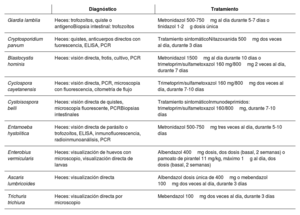
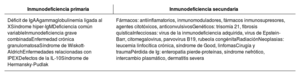
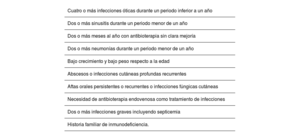
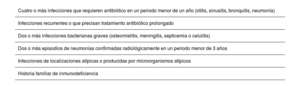
Los síndromes malabsortivos intestinales plantean en la práctica clínica habitual un reto diagnóstico y terapéutico, tanto para los médicos de atención primaria como para los especialistas en aparato digestivo. Existen múltiples causas de malabsorción intestinal, en esta actualización trataremos de abordar de forma práctica tres entidades con relevancia clínica, bien por su prevalencia en aumento o por su complejidad diagnóstica y terapéutica: el sobrecrecimiento bacteriano intestinal, las infecciones por parásitos intestinales y las inmunodeficiencias intestinales.

El sobrecrecimiento bacteriano es una enfermedad con alta prevalencia en países desarrollados que provoca síntomas gastrointestinales diversos. En los países en desarrollo, las infecciones por parásitos intestinales son una causa significativa de morbilidad, afectando al 24% de la población mundial. La sintomatología digestiva de ambas enfermedades se asocia con trastornos estructurales, funcionales del intestino delgado, condiciones sistémicas, medicamentos y trastornos inmunológicos. En relación con las inmunodeficiencias, estas representan un trastorno menos frecuente pero no menos importante, debido a la morbilidad y mortalidad que conllevan. Se abordarán estas entidades y su sintomatología digestiva, intentando dar respuesta a las dudas, especialmente las diagnósticas y terapéuticas, que plantean estas entidades en la práctica clínica.

Palabras clave
Sobrecrecimiento bacteriano
Parásitos
Inmunodeficiencia
Malabsorción intestinal
Abstract

Intestinal malabsorption syndromes pose a diagnostic and treatment challenge in the routine clinical practice of both primary care physicians and gastroenterology specialists. There are multiple causes of intestinal malabsorption. This update will attempt to address, in a practical manner, three entities that are clinically relevant, either because of their increasing prevalence or because of their diagnostic and treatment complexity: intestinal bacterial overgrowth, intestinal parasite infections, and intestinal immunodeficiencies.

Bacterial overgrowth is a highly prevalent disease in developed countries that causes various gastrointestinal symptoms. In developing countries, intestinal parasite infections are a significant cause of morbidity. It affects 24% of the world's population. The gastrointestinal symptomatology of both diseases is associated with structural and functional disorders of the small intestine, systemic conditions, medications, and immunological disorders. Immunodeficiencies are a less frequent but no less important disorder, given the morbidity and mortality they entail. This update will address these conditions and their gastrointestinal symptoms and will attempt to answer questions, especially regarding diagnostic and treatment, that these diseases raise in clinical practice.

Keywords
Bacterial overgrowth
Parasites
Immunodeficiency
Intestinal malabsorption

Identifíquese

¿Aún no es suscriptor de la revista?

Comprar el acceso al artículo

Comprando el artículo el pdf del mismo podrá ser descargado

Teléfono para incidencias

De lunes a viernes de 9h a 18h (GMT+1) excepto los meses de julio y agosto que será de 9 a 15h

Llamadas desde España 932 415 960
Llamadas desde fuera de España +34 932 415 960
Bibliografía
[1]
E.M.M. Quigley
202405070517584988
.
The spectrum of small intestinal bacterial overgrowth (SIBO).
Curr Gastroenterol Rep., (2019), 21
[2]
D. Poon
202405070517584989
, G.R. Law, G. Major, H.J.N. Andreyev.
A systematic review and meta-analysis on the prevalence of non-malignant, organic gastrointestinal disorders misdiagnosed as irritable bowel syndrome.
[3]
E.J. Giamarellos-Bourboulis, E. Pyleris, C. Barbatzas, A. Pistiki, M. Pimentel.
Small intestinal bacterial overgrowth is associated with irritable bowel syndrome and is independent of proton pump inhibitor usage.
BMC Gastroenterol., (2016), 16 pp. 1-7
[4]
M. Pimentel
2024050705175849810
2024050705175849811
, R.J. Saad, M.D. Long, S.S.C. Rao.
ACG clinical guideline: Small intestinal bacterial overgrowth.
Am J Gastroenterol., (2020), 115 pp. 165-178
[5]
E.M.M. Quigley
2024050705175849812
2024050705175849813
, J.A. Murray, M. Pimentel.
AGA clinical practice update on small intestinal bacterial overgrowth: Expert review.
Gastroenterology., (2020), 159 pp. 1526-1532
[6]
R.S. Choung, K.C. Ruff, A. Malhotra, L. Herrick, G.R. Locke, W.S. Harmsen, et al.
Clinical predictors of small intestinal bacterial overgrowth by duodenal aspirate culture.
Aliment Pharmacol Ther., (2011), 33 pp. 1059-1067
[7]
G. Leite, W. Morales, S. Weitsman, S. Celly, G. Parodi, R. Mathur, et al.
The duodenal microbiome is altered in small intestinal bacterial overgrowth.
PLoS One., (2020), 15 pp. e0234906
[8]
L. Gatta
2024050705175849814
2024050705175849815
, C. Scarpignato, R.W. McCallum, L. Lombardo, M. Pimentel, R. D’Incà, et al.
Systematic review with meta-analysis: rifaximin is effective and safe for the treatment of small intestine bacterial overgrowth.
Aliment Pharmacol Ther., (2017), 45 pp. 604-616
[9]
G.B. Saffouri, R.R. Shields-Cutler, J. Chen, Y. Yang, H.R. Lekatz, V.L. Hale, et al.
Small intestinal microbial dysbiosis underlies symptoms associated with functional gastrointestinal disorders.
Nature Communications., (2019), 10 pp. 1-11
[10]
M. Ahmed
2024050705175849816
2024050705175849817
.
Intestinal parasitic infections in 2023.
Gastroenterology Res., (2023), 16 pp. 127
[11]
I. Díaz-Alberola
2024050705175849818
2024050705175849819
, J.F. Gutiérrez-Bautista, A. Espuch-Oliver, J.M. García-Aznar, P. Anderson, P. Jiménez, et al.
Incidence, management experience and characteristics of patients with giardiasis and common variable immunodeficiency.
J Clin Med., (2022), 11 pp. 7007
[12]
E. Gerace
2024050705175849820
, V.D.M. Lo Presti, C. Biondo.
Cryptosporidium infection: Epidemiology, pathogenesis, and differential diagnosis.
Eur J Microbiol Immunol (Bp)., (2019), 9 pp. 119
[13]
C.M. Coyle
2024050705175849821
, J. Varughese, L.M. Weiss, H.B. Tanowitz.
Blastocystis: To treat or not to treat.
Clin Infect Dis., (2012), 54 pp. 105-110
[14]
B.A. Mathison
2024050705175849822
, B.S. Pritt.
Cyclosporiasis—updates on clinical presentation, pathology, clinical diagnosis, and treatment.
Microorganisms., (2021), 9 pp. 1863
[15]
J.P. Dubey
2024050705175849823
, S. Almeria.
Cystoisospora belli infections in humans: the past 100 years.
Parasitology., (2019), 146 pp. 1490-1527
[16]
R. Bansal, S. Natarajan, J. Aron.
Amebic colitis.
Am J Medical Sciences., (2019), 357 pp. e15
[17]
M. Sultan Khuroo
2024050705175849824
.
Ascariasis.
Gastroenterol Clin North Am., (1996), 25 pp. 553-577
[18]
A. Viswanath, S.N.S. Yarrarapu, M. Williams.
Trichuris trichiura Infection. StatPearls. 2023. En: StatPearls [Internet].
StatPearls Publishing, (2023),
[19]
C.M. Denkinger, P. Harigopal, P. Ruiz, L.M. Dowdy.
Cryptosporidium parvum-associated sclerosing cholangitis in a liver transplant patient.
Transplant Infectious Disease., (2008), 10 pp. 133-136
[20]
S.P. Misra, V. Misra, M. Dwivedi.
Ileocecal masses in patients with amebic liver abscess: Etiology and management.
World J Gastroenterol: WJG., (2006), 12 pp. 1933
[21]
Sulmiati, F. Nurmantu, Ahmadwirawan, N. Mariana, T.R. Habar, M. Faruk.
Acute intestinal obstruction due to ascariasis in a child: A case report.
Int J Surg Case Rep., (2023), 104 pp. 107923
[22]
J. Chinen
2024050705175849825
, W.T. Shearer.
6. Secondary immunodeficiencies, including HIV infection.
J Allergy Clin Immunol., (2008), 121 pp. S388-S392
[23]
V. Modell, J.S. Orange, J. Quinn, F. Modell.
Global report on primary immunodeficiencies: 2018 update from the Jeffrey Modell Centers Network on disease classification, regional trends, treatment modalities, and physician reported outcomes.
Immunol Res., (2018), 66 pp. 367-380
[24]
S. Agarwal
2024050705175849826
2024050705175849827
, L. Mayer.
Diagnosis and treatment of gastrointestinal disorders in patients with primary immunodeficiency.
Clin Gastroenterol Hepatol., (2013), 11 pp. 1050
[25]
A. Subbarayan, G. Colarusso, S.M. Hughes, A.R. Gennery, M. Slatter, A.J. Cant, et al.
Clinical features that identify children with primary immunodeficiency diseases.
Pediatrics., (2011), 127 pp. 810-816
[26]
L. Di Meglio
2024050705175849828
, L. Carucci, R. Berni Canani.
Immunodeficiency disorders resulting in malabsorption. Textbook of pediatric gastroenterology, hepatology and nutrition: A comprehensive guide to practice.
2ª ed, Springer, (2021), pp. 495-511
[27]
S. Agarwal
2024050705175849829
2024050705175849830
, C. Cunningham-Rundles.
Gastrointestinal manifestations and complications of primary immunodeficiency disorders.
Immunol Allergy Clin North Am., (2019), 39 pp. 81-94
[28]
R. Yazdani
2024050705175849831
, S. Fekrvand, S. Shahkarami, G. Azizi, B. Moazzami, H. Abolhassani, et al.
The hyper IgM syndromes: Epidemiology, pathogenesis, clinical manifestations, diagnosis and management.
Clinical Immunology., (2019), 198 pp. 19-30
[29]
R. Yazdani
2024050705175849832
, G. Azizi, H. Abolhassani, A. Aghamohammadi.
Selective IgA deficiency: Epidemiology, pathogenesis, clinical phenotype, diagnosis, prognosis and management.
Scand J Immunol., (2017), 85 pp. 3-12
[30]
F.A. Bonilla
2024050705175849833
, I. Barlan, H. Chapel, B.T. Costa-Carvalho, C. Cunningham-Rundles, M.T. de la Morena, et al.
International Consensus Document (ICON): Common variable immunodeficiency disorders.
J Allergy Clin Immunol Pract., (2016), 4 pp. 38