
Vol. 11. Núm. 1.
Páginas 26-34 (Enero 2012)

Actualización
Disfagia orofaríngea y trastornos motores esofágicos

Oropharyngeal dysphagia and esophageal motor disorders

F.J. Rodríguez GilC. Martínez PrietoR. de Prado Serrano
Doi : https://10.1016/S0304-5412(12)70255-X
Opciones
Resumen

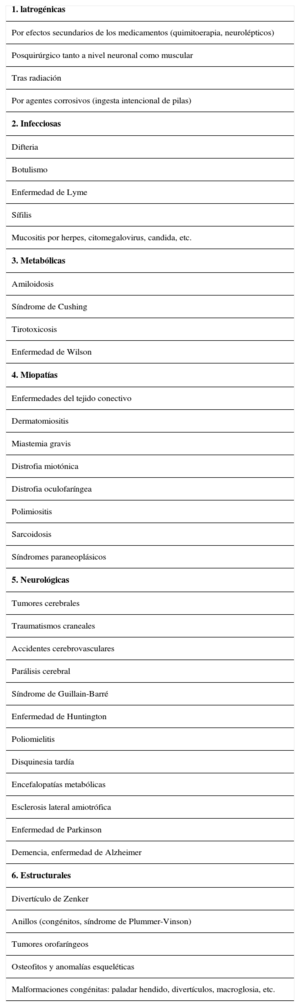
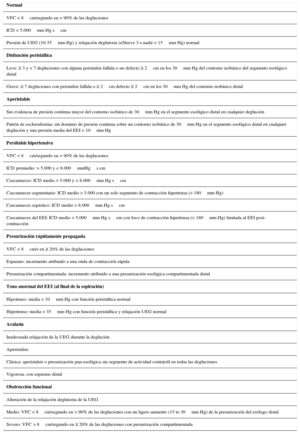
La disfagia orofaríngea consiste en la dificultad para la propulsión del bolo alimenticio desde la hipofaringe hasta el esófago cervical. Es una patología muy prevalente en pacientes con alteraciones neuromusculares. El estudio con videofluoroscopia y manometría permite su clasificación y enfoque terapéutico.

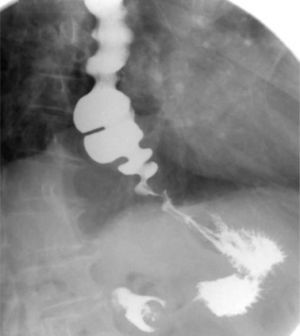
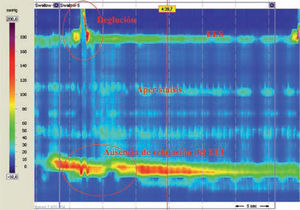
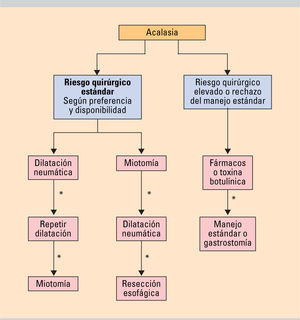
Los trastornos motores esofágicos se dividen en primarios y secundarios. Los trastornos primarios se clasifican según sus hallazgos manométricos. La acalasia es el trastorno motor más caracterizado y se define por una falta de relajación del esfínter esofágico inferior asociado a aperistalsis. La manometría esofágica es la prueba diagnóstica por excelencia, pero debe descartarse mediante endoscopia lesiones que afecten al cardias. El tratamiento puede ser quirúrgico o endoscópico mediante la administración de toxina botulínica o dilatación con balón.

El espasmo esofágico difuso se manifiesta como dolor torácico o disfagia. Su diagnóstico se obtiene mediante manometría. El tratamiento está menos definido y con peores resultados que en la acalasia.

Palabras clave
Disfagia orofaríngea
Acalasia
Espasmo esofágico difuso
Trastornos motores esofágicos
Abstract

Oropharyngeal dysphagia consists in difficulty for food bolus propulsion from the hypopharynx to the cervical esophagus. This condition is very prevalent in patients with neuromuscular disorders. The study with the videofluoroscopy and manometry permits its classification and therapeutic approach. Esophageal motor disorders are divided into primary and secondary. The primary disorders are classified according to the manometric findings. Achalasia is a more characterized motor disorder and is defined by non-relaxing lower esophageal sphincter associated to a aperistalsis. The esophageal manometry is the diagnostic test par excellence, however injuries that affect the cardias should be ruled out by endoscopy. Treatment may be surgical or by endoscopy through the administration of botulinum toxin or balloon dilation.

Diffuses esophageal spasm is seen as chest pain or dysphagia. Its diagnosis is obtained by manometry. The treatment is less defined and with worse results than in achalasia.

Keywords
Oropharynx dysphagia
Achalasia
Diffuse esophageal spasm
Esophageal motor disorders

Identifíquese

¿Aún no es suscriptor de la revista?

Comprar el acceso al artículo

Comprando el artículo el pdf del mismo podrá ser descargado

Teléfono para incidencias

De lunes a viernes de 9h a 18h (GMT+1) excepto los meses de julio y agosto que será de 9 a 15h

Llamadas desde España 932 415 960
Llamadas desde fuera de España +34 932 415 960
Bibliografía
[1.]
P. Clavé, V. Arreola, M. Romea, L. Medina, E. Palomera, M. Serra-Prat.
Accuracy of the volume-viscosity swallow test for clinical screening of oropharyngeal dysphagia and aspiration.
Clin Nutr, (2008), 27 pp. 806-815
[2.]
I.J. Cook, P.J. Kahrillas.
AGA Technical review on management of oropharyngeal dysphagia.
Gastroenterology, (1999), 116 pp. 455-478
[3.]
A. Ruiz de León, P. Clavé.
Videofluoroscopy and neurogenic dysphagia.
Rev Esp Enferm Dig, (2007), 99 pp. 3-6
[4.]
A. Pal, R.B. Williams, I.J. Cook, J.G. Brasseur.
Intrabolus pressure gradient identifies pathological constriction in the upper esophageal sphincter during flow.
Am J Physiol Gastrointest Liver Physiol, (2003), 285 pp. G1037-G1048
[5.]
P. Clavé, R. Terré, M. de Kraa, M. Serra.
Approaching oropharyngeal dysphagia.
Rev Esp Enferm Dig, (2004), 96 pp. 119-131
[6.]
S.J. Spechler, D.O. Castell.
Classification of oesophageal motility abnormalities.
Gut, (2001), 49 pp. 145-151
[7.]
P.J. Kahrilas, S.K. Ghosh, J.E. Pandolfino.
Esophageal motility disorders in terms of pressure topography: the Chicago Classification.
J Clin Gastroenterol, (2008), 42 pp. 627-635
[8.]
J.F. Mayberry.
Epidemiology and demographics of achalasia.
Gastrointest Endosc Clin NAm, (2001), 11 pp. 235-248
[9.]
P.J. Kahrilas, S.M. Kishk, J.F. Helm, W.J. Dodds, J.M. Harig, W.J. Hogan.
Comparison of pseudoachalasia and achalasia.
Am J Med, (1987), 82 pp. 439-446
[10.]
W. Park, M.F. Vaezi.
Etiology and pathogenesis of achalasia: the current understanding.
Am J Gastroenterol, (2005), 100 pp. 1404-1414
[11.]
W.J. Qualman, H.M. Haupt, P. Yang, S.R. Hamilyon.
Esophageal Lewy bodies associated whit ganglion cell loss in achalasia. Similarity to Parkinson's disease.
Gastroenterology, (1984), 87 pp. 848-856
[12.]
A. Ruiz de León, C. Sevilla-Mantilla, J. Pérez de la Serna.
Enfermedades motoras del esófago. Trastornos motores esofágicos primarios.
Trastornos motores del aparato digestivo, Ed. Médica Panamericana, pp. 69-80
[13.]
J.E. Pandolfino, M.A. Kwiatek, T. Nealis, W. Bulsiewicz, J. Post, P.J. Kahrilas.
Achalasia: a new clinically relevant classification by high-resolution manometry.
Gastroenterology, (2008), 135 pp. 1526-1533
[14.]
J.P. Tracey, M. Traube.
Difficulties in the diagnosis of pseudoachalasia.
Am J Gastroenterol, (1994), 89 pp. 2014-2018
[15.]
Wen ZH, Gardener E, Wang YP. Nitratos para la acalasia. Biblioteca Cochrane Plus; 2008, Número 4. Oxford: Update Software Ltd. Disponible en: http://www.update-software.com.
[16.]
C.N. Andrews, M. Anvari, J. Dobranowski.
Laparoscopic Heller's myotomy or botulinum toxin injection for management of esophageal achalasia Patient choice and treatment outcomes.
Surg Endosc, (1999), 13 pp. 742-746
[17.]
U.C. Ghoshal, R. Aggarwal, S. Kumar, S.R. Naik.
Pneumatic dilation versus intrasphincteric botulinum toxin injection in the treatment of achalasia cardia in India: an economic analysis.
Indian J Gastroenterol, (2002), 21 pp. 193-196
[18.]
J.B. O’Connor, M.E. Singer, T.F. Imperiale, M.F. Vaezi, J.E. Richter.
The cost-effectiveness of treatment strategies for achalasia.
Dig Dis Sci, (2002), 47 pp. 1516-1525
[19.]
J. Pérez de la Serna, C. Sevilla Mantilla, A. Ruiz de León.
Dilatación neumática del cardias en la acalasia.
Avances, controversias y actualizaciones. Cirugía General y del Aparato Digestivo II, Ed. EMISA, pp. 53-62
[20.]
J. Ponce, V. Garrigues, V. Pertejo, T. Sala, J. Berenguer.
Individual prediction of response to pneumatic dilation in patients with achalasia.
Dig Dis Sci, (1996), 41 pp. 2135-2141
[21.]
G.M. Campos, E. Vittinghoff, C. Rabl, M. Takata, M. Gadenstatter, F. Lin, et al.
Endoscopic and surgical treatments for achalasia: a systematic review and metaanalysis.
[22.]
J.B. O’Connor, M.E. Singer, T.F. Imperiale, M.F. Vaezi, J.E. Richter.
The cost-effectiveness of treatment strategies for achalasia.
Dig Dis Sci, (2002), 47 pp. 1516-1525
[23.]
D.L. Miller, M.S. Allen, V.F. Trastek, C. Deschamps, P.C. Pairolero.
Esophageal resection for recurrent achalasia.
Ann Thorac Surg, (1995),
[24.]
C. Grubel, J. Borovicka, W. Schwizer, M. Fox, G. Hebbard.
Diffuse esophageal spasm.
Am J Gastroenterol, (2008), 103 pp. 450-457
[25.]
S.S. Khatami, F. Khandwala, S.S. Shay, M.F. Vaezi.
Does diffuse esophageal spasm progress to achalasia? A prospective cohort study.
Dig Dis Sci, (2005), 50 pp. 1605-1610
[26.]
I. Dogan, J.L. Puckett, B.S. Padda, R.K. Mittal.
Prevalence of increased esophageal muscle thickness in patients with esophageal symptoms.
Am J Gastroenterol, (2007), 102 pp. 137-145
[27.]
R. Tutuian, D.O. Castell.
Review article: oesophageal spasm - diagnosis and management.
Aliment Pharmacol Ther, (2006), 23 pp. 1393-1402
[28.]
J.E. Pandolfino, S.K. Ghosh, J. Rice, J.O. Clarke, M.A. Kwiatek, P.J. Kahrilas.
Classifying esophageal motility by pressure topography characteristics: a study of 400 patients and 75 controls.
Am J Gastroenterol, (2008), 103 pp. 27-37
[29.]
M. Handa, K. Mine, H. Yamamoto, H. Hayashi, O. Tsuchida, F. Kanazawa, et al.
Antidepressant treatment of patients with diffuse esophageal spasm: a psychosomatic approach.
J Clin Gastroenterol, (1999), 28 pp. 228-232
[30.]
A.R. Baunack, T.R. Weihrauch.
Clinical efficacy of nifedipine and other calcium antagonists in patients with primary esophageal motor dysfunctions.
Arzneimittelforschung, (1991), 41 pp. 595-602
[31.]
R. Tutuian, D.O. Castell.
Review article: oesophageal spam- diagnosis and management.
Aliment Pharmacol Ther, (2006), 23 pp. 1393-1442
[32.]
D. Gui, S. Rossi, M. Runfola, S.C. Magalini.
Review article: botulinum toxin in the therapy of gastrointestinal motility disorders.
Aliment Pharmacol Ther, (2003), 18 pp. 1-16
[33.]
M. Leconte, R. Douard, M. Gaudric, I. Dumontier, S. Chaussade, B. Dousset.
Functional results after extended myotomy for diffuse oesophageal spasm.
Br J Surg, (2007), 94 pp. 1113-1118
[34.]
A. Akesson, F.A. Wollheim.
Organ manifestations in 100 patients with progressive systemic sclerosis: a comparison between the CREST syndrome and diffuse scleroderma.
Br J Rheumatol, (1989), 28 pp. 281-286
[35.]
S. Howe, E.Y. Eaker, J.E. Sallustio, C. Peebles, E.M. Tan, R.C. Williams Jr..
Antimyenteric neuronal antibodies in scleroderma.
J Clin Invest, (1994), 94 pp. 761-770
[36.]
T.R. Weihrauch, G.W. Korting.
Manometric assessment of oesophageal involvement in progressive systemic sclerosis, morphoea and Raynaud's disease.
Br J Dermatol, (1982), 107 pp. 325-332
Copyright © 2012. Elsevier España, S.L.. Todos los derechos reservados