
Vol. 11. Núm. 1.
Páginas 1-12 (Enero 2012)

Actualización
Enfermedad por reflujo gastroesofágico

Gastroesophageal reflux disease

F. Alberca de las ParrasF.J. Álvarez HiguerasE. Belchí SeguraF. Carballo Álvarez
Doi : https://10.1016/S0304-5412(12)70253-6
Opciones
Resumen

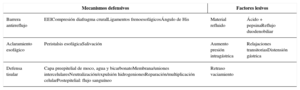
El reflujo gastroesofágico es una entidad de alta prevalencia clínica que consiste en el paso de contenido gástrico o duodenal al esófago en ausencia de vómitos, eructos o cualquier otra situación que lo induzca. Se produce por un desequilibrio entre factores defensivos esofágicos (barrera antirreflujo, aclaramiento esofágico y defensa tisular) y factores agresivos (el material refluido, el aumento de presión intragástrica y el retraso de vaciamiento). La pirosis y la regurgitación son los síntomas principales, aunque también se pueden presentar otros como la disfagia, la tos crónica, el dolor torácico, la patología otorrinolaringológica y el asma. La respuesta clínica al tratamiento con los inhibidores de la bomba de protones es una primera etapa en el proceso diagnóstico y puede continuar con la realización de endoscopia alta y pHmetría en casos seleccionados. La llave del tratamiento son los inhibidores de la bomba de protones, habiéndose establecido actualmente que las pautas descendentes (dosis altas iniciales) son las más coste-efectivas. Sólo un pequeño porcentaje de pacientes con enfermedad por reflujo gastroesofágico necesita cirugía y se suele limitar a la aparición de complicaciones como el esófago de Barrett, las estenosis y el adenocarcinoma esofágico o al fracaso del tratamiento médico.

Palabras Clave
Enfermedad por reflujo gastroesofágico
Endoscopia
Inhibidores de la bomba de protones
Esofagitis
Abstract

Gastroesophageal reflux is a highly prevalent clinical entity consisting of the passage of gastric or duodenal contents into the esophagus in the absence of vomiting, belching, or any other situation that induces. It is caused by an imbalance between esophageal defensive factors (antireflux barrier, esophageal clearance and tissue defense) and aggressive factors (the refluxed material, increased intragastric pressure and delayed emptying). Heartburn and regurgitation are the main symptoms but also may be other as dysphagia, chronic cough, chest pain, otolaryngology pathology and asthma. Clinical response to treatment with inhibitors of proton pump is a first step in the diagnostic process and may continue with the implementation of upper endoscopy and pH monitoring in selected cases. The key to treatment are the proton pump inhibitors, having shown that descending patterns (high initial doses) are the most cost-effective. Only a small percentage of patients with gastroesophageal reflux disease need surgery and is usually limited to the occurrence of complications such as Barrett's esophagus, strictures and esophageal adenocarcinoma or failure of medical treatment.

Keywords
Gastroesophageal Reflux Disease
Endoscopy
Protom Pump Inhibitors
Oesophagitis

Identifíquese

¿Aún no es suscriptor de la revista?
Comprar el acceso al artículo

Comprando el artículo el pdf del mismo podrá ser descargado

Teléfono para incidencias

De lunes a viernes de 9h a 18h (GMT+1) excepto los meses de julio y agosto que será de 9 a 15h
Llamadas desde España 932 415 960
Llamadas desde fuera de España +34 932 415 960
Bibliografía
[1.]
N. Vakil, S.V. Van Zanten, P. Kahrilas, J. Dent, R. Jones, The Global Consensus Group.
The Montreal definition and classification of gastroesophageal reflux disease: a global evidence-based consensus.
Am J Gastroenterol, (2006), 101 pp. 1900-1920
[2.]
J. Ponce, B. Beltrán, M. Ponce, J. Zapardiel, V. Ortiz, O. Vegazo, et al.
Impact of gastroesophageal reflux disease on the quality of life of Spanish patients: The relevance of the biometric factors and the severity of symptoms.
Eur J Gastroenterol Hepatol, (2009), 21 pp. 620-629
[3.]
D. Armstrong, J.K. Marshall, N. Chiba, R. Enns, C.A. Fallone, R. Fass, et al.
Canadian Consensus Conference on the management of gastroesophageal reflux disease in adults -update 2004.
Can J Gastroenterol, (2005), 19 pp. 15-35
[4.]
P. Moayyedi, N.J. Talley.
Gastro-oesophageal reflux disease.
Lancet, (2006), 367 pp. 2086-2100
[5.]
J. Dent, D. Armstrong, B. Delaney, P. Moayyedi, J. Talley, N. Vakil.
Symptom evaluation in reflux disease: workshop background, processes, terminology, recommendations, and discussion outputs.
Gut, (2004), 53 pp. 1-24
[6.]
I. Mainie, R. Tutuian, S. Shay, M. Vela, X. Zhang, D. Sifrim, et al.
Acid and non-acid reflux in patients with persistent symptoms despite acid suppressive therapy: a multicentre study using combined ambulatory impedance-pH monitoring.
Gut, (2006), 55 pp. 1398-1402
[7.]
N.J. Talley, V. Stanghellini, R.C. Heading, K.L. Kock, J.R. Malagelada, G.N.J. Tytgat.
Functional gastroduodenal disorders.
Gut, (1999), 45 pp. 37-42
[8.]
V. Garrigues, J. Pomce.
Aspectos menos conocidos de la enfermedad por reflujo gastroesofágico: pirosis funcional y reflujo no ácido.
Gastroenterol Hepatol, (2008), 31 pp. 522-529
[9.]
J. Ponce, O. Vegazo, B. Beltrán, J. Jiménez, J. Zapardiel, D. Calle, Iberge Study Group, et al.
Prevalence of gastro-esophageal reflux disease in Spain and associated factors.
Aliment Pharmacol Ther, (2006), 23 pp. 175-184
[10.]
J. Isoulari, M. Luostarinen, E. Isolauri, P. Reinikainen, M. Viljakka, O. Keyrilainen.
Natural course of gastroesophageal reflux disease: a follow-up of 60 patients.
Am J Gastroent, (1997), 92 pp. 37-41
[11.]
A. Lanas, S. Santolaria.
Gastroesophageal reflux disease (GERD): current agents and future perspective.
Curr Pharm Des, (2001), 7 pp. 1-18
[12.]
Grupo de trabajo de la guía de práctica clínica sobre ERGE. Manejo del paciente con enfermedad por reflujo gastroesofágico (ERGE). Guía de Práctica Clínica. Actualización 2007. Asociación Española de Gastroenterología, Sociedad Española de Medicina de Familia y Comunitaria y Centro Cochrane Iberoamericano; 2007.
[13.]
F. Johnson, B. Joelsson, K. Gudmundsson, L. Greiff.
Symptoms and endoscopic findings in the diagnosis of gastroesophageal reflux disease.
Scand J Gastroenterol, (1987), 22 pp. 714-718
[13.]
N. Vakil, P. Moayyedi, M.B. Fennerty, N.J. Talley.
Limitedvalue of alarmfeatures in the diagnosis of upper gastrointestinal malignancy: systematic review and meta-analysis.
Gastroenterology, (2006), 131 pp. 390-401
[15.]
K.R. DeVault, D.O. Castell.
Updated guidelines for the diagnosis and treatment of gastroesophageal reflux disease The Practice Parameters Committee of American College of Gastroenterology.
Am J Gastroenterol, (1999), 94 pp. 1434-1442
[16.]
M.J. Corso, K.G. Pursnani, M.A. Mohiuddin, R.M. Gideon, J.A. Castell, D.A. Katzka, et al.
Globus sensationis associated with hypertensive upper esophageal sphincter but not with gastroesophageal reflux.
DigDisSci, (1998), 43 pp. 1513
[17.]
A.P. Hungin, A.S. Raghunath, I. Wiklund.
Beyond heartburn: a systematicreview of the extra-oesophageal spectrum of reflux-induced disease.
Fam Pract, (2005), 22 pp. 591-603
[18.]
British Society of Gastroenterology. Guidelinesforthe diagnosis and management of Barrett’ columnar-line do esophagus. A Report of theWorkingParty of the British Society of Gastroenterology, Nov 2005.
[19.]
Savary M, Miller G. De esophagus. Hand book and Atlas of Endoscopy. Solothurn, Switherland: Grassmann; 1977. p.135.
[20.]
L.R. Lundell, J. Dent, J. Bennett, A.L. Blum, D. Armstrong, J.P. Galmiche, et al.
Endoscopic assessment of oesophagitis: clinical and functional correlates and further validation of the Los Angeles classification.
Gut, (1999), 45 pp. 172-180
[21.]
N.J. Shaheen, M.A. Crosby, E.M. Bozymski, R.S. Sandler.
Is there publication bias in the reporting of cancer risk in Barrett's esophagus?.
Gastroenterology, (2000), 119 pp. 333-338
[22.]
V. Garrigues, V. Pons.
Tratamiento de las enfermedades gastroenterológicas.
3.ª ed, Elsevier Doyma, (2010),
[23.]
H. Hampel, N.S. Abraham, H.B. El-Serag.
Meta-analysis: obesity and the risk for gastroesophageal reflux disease and its complications.
Ann Intern Med, (2005), 143 pp. 199-211
[24.]
R. Jones, O. Junghard, J. Dent, N. Vakil, K. Halling, B. Wernersson, et al.
Development of the GerdQ, a tool for the diagnosis and management of gastro-oesophageal reflux disease in primary care.
Aliment Pharmacol Ther, (2009), 30 pp. 1030-1038
[25.]
J. Dent, J. Brun, A.M. Fendrick, M.B. Fennerty, J. Janssens, P.J. Kahrilas, et al.
An evidence-based appraisal of reflux disease management-The Genval Workshop Report.
Gut., (1999), Sup l2 pp. S1-S16
[26.]
P. Malfertheiner, F. Megraud, C. O’Morain, F. Bazzoli, E. El-Omar, D. Graham, et al.
Current concepts in the management of Helicobacter pylori infection: the Maastricht III Consensus Report.
[27.]
R.C. Heading.
Review article: diagnosis and clinical investigation of gastro-oesophageal reflux disease: a European view.
Aliment Pharmacol Ther, (2004), 20 pp. 9-13
[28.]
D.R. Lichtenstein.
and members og Standards Practice Committee of ASGE. Role of endoscopy in the management of GERD.
Gastrointestinal Endoscopy, (2007), 66 pp. 219-224
[29.]
P.J. Kahrilas, N.J. Shaheen, M.F. Vaezi, S.W. Hiltz, E. Black, I.M. Modlin, et al.
American Gastroenterological Associationet al. American Gastroenterological Association medical position statement on the management of gastroesophageal reflux disease.
Gastroenterology, (2008), 135 pp. 1383-1391
[30.]
L. Wallin, T. Madsen.
12-Hour simultaneous registration of acid reflux and peristalsis activity in the esophagus: A study in normal subjets.
Scand J Gastroenterol, (1979), 14 pp. 561-566
[31.]
M. Marzo, P. Alonso, X. Bonfill, M. Fernández, J. Ferrandiz, G. Martínez, et al.
Guía de práctica clínica sobre el manejo del paciente con enfermedad por reflujo gastroesofágico (ERGE).
Gastroentol Hepatol, (2002), 25 pp. 85-110
[32.]
S.J. Edwards, T. Lind, L. Lundell.
Systematic review: proton pump inhibitors (PPIs) for the healing of reflux oesophagitis - a comparison of esomeprazole with other PPIs.
Alimentary Pharmacology and Therapeutics, (2006), 24 pp. 743-750
[33.]
I. Wiklund.
Review of the quality of life and burden of illness in gastroesophageal reflux disease.
Dig Dis, (2004), 22 pp. 108-114
[34.]
M.D. Crowell, R.L. Levy, J.K. DiBaise, R.W. Jeffery.
Symptomatic improvement in gastroesophageal reflux disease (GERD) following weight loss through caloric restriction and behavioral modification.
Gastroenterology, (2010), 138 pp. S646
[35.]
D.O. Castell, P.J. Kahrilas, J.E. Richter, N.B. Vakil, D.A. Johnson, S. Zuckerman, et al.
Esomeprazole (40mg) compared with lansoprazole (30mg) in the treatment of erosive esophagitis.
Am J Gastroenterol, (2002), 97 pp. 575-583
[36.]
J. Labenz, D. Armstrong, K. Lauritsen, P. Katelaris, S. Schmidt, K. Schütze, et al.
A randomized comparative study of esomeprazole 40mg versus pantoprazole 40mg for healing erosive oesophagitis: the EXPO study.
Aliment Pharmacol Ther, (2005), 21 pp. 739-746
[37.]
J. Marrero.
Interacciones medicamentosas de los antiulcerosos.
Emergencias, (2002), 14 pp. S14-S21
[38.]
A.M. Harmsze.
Esomeprazole but not pantoprazole is associated with lower plasma concentrations of clopidogrel's active metabolite.
Ann Pharmacother, (2011), 45 pp. 542-543
[39.]
C.K. Chow, ACP Journal Club.
Adding omeprazole to clopidogrel reduced GI events and did not increase CV events.
Ann Intern Med, (2011), 154 pp. JC3-JC7
[40.]
L. Lundell, P. Miettinen, H.E. Myrvold, S.A. Pedersen, B. Liedman, J.G. Hatlebakk, et al.
Continued (5-year) follow up of a randomized clinical study comparing antireflux surgery and omeprazole in gastroesophageal reflux disease.
J Am Coll Surg, (2001), 192 pp. 172-179
[41.]
R. Carlsson, J. Dent, R. Watts, S. Riley, R. Sheikh, J. Hatlebakk, International GORD Study Group, et al.
Gastro-oesophageal reflux disease in primary care: an international study of different treatment strategies with omeprazole.
Eur J Gastroenterol Hepatol, (1998), 10 pp. 119-124
[42.]
P. Bytzer, A.L. Blum.
Rationale and proposed algorithms for symptom-based proton pump inhibitor therapy for gastro-oesophageal reflux disease.
Aliment Pharmacol Ther, (2004), 20 pp. 389-398
[41.]
R. Carlsson, J.P. Galmiche, J. Dent, L. Lundell, L. Frison.
Prognostic factors influencing relapse of esophagitis during maintenance therapy with antisecretory drugs: a meta-analysis of long-term omeprazole trials.
Aliment Pharmacol Ther, (1997), 11 pp. 473-482
[42.]
K.R. DeVault.
Review article: the role of acid suppression in patients with non-erosive reflux disease or functional heartburn.
Aliment Pharmacol Ther, (2006), 23 pp. 33-39
[43.]
L.B. Gerson, A.S. Robbins, A. Garber, J. Hornberger, G. Triadafilopoulos.
A cost-effectiveness analysis of prescribing strategies in the management of gastroesophageal reflux disease.
Am J Gastroenterol, (2000), 95 pp. 395-407
[44.]
I. Wiklund, K.D. Bardhan, S. Müller-Lissner, M.A. Bigard, G. Bianchi Porro, J. Ponce, et al.
Quality of life during acute and intermittent treatment of gastroesophageal reflux disease with omeprazole compared with ranitidine. Results from a multi-center clinical trial.
Ital J Gastroenterol Hepatol, (1998), 30 pp. 19-27
[47.]
J. Ponce, L. Argüello, G. Bastida, M. Ponce, V. Ortiz, V. Garrigues.
On-demand therapy with rabeprazole in nonerosive and erosive gastro-oesophageal reflux disease in clinical practice: effectiveness, health-related quality of life and patient satisfaction.
Dig Dis Sci, (2004), 49 pp. 931-936
[48.]
L.F. Martínez de Haro, A. Ortiz, P. Parrilla, J.A. García Marcilla, J.L. Aguayo, G. Morales.
Long-term results of Nissen fundoplication in reflux esophagitis without strictures. Clinical, endoscopic and pH-metric evaluation.
Dig Dis Sci, (1992), 37 pp. 523-527
[49.]
J.P. Galmiche, J.G. Hatlebakk, S.E. Attwood, C. Ell, R. Fiocca, S. Eklund, et al.
Laparoscopic antireflux surgery vs long-term esomeprazole treatment for chronic GERD. Final results after 5 yrs of follow up in the Lotus Study.
Gastroenterology, (2010), 138 pp. S53
[50.]
S.J. Spechler, E. Lee, D. Ahnen, R.K. Goyal, I. Hirano, F. Ramírez, et al.
Long-term outcome of medical and surgical therapies for gastroesophageal reflux disease: follow-up of a randomized controlled trial.
JAMA, (2001), 285 pp. 331-338
Copyright © 2012. Elsevier España, S.L.. Todos los derechos reservados