
Vol. 12. Núm. 30.
Páginas 1793-1797 (Abril 2017)

Protocolos de práctica asistencial
Protocolo diagnóstico de la alergia a alimentos mediada por IgE

Diagnostic protocol for IgE-mediated food allergy

M. Fernández Rivas
Doi : https://10.1016/j.med.2017.03.015
Opciones
Resumen
Introducción

El diagnóstico de la alergia a alimentos (AA) mediada por IgE es de gran importancia para poder establecer una adecuada dieta de evitación que sigue siendo la única alternativa terapéutica en la mayoría de los pacientes.

Procedimiento diagnóstico

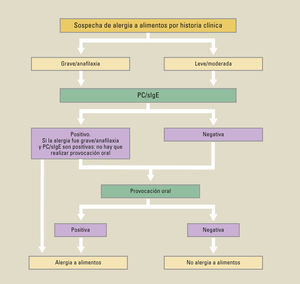
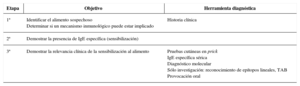
En la primera etapa del diagnóstico, mediante la historia clínica se intenta identificar el alimento sospechoso, establecer si un mecanismo inmunológico puede estar implicado y decidir las pruebas diagnósticas a realizar. En la segunda etapa se intenta demostrar la presencia de IgE específica frente al alimento bajo sospecha mediante pruebas cutáneas y determinaciones de IgE específica sérica, que no son per se diagnósticas de AA. Para confirmar el diagnóstico es necesario evaluarlas en el contexto de la historia clínica, y realizar pruebas de provocación oral con el alimento. El diagnóstico molecular con alérgenos individuales ha mejorado la capacidad diagnóstica de las determinaciones de IgE.

Conclusión

Un diagnóstico correcto de AA permite a los pacientes llevar a cabo una dieta segura y preserva su calidad de vida.

Palabras clave
Alergia a alimentos
IgE
Provocación oral
Pruebas cutáneas
Abstract
Introduction

Diagnosing IgE-mediated food allergy (FA) is of great importance to establish a proper elimination diet, which remains the only therapeutic alternative for most patients.

Diagnostic procedure

In the first stage of diagnosis, by means of the clinical history, an attempt is made to identify the suspicious food, to establish whether an immune mechanism is involved and to decide which diagnostic tests need to be conducted. The second stage aims to prove the presence of specific IgE against the suspected food by means of skin prick testing and serum-specific IgE determinations, which are not diagnostic per se of FA. To confirm diagnosis it is necessary to assess them within the context of the medical history, and to conduct oral food challenges. The recent developments of molecular diagnosis with individual food allergens has improved the diagnostic capability of IgE determinations.

Conclusion

A correct diagnosis of FA allows patients to have a safe diet and preserves their quality of life.

Keywords
Food allergy
IgE
Oral food challenge
Skin tests

Identifíquese

¿Aún no es suscriptor de la revista?

Comprar el acceso al artículo

Comprando el artículo el pdf del mismo podrá ser descargado

Teléfono para incidencias

De lunes a viernes de 9h a 18h (GMT+1) excepto los meses de julio y agosto que será de 9 a 15h

Llamadas desde España 932 415 960
Llamadas desde fuera de España +34 932 415 960
Bibliografía
[1]
201703300050526338
201703300050526339
A.W. Burks, M. Tang, S. Sicherer, A. Muraro, P.A. Eigenmann, M. Ebisawa, et al.
ICON: food allergy.
J Allergy Clin Immunol., (2012), 129
906-20
[2]
2017033000505263310
2017033000505263311
B.I. Nwaru, L. Hickstein, S.S. Panesar, G. Roberts, A. Muraro, A. Sheikh, EAACI Food Allergy and Anaphylaxis Guidelines Group.
Prevalence of common food allergies in Europe: a systematic review and meta-analysis.
Allergy., (2014), 69 pp. 992-1007
[3]
2017033000505263312
2017033000505263313
A. Muraro, T. Werfel, K. Hoffmann-Sommergruber, G. Roberts, K. Beyer, C. Bindslev-Jensen, EAACI Food Allergy and Anaphylaxis Guidelines Group, et al.
EAACI food allergy and anaphylaxis guidelines: diagnosis and management of food allergy.
1008-25
[4]
2017033000505263314
M. Worm, A. Moneret-Vautrin, K. Scherer, R. Lang, M. Fernández-Rivas, V. Cardona, et al.
First European data from the network of severe allergic reactions (NORA).
1397-404
[5]
2017033000505263315
2017033000505263316
K. Soares-Weiser, Y. Takwoingi, S.S. Panesar, A. Muraro, T. Werfel, K. Hoffmann-Sommergruber, EAACI Food Allergy and Anaphylaxis Guidelines Group, et al.
The diagnosis of food allergy: a systematic review and meta-analysis.
Allergy., (2014), 69 pp. 76-86
[6]
2017033000505263317
2017033000505263318
P.M. Matricardi, J. Kleine-Tebbe, H.J. Hoffmann, R. Valenta, C. Hilger, S. Hofmaier, et al.
EAACI Molecular Allergology User's Guide.
Pediatr Allergy Immunol., (2016), 27 pp. 1-250
[7]
2017033000505263319
2017033000505263320
A. Nowak-Wegrzyn, A.H. Assa’ad, S.L. Bahna, S.A. Bock, S.H. Sicherer, S.S. Teuber, Adverse Reactions to Food Committee of American Academy of Allergy.
Asthma & Immunology. Work Group report: oral food challenge testing.
J Allergy Clin Immunol., (2009), 123Suppl6
S365-83
[8]
2017033000505263321
2017033000505263322
H.A. Sampson, R. Gerth van Wijk, C. Bindslev-Jensen, S. Sicherer, S.S. Teuber, A.W. Burks, et al.
Standardizing double-blind, placebo-controlled oral food challenges: American Academy of Allergy, Asthma & Immunology-European Academy of Allergy and Clinical Immunology PRACTALL consensus report.
J Allergy Clin Immunol., (2012), 130
1260-74