

Vol. 13. Núm. 47.
Páginas 2758-2761 (Enero 2022)

Protocolo diagnóstico y terapéutico de las infecciones bacterianas de la piel

Diagnostic and treatment protocol for bacterial skin infections

G. Selda-EnríquezP. Burgos-BlascoA. Melian-OliveraA. Hermosa-Gelbard
Doi : https://10.1016/j.med.2022.01.005
Opciones
Resumen

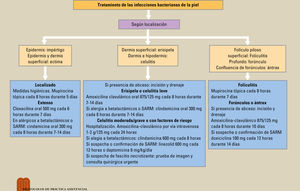
La piel sana está protegida por la microbiota cutánea, pero cuando se produce un desequilibrio de su composición o se origina un daño en la barrera cutánea se puede ocasionar una infección. Las infecciones bacterianas cutáneas se pueden clasificar según la profundidad a la que se origina la infección en (de más superficial a profundo): impétigo, ectima, erisipela, celulitis y fascitis necrotizante o foliculitis si afecta al folículo piloso en su porción superficial y el forúnculo, que es la infección profunda del folículo. Es muy importante saber identificarlas clínicamente, conocer cuándo es necesario realizar pruebas complementarias y administrar el tratamiento antibiótico adecuado. Este protocolo intentará ser una guía práctica para ayudar a médicos generales y especialistas a manejar las infecciones bacterianas cutáneas.

Palabras clave
Impétigo
Celulitis
Foliculitis
Antibióticos
Abstract

Healthy skin is protected by the skin microbiota, but when there is an imbalance in its composition or injury to the skin barrier occurs, it can lead to an infection. Bacterial skin infections can be classified according to the depth at which the infection originates (from more superficial to deeper): impetigo; ecthyma; erysipelas; cellulitis; necrotizing fasciitis; folliculitis, if it affects the superficial part of the hair follicle; or boils, which is a deep infection of the follicle. It is important to know how to clinically identify them, when it is necessary to conduct additional tests, and administer appropriate antibiotic treatment. This protocol aims to be a practical guide for helping general practitioners and specialists in managing bacterial skin infections.

Keywords
Impetigo
Cellulitis
Folliculitis
Antibiotics

Identifíquese

¿Aún no es suscriptor de la revista?
Comprar el acceso al artículo

Comprando el artículo el pdf del mismo podrá ser descargado

Teléfono para incidencias

De lunes a viernes de 9h a 18h (GMT+1) excepto los meses de julio y agosto que será de 9 a 15h
Llamadas desde España 932 415 960
Llamadas desde fuera de España +34 932 415 960
Bibliografía
[1]
G.L.
202201280753482608
Darmstadt, A.T. Lane.
Impetigo: an overview.
Pediatr Dermatol., (1994), 11 pp. 293-303
[2]
O. Becquet, J. Pasche, H. Gatti, C. Chenel, M. Abély, P. Morville, et al.
Acute post-streptococcal glomerulonephritis in children of French Polynesia: a 3-year retrospective study.
Pediatr Nephrol., (2010), 25 pp. 275-280
[3]
D.L.
202201280753482609
2022012807534826010
Stevens, A.L. Bisno, H.F. Chambers, E.P. Dellinger, E.J. Goldstein, S.L. Gorbach, et al.
Practice guidelines for the diagnosis and management of skin and soft tissue infections: 2014 update by the infectious diseases society of America.
Clin Infect Dis., (2014), 59 pp. 147-159
[4]
S.
2022012807534826011
Koning, R. van der Sande, A.P. Verhagen, L.W. van Suijlekom-Smit, A.D. Morris, C.C. Butler, et al.
Interventions for impetigo.
Cochrane Database Syst Rev., (2012), 1 pp. CD003261
[5]
C.
2022012807534826012
2022012807534826013
Liu, A. Bayer, S.E. Cosgrove, R.S. Daum, S.K. Fridkin, R.J. Gorwitz, et al.
Infectious Diseases Society of America. Clinical practice guidelines by the infectious diseases society of america for the treatment of methicillin-resistant Staphylococcus aureus infections in adults and children.
Clin Infect Dis., (2011), 52 pp. e18-e55
[6]
A.N.
2022012807534826014
Amin, E.A. Cerceo, S.B. Deitelzweig, J.C. Pile, D.J. Rosenberg, B.M. Sherman.
Hospitalist perspective on the treatment of skin and soft tissue infections.
Mayo Clin Proc., (2014), 89 pp. 1436-1451
[7]
K.
2022012807534826015
2022012807534826016
Ramakrishnan, R.C. Salinas, N.I. Agudelo Higuita.
Skin and soft tissue infections.
Am Fam Physician., (2015), 92 pp. 474-483