

Vol. 12. Núm. 62.
Páginas 3637-3649 (Septiembre 2018)

Actualización
Alteraciones de la esfera mental: demencia y depresión en el anciano

Changes in the mental sphere: dementia and depression in the elderly patient

E.M. Fernández de la Puente RodríguezaR. Bielza GalindobJ. Galindo Ortiz de LandázuricJ. Olivera Pueyod
Doi : https://10.1016/j.med.2018.09.002
Opciones
Resumen

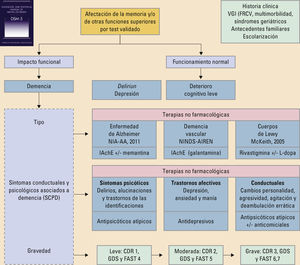
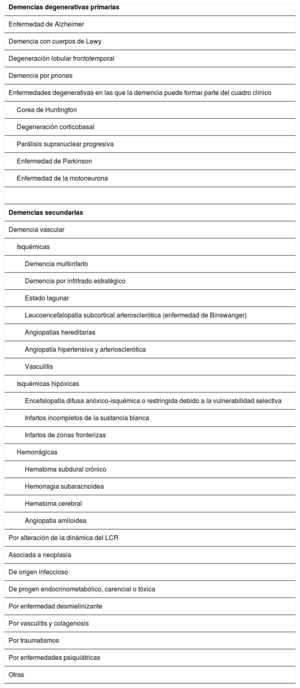
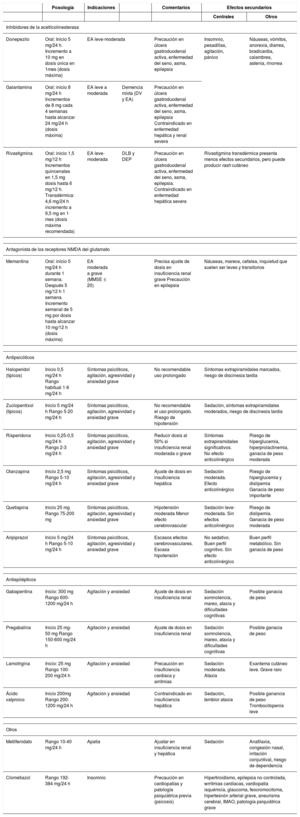
Tanto la demencia como la depresión son frecuentes y condicionan un grave impacto en el paciente y su entorno. Ante la sospecha de deterioro cognitivo, es necesario: confirmar el diagnóstico de demencia (afectación de una o más funciones superiores con repercusión en el funcionamiento global), realizar un adecuado diagnóstico diferencial, clasificar y estadificar la demencia y valorar los síntomas no cognitivos. Se debe considerar la presencia de enfermedades crónicas, el deterioro funcional, el consumo elevado de fármacos o los problemas del entorno sociofamiliar concomitantes. Se recomienda el tratamiento con inhibidores de la acetil-colinesterasa y/o memantina cuando estén indicados, junto con terapias no farmacológicas. En la depresión del mayor es más común la irritabilidad, la ansiedad y los síntomas cognitivos. Se asocia a comorbilidad y/o deterioro cognitivo. La relación entre depresión y enfermedad médica es bidireccional: problemas médicos como el dolor crónico predisponen a la depresión, y la depresión está asociada con peor un pronóstico para otras enfermedades. El tratamiento de la depresión en los ancianos es tan eficaz como en el resto de la población, y es fundamental su detección y correcto diagnóstico.

Palabras clave
Demencia
Depresión
Anciano
Abstract

Dementia and depression are both common and have a major impact on the patient and their environment. If cognitive impairment is suspected, it is necessary to confirm the diagnosis of dementia (impairment of one or more cognitive higher functions affecting overall functioning), to make an appropriate differential diagnosis, to classify and stage the dementia, and to assess non-cognitive symptoms. The presence of chronic disease, functional impairment, high drug consumption and concomitant social and family problems should be considered. Treatment is recommended with acetylcholinesterase and/or memantine when indicated, along with non-pharmacological therapies. Irritability, anxiety and cognitive symptoms are more common in depressed elderly patients. The relationship between depression and medical disease is two-way: medical problems such as chronic pain predispose to depression, and depression is associated with a poorer prognosis for other diseases. Treatment of depression in the elderly is as effective as in the rest of the population, and its detection and correct diagnosis is essential.

Keywords
Dementia
Depression
The elderly patient

Identifíquese

¿Aún no es suscriptor de la revista?

Comprar el acceso al artículo

Comprando el artículo el pdf del mismo podrá ser descargado

Teléfono para incidencias

De lunes a viernes de 9h a 18h (GMT+1) excepto los meses de julio y agosto que será de 9 a 15h

Llamadas desde España 932 415 960
Llamadas desde fuera de España +34 932 415 960
Bibliografía
[1]
202103120735567128
202103120735567129
Grupo de trabajo de la Guía de Práctica Clínica sobre la atención integral a las personas con enfermedad de Alzheimer y otras demencias. Guía de Práctica Clínica sobre la atención integral a las personas con enfermedad de Alzheimer y otras demencias. Plan de Calidad para el Sistema Nacional de Salud del Ministerio de Sanidad, Política Social e Igualdad. Agència d’Informació, Avaluació i Qualitat en Salut de Cataluña; 2010. Guías de Práctica Clínica en el SNS: AIAQS Núm. 2009/07.
[2]
2021031207355671210
Y.-T. Wu, A.S. Beiser, M.M.B. Breteler, L. Fratiglioni, C. Helmer, H.C. Hendrie, et al.
The changing prevalence and incidence of dementia over time — current evidence.
Nat Rev Neurol., (2017), 13 pp. 327-339
[3]
2021031207355671211
2021031207355671212
G. Livingston, A. Sommerlad, V. Orgeta, S.G. Costafreda, J. Huntley, D. Ames, et al.
Dementia prevention, intervention, and care.
Lancet, (2017), pp. 390
[4]
2021031207355671213
Asociación Americana de Psiquiatría. Guia de consulta de los criterios diagnóticos del DSM-5. 2014.
[5]
2021031207355671214
G.A. Warshaw, E.J. Bragg, L.P. Fried, W.J. Hall.
Which patients benefit the most from a geriatrician's care? Consensus among directors of geriatrics academic programs.
J Am Geriatr Soc., (2008), 56 pp. 1796-1801
[6]
2021031207355671215
C. Fu, X. Jin, B. Chen, F. Xue, H. Niu, R. Guo, et al.
Comparison of the Mini-Mental State Examination and Montreal Cognitive Assessment executive subtests in detecting post-stroke cognitive impairment.
Geriatr Gerontol Int., (2017), 17 pp. 2329-2335
[7]
2021031207355671216
P.S. Sachdev, A. Mohan, L. Taylor, D.V. Jeste.
DSM-5 and Mental Disorders in Older Individuals.
Harv Rev Psychiatry, (2015), 23 pp. 320-328
[8]
2021031207355671217
2021031207355671218
R.C. Petersen.
Mild cognitive impairment.
N Engl J Med., (2011), 364 pp. 2227-2234
[9]
2021031207355671219
R.O. Roberts, D.S. Knopman, M.M. Mielke, R.H. Cha, V.S. Pankratz, T.J.H. Christianson, et al.
Higher risk of progression to dementia in mild cognitive impairment cases who revert to normal.
Neurology, (2014), 82 pp. 317-325
[10]
2021031207355671220
A.J. Mitchell, M. Shiri-Feshki.
Rate of progression of mild cognitive impairment to dementia–meta-analysis of 41 robust inception cohort studies.
Acta Psychiatr Scand., (2009), 119 pp. 252-265
[11]
2021031207355671221
J. Witlox, L.S.M. Eurelings, J.F.M. de Jonghe, K.J. Kalisvaart, P. Eikelenboom, W.A. van Gool.
Delirium in elderly patients and the risk of postdischarge mortality, institutionalization, and dementia: a meta-analysis.
JAMA, (2010), 304 pp. 443-451
[12]
2021031207355671222
F. Romero Delgado, R. Domínguez Rubio, R. Barahona-Hernando, O. Rodríguez Gómez.
Dementia.
Med., (2015), 11 pp. 4297-4305
[13]
2021031207355671223
2021031207355671224
J. Hort, J.T. O’Brien, G. Gainotti, T. Pirttila, B.O. Popescu, I. Rektorova, et al.
EFNS guidelines for the diagnosis and management of Alzheimer's disease.
Eur J Neurol., (2010), 17 pp. 1236-1248
[14]
2021031207355671225
2021031207355671226
G.M. McKhann, D.S. Knopman, H. Chertkow, B.T. Hyman, C.R. Jack, C.H. Kawas, et al.
The diagnosis of dementia due to Alzheimer's disease: recommendations from the National Institute on Aging-Alzheimer's Association workgroups on diagnostic guidelines for Alzheimer's disease.
Alzheimers Dement., (2011), 7 pp. 263-269
[15]
2021031207355671227
B. Dubois, H.H. Feldman, C. Jacova, S.T. Dekosky, P. Barberger-Gateau, J. Cummings, et al.
Research criteria for the diagnosis of Alzheimer's disease: revising the NINCDS-ADRDA criteria.
Lancet Neurol., (2007), 6 pp. 734-746
[16]
2021031207355671228
M.S. Albert, S.T. DeKosky, D. Dickson, B. Dubois, H.H. Feldman, N.C. Fox, et al.
The diagnosis of mild cognitive impairment due to Alzheimer's disease: recommendations from the National Institute on Aging-Alzheimer's Association workgroups on diagnostic guidelines for Alzheimer's disease.
Alzheimers Dement., (2011), 7 pp. 270-279
[17]
2021031207355671229
J. Gascón-Bayarri, R. Reñé, J.L. del Barrio, J. de Pedro-Cuesta, J.M. Ramón, J.M. Manubens, et al.
Prevalence of dementia subtypes in El Prat de Llobregat, Catalonia, Spain: the PRATICON study.
Neuroepidemiology, (2007), 28 pp. 224-234
[18]
2021031207355671230
I.G. McKeith, D.W. Dickson, J. Lowe, M. Emre, J.T. O’Brien, H. Feldman, et al.
Diagnosis and management of dementia with Lewy bodies: third report of the DLB Consortium.
[19]
2021031207355671231
J.J. Young, M. Lavakumar, D. Tampi, S. Balachandran, R.R. Tampi.
Frontotemporal dementia: latest evidence and clinical implications.
Ther Adv Psychopharmacol, (2018), 8 pp. 33-48
[20]
2021031207355671232
2021031207355671233
J. Olazarán-Rodríguez, L.F. Agüera-Ortiz, R. Muñiz-Schwochert.
Síntomas psicológicos y conductuales de la demencia: Prevención, diagnóstico y tratamiento.
Rev Neurol., (2012), 55 pp. 598-608
[21]
2021031207355671234
S.M. Dyer, S.L. Harrison, K. Laver, C. Whitehead, M. Crotty.
An overview of systematic reviews of pharmacological and non-pharmacological interventions for the treatment of behavioral and psychological symptoms of dementia.
Int Psychogeriatrics, (2017), pp. 1-15
[22]
2021031207355671235
I. Abraha, J.M. Rimland, F.M. Trotta, G. Dell’Aquila, A. Cruz-Jentoft, M. Petrovic, et al.
Systematic review of systematic reviews of non-pharmacological interventions to treat behavioural disturbances in older patients with dementia. The SENATOR-OnTop series.
BMJ Open, (2017), 7 pp. e012759
[23]
2021031207355671236
2021031207355671237
J.T. O’Brien, C. Holmes, M. Jones, R. Jones, G. Livingston, I. McKeith, et al.
Clinical practice with anti-dementia drugs: A revised (third) consensus statement from the British Association for Psychopharmacology.
J Psychopharmacol., (2017), 31 pp. 147-168
[24]
2021031207355671238
P. Martínez Lage.
Know Alzheimer. Respuestas concretas a dudas reales. Manual para geriatras.
Profarmaco 2, (2014),
[25]
2021031207355671239
V.C. Vilela, R.L. Pacheco, C.O.C. Latorraca, D.V. Pachito, R. Riera.
What do Cochrane systematic reviews say about non-pharmacological interventions for treating cognitive decline and dementia?.
Sao Paulo Med J., (2017), 135 pp. 309-320
[26]
2021031207355671240
J. Rodda, N. Boyce, Z. Walker.
The old age psychiatry handbook. A practical guide.
Wiley, (2008),
[27]
2021031207355671241
M. Martín-Carrasco, L. Agüera-Ortiz, L. Caballero-Martínez, J. Cervilla, J. Menchón-Magriñá, A. Montejo-González.
Consenso de la Sociedad Española de Psicogeriatría sobre la depresión en el anciano.
Psicogeriatría, (2011), 3 pp. 55-65
[28]
2021031207355671242
J. Olivera, S. Benabarre, T. Lorente, M. Rodríguez, C. Pelegrín, J.M. Calvo, et al.
Prevalence of psychiatric symptoms and mental disorders detected in primary care in an elderly Spanish population. The PSICOTARD Study: preliminary findings.
Int J Geriatr Psychiatry, (2008), 23 pp. 915-921
[29]
2021031207355671243
R. Baldwin.
Aetiology of late-life depression.
Adv Psychiatr Treat, (1999), 5 pp. 435-442
[30]
2021031207355671244
W.D. Taylor, H.J. Aizenstein, G.S. Alexopoulos.
The vascular depression hypothesis: mechanisms linking vascular disease with depression.
Mol Psychiatry, (2013), 18 pp. 963-974
[31]
2021031207355671245
J. Cervilla.
Síndromes depresivos.
Psiquiatría geriátrica, 2a ed., Masson, pp. 409-435
[32]
2021031207355671246
M. Sánchez.
Trastornos afectivos en el anciano.
Guía esencial de psicogeriatría, Editorial Médica Panamericana, pp. 167-212
[33]
2021031207355671247
J. Vallejo.
Las depresiones.
Introducción a la psicopatología y psiquiatría, Masson, pp. 485-512
[34]
2021031207355671248
R. Catalán, C. Gastó.
Identificación de la melancolía en la asistencia Primaria.
Salud Ment., (1998), 1 pp. 27-39
[35]
2021031207355671249
R.C. Baldwin.
Delusional depression in elderly patients: Characteristics and relationship to age at onset.
Int J Geriatr Psychiatry, (1995), 10 pp. 981-985
[36]
2021031207355671250
G.S. Alexopoulos, B.S. Meyers, R.C. Young, S. Campbell, D. Silbersweig, M. Charlson.
«Vascular depression» hypothesis.
Arch Gen Psychiatry, (1997), 54 pp. 915-922
[37]
2021031207355671251
Baldwin R, Wild R. Management of depression in later life. 2004; 10:131-139.
[38]
2021031207355671252
2021031207355671253
K. Wilson, P. Mottram, A. Sivanranthan, A. Nightingale.
Antidepressant versus placebo for depressed elderly.
Cochrane database Syst Rev., (2001 Jan 22), pp. CD000561
[39]
2021031207355671254
C. Katona, T. Hansen, C.K. Olsen.
A randomized, double-blind, placebo-controlled, duloxetine-referenced, fixed-dose study comparing the efficacy and safety of Lu AA21004 in elderly patients with major depressive disorder.
Int Clin Psychopharmacol., (2012), 27 pp. 215-223
[40]
2021031207355671255
2021031207355671256
Sociedad Española de Psicogeriatría.
Documento de la Sociedad Española de Psicogeriatría sobre el uso de antipsicóticos en personas de edad avanzada.
Psicogeriatría., (2017), 7 pp. S1-S37