

Vol. 12. Núm. 7.
Páginas 363-379 (Abril 2016)

Actualización
Abdomen agudo

Acute abdomen

M.A. Mayo OssorioJ.M. Pacheco GarcíaJ.M. Vázquez Gallego
Doi : https://10.1016/j.med.2016.03.012
Opciones
Resumen
Introducción

El abdomen agudo es una entidad mórbida, multisindrómica, de defensa aguda ante agresiones abdominales de muy distintas características.

Fisiopatología

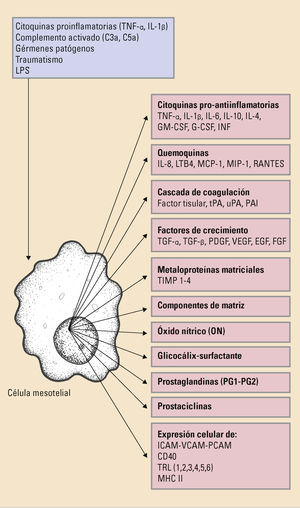
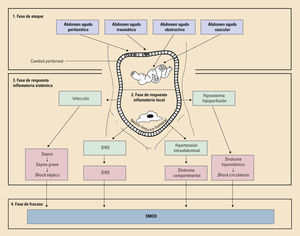
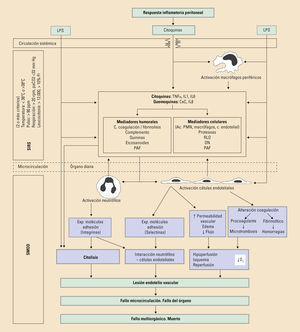
Ante ellas, se ponen en marcha, concatenadamente, una serie de procesos reactivos y defensivos inflamatorios locorregionales y sistémicos, de los que hoy se han desentrañado muchos, quedando aún aspectos de difícil interpretación y estudio necesario. En este sentido, destacan la teoría mesotelial de inicio y control de la respuesta patobiológica peritoneal; el concepto de la cavidad peritoneal como unidad orgánica funcional de respuesta neuro-inmune-humoral frente a la agresión abdominal y el papel citoquínico concatenador de los eventos inflamatorios locorregionales y sistémicos, entre los más importantes.

Manifestaciones clínicas

Su conocimiento total es fundamental para suplementar así los numerosos conocimientos clínicos y exploratorios que el pasado nos había legado en esta patología, y poder así conseguir que los numerosos pacientes con ella, de grave evolución y letalidad a su libre albedrio, puedan ser tratados de manera más eficaz.

Manejo clínico

Este trabajo revisa alguno de estos fascinantes problemas. También se aportan los datos clínicos y exploratorios en la investigación hoy al uso en este síndrome, así como las pautas generales de su tratamiento.

Palabras clave
Célula mesotelial
Síndromes sistémicos
Cross-talk
Toxicidad mediada por neutrófilos
Dolor abdominal
Tratamiento del abdomen agudo
Diagnóstico del abdomen agudo
Abstract
Introduction

The acute abdomen is a morbid entity, multi-syndromic, acute abdominal defense against aggression with very different characteristics.

Pathophysiology

Before them, they are started sequentially a series of locoregional and systemic inflammatory reactive and defensive processes, which have now unraveled many aspects still being difficult to interpret and study required. In this regard they include mesothelial theory start and peritoneal patobiologic control response; the concept of the peritoneal cavity and functional organic unity of neuro-immune-humoral response against the abdominal aggression, as well as the role of cytokines as a link among locoregional and systemic inflammatory events.

Clinical manifestations

Its total knowledge is essential in order to supplement the numerous clinical and exploratory knowledge that the past had left us in this condition, so we can get that many patients with it serious evolution and lethality to their free will, can be more effectively treated.

Clinical management

This paper reviews some of these fascinating problems. Today the investigational use in clinical syndrome and exploratory data as well as general guidelines for their treatment are also provided.

Keywords
Mesothelial cell
Systemic syndromes
Cross-talk
Neutrophil-mediated toxicity
Abdominal pain
Treatment of acute abdomen
Diagnosis of acute abdomen

Identifíquese

¿Aún no es suscriptor de la revista?

Comprar el acceso al artículo

Comprando el artículo el pdf del mismo podrá ser descargado

Teléfono para incidencias

De lunes a viernes de 9h a 18h (GMT+1) excepto los meses de julio y agosto que será de 9 a 15h

Llamadas desde España 932 415 960
Llamadas desde fuera de España +34 932 415 960
Bibliografía
[1]
R.F. Martin, R.L. Rossi.
The acute abdomen.
Surg Clin N Am, (1997), 77 pp. 1227-1243
[2]
V. Yao, C. Platell, J.C. Hall.
Peritoneal mesothelial cells produce inflammatory related cytokines.
ANZ J Surg, (2004), 74 pp. 997-1002
[3]
E. Lin, S.E. Calvano, S.F. Lowry.
Inflammatory cytokines and cell response in surgery.
Surgery, (2000), 127 pp. 117-125
[4]
S. Yung, T.M. Chan.
Pathophysiological changes to the peritoneal membrane during PD-related: The role of mesothelial cells.
Mediators Inflamm, (2012), pp. 484167
[5]
T. Sammour, A. Kahokehr, M. Soop, A.G. Hill.
Peritoneal damage: the inflammatory response and clinical implications of the neuro-inmmune-humoral axis.
World J Surg, (2010), 34 pp. 704-720
[6]
J.C. Hall, K.A. Heel, J.M. Papadimitriou, C. Hell.
The pathobiology of peritonitis.
Gastroenterology, (1998), 114 pp. 185-196
[7]
R. Nachtsheim, B. Dudley, P.L. Mc Neil, R. Howdieshell.
The peritoneal cavity is a distinct compartment of angiogenic molecular mediators.
J Surg Res, (2006), 134 pp. 28-35
[8]
V. Yao, C. Platell, C. Hall.
Role of peritoneal mesothelial cells in peritonitis.
Br J Surg, (2003), 90 pp. 1187-1194
[9]
S. Yung, T.M. Chan.
Intrinsic cells: mesothelial cells-central players in regulating inflammation and resolution.
Perit Dial Int, (2009), 29 pp. S21-S27
[10]
F. Broche, J.M. Tellado.
Defense mechanisms of the peritoneal cavity.
Curr Opin Crit Care, (2001), 7 pp. 105-116
[11]
R.J.E. Skipworth, K.C.H. Fearon.
Surgery peritonitis., (2007), pp. 98-101
[12]
Li FK, A. Davenport, L. Robson, P. Loetscher, R. Rothlein, J.D. Williams, et al.
Leukocyte migration across human peritoneal mesothelial cells is dependent on directed chemokinesecretion and ICAM-1.
Kidney Int, (1998), 54 pp. 2170-2183
[13]
W. Schulte, J. Bernhagen, R. Bucala.
Citokynes in sepsis: potent immunoregulators and potential therapeutic targets–an updated view.
Mediators Inflamm, (2013), 2013 pp. 165974
[14]
A. Schwentker, T.R. Billiar.
Nitric oxide and wound repair.
Surg Clin N Am, (2003), 83 pp. 521-530
[15]
C.J. O¿Boyle, J. MacFie, C.J. Mitchel, D. Johnstone, P.M. Sagar, P.C. Sedman.
Microbiology of bacterial translocation in humans.
Gut, (1998), 422 pp. 9-35
[16]
S.M. Steinberg.
Bacterial translocation: what is and what is not.
Am J Surg, (2003), 186 pp. 301-305
[17]
A. García de Lorenzo, J. Acosta, J.A. Rodríguez Montes.
Importancia clínica de la translocación bacteriana.
Nutr Hosp, (2007), 22 pp. 49-54
[18]
R.P. Dellinger, M.M. Levy, A. Rhodes, D. Annane, H. Gerlach, S.M. Opal, et al.
Surviving sepsis campa international guidelines for management of severe sepsis septic shock 2012.
Crit Care Med, (2013), 41 pp. 580-637
[19]
F. Riché, E. Gayat, C. Collet, J. Matéo, M.J. Laisné, J.M. Launay, et al.
Local and systemic innate response to secondary human peritonitis.
Critical Care, (2013), 17 pp. R201
[20]
J. Valverde, A. Sitges-Serra.
Respuesta biológica a la infección. Síndrome de respuesta inflamatoria sistémica (SIRS) y Síndrome de disfunción orgánica múltiple (SDOM).
Cirugía AEC, 2ª ed., Ed Panamericana, pp. 151-157
[21]
R.S. Hotchkiss, I.E. Karl.
The pathophysiology and treatment of sepsis.
N Engl J Med, (2003), 348 pp. 138-150
[22]
M. Sartelli, F. Catena, S. Di Saverio, L. Ansaloni, M. Malangoni, E.E. Moore, et al.
Current concept of abdominal sepsis: WSES position paper.
World J Emerg Surg, (2014), pp. 9:22
[23]
D.C. Angus, T. van der Poll.
Severe sepsis and septic shock N Engl J Med, (2013), 369 pp. 840-851
[24]
M. Kalia, N. Herring.
Physiology of shock and volume resuscitation.
Surgery (Oxford), (2013), 31 pp. 545-551
[25]
R.R. Ivatury, L. Diebel, J.M. Porter, R.J. Simon.
Intra-abdominal hypertension and the abdominal compartment syndrome.
Surg Clin North Am, (1997), 77 pp. 783-798
[26]
J.A. Carr.
Abdominal compartment syndrome: A decade of progress.
J Am Coll Surg, (2013), 216 pp. 135-146
[27]
E.A. Deitch.
Multiple organ failure.
Ann Surg, (1992), 216 pp. 117-134
[28]
Marshall JC. Multiple organ dysfunction syndrome. En: Souba, W.W., Fink, M.P., Jurkovich, G., et al, editors. ACS Surgery. New York: Ed WebMD; 2006. 1500-19.
[29]
Vázquez JM, Martin L. Pancreatitis agudas. En: Torres, L.M., editor. Cuidados críticos y emergencias. Tomo I. Madrid: Aran; 2001. p. 1167-90.
[30]
Silen W, Cope Z. The principle of diagnosis in acute abdominal disease. En: Silen, W., Cope, Z., editors. Early diagnosis of the acute abdomen. 10th ed. New York: Oxford University Press; 1996.p. 3-18.
[31]
Vitello JM, Nyhus LlM. Síntomas y su significado. En: Nyhus LlM, Vitello JM, Condon RE, editores. Dolor abdominal. Madrid: Ed Panamericana; 1996. p. 1-30.
[32]
Delcore R, Cheung LY. Acute abdominal pain. En: Souba, W.W., Fink, M., Jurkovich, G., et al, editors. ACS Surgery. New York: Ed WebMD; 2006. p. 397-412.
[33]
ChE. Steeds.
The anatomy and physiology of pain.
Surgery (Oxford), (2013), 31 pp. 49-53
[34]
J. Smith, D.N. Lobo.
Investigation of the acute abdomen.
Surgery (Oxford), (2012), 30 pp. 296-305
[35]
S. Roy, P. Weimersheimer.
Nonoperative cause of abdominal pain.
Surg Clin N Am, (1997), 77 pp. 1433-1454
[36]
Z. Cope, W. Silen.
Abdomen agudo de Cope Diagnóstico temprano. 18ª ed.
Manual Moderno, (1994),
[37]
A. Garci¿a Mari¿n, T. Sánchez Rodri¿guez, C. Camarero Mulas, F. Turégano Fuentes.
Dolor abdominal Abdomen agudo.
Medicine, (2011), 10 pp. 6069-6077
[38]
F. González San Marti¿n, M.I. Marti¿n Arribas, E. Perianes Di¿az, A. Rodri¿guez Pérez.
Dolor abdominal agudo en el adulto.
Medicine, (2012), 11 pp. 355-364
[39]
C. del Arco Galán, M.L. Parra Gordo, G. Garci¿a-Casasola Sánchez.
Pruebas de imagen en el dolor abdominal agudo.
Rev Clin Esp, (2008), 208 pp. 520-524
[40]
H. Gupta, D.E. Dupuy.
Advances in imaging of acute abdomen.
Surg Clin N Am, (1997), 77 pp. 1245-1263
[41]
M. Carreras Aja, I. Arrieta Artieda, S. Borruel Nacenta.
La tomografía computarizada multidetector en el abdomen agudo.
Radiología, (2011), 53 pp. 60-69
[42]
M.A. Memon, R.J. Fitztgibbons.
The role of minimalist access surgery in the acute abdomen.
Surg Clin N Am, (1997), 77 pp. 1333-1353
[43]
C. Marterola, P. Astudillo, H. Losada, V. Pineda, A. Sanhueza, M. Vial.
Analgesia in patients with acute abdominal pain.
Cochrane Database Syst Rev, (2007), 3 pp. CD0056620
[44]
X. Guirao, J. Arias, J.M. Badia, J.A. García-Rodríguez, J. Mensa, F. Álvarez-Lerma, et al.
Recomendaciones en el tratamiento antibiótico empírico de la infección intraabdominal.
Rev Esp Quimioter, (2009), 22 pp. 151-172