

Vol. 12. Núm. 7.
Páginas 346-362 (Abril 2016)

Actualización
Ìleo intestinal

Intestinal obstruction

J.M. Pacheco GarcíaM.A. Mayo OssorioJ.M. Vázquez Gallego
Doi : https://10.1016/j.med.2016.03.011
Opciones
Resumen
Introducción

El íleo intestinal o síndrome obstructivo intestinal (SOI) es uno de los cuatro tipos de abdomen agudo, muy frecuente en nuestras urgencias hospitalarias y fuente de una morbimortalidad importante.

Fisiopatología

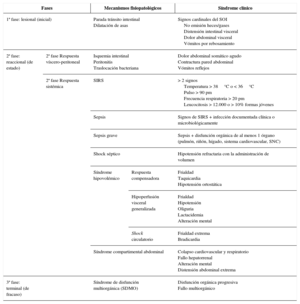
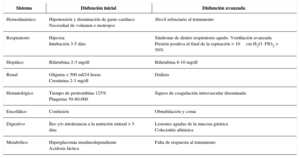
Iniciado multicausalmente a nivel del tubo intestinal, se establece una parada en su tránsito, más o menos completa, que desencadena una multitud de procesos de defensa y reacción inflamatoria concatenados, primero en la cavidad peritoneal y después sistémicos, participando así todo el organismo en ello. Aunque no todos esos procesos son completamente conocidos, los exponemos con sus aspectos fisiopatológicos generales, sus complicaciones y su repercusión clínica, encuadrándolos en tres fases: de inicio, de reacción o estado y, por último, de fracaso.

Manejo clínico

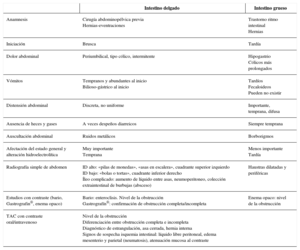
El estudio de las causas del SOI nos lleva a delimitar cuatro entidades etiopatogénicas distintas (dos dinámicas y dos adinámicas) que implican una investigación clínica y una puesta en marcha terapéutica muy diferenciadas y ricas, cuyos aspectos más importantes se exponen así en este trabajo.

Palabras clave
Íleo
Parada intestinal
Respuesta local y sistémica
Adhesiolisis
Stents expandibles
Colectomías
Abstract
Introduction

The intestinal ileus or intestinal obstruction syndrome (IOS) is one of four types of acute abdomen, very common in our hospital emergency and a major source of morbidity and mortality.

Pathophysiology

It starts at the intestinal tube as the consequence of several causes. A more or less complete stop in the intestinal transit triggers a multitude of defense reactions and concatenated inflammatory response. These reactions begin in the intestinal cavity and expand to a systemcia participation. Although knowledge is incomplete, we describe the general pathophysiology, its complications and the clinical impact, distributted in three phases: beginning, state and failure.

Clinical management

The study of the causes of IOS leads us to define four different etiopathogenic entities (two dynamic and two adynamic) involving clinical research and put into very different and rich therapeutic march, whose most important aspects are well presented in this paper.

Keywords
Ileus
Intestinal stop
Local and systemic response
Adhesiolysis
Expandable stents
Colectomies

Identifíquese

¿Aún no es suscriptor de la revista?

Comprar el acceso al artículo

Comprando el artículo el pdf del mismo podrá ser descargado

Teléfono para incidencias

De lunes a viernes de 9h a 18h (GMT+1) excepto los meses de julio y agosto que será de 9 a 15h

Llamadas desde España 932 415 960
Llamadas desde fuera de España +34 932 415 960
Bibliografía
[1]
M.S. Saund, D.I. Soybel.
Ileus and bowel obstruction.
Greenfied's surgery., 4th ed., Lippincott. Williams & Wilkins, pp. 767-787
[2]
M.J. Worsey, V.F. Fazio.
Intestinal obstruction.
Surgery, Mosby, pp. 4
[3]
J.M. Vázquez, A. Gil-Olarte.
Síndrome de obstrucción intestinal.
Medicine, (2004), 9 pp. 400-408
[4]
D.G. Glancy.
Intestinal obstruction.
Surgery (Oxford), (2014), 32 pp. 204-211
[5]
J.A. Stephenson.
Intestinal obstruction.
Surgery (Oxford), (2010), 29 pp. 33-38
[6]
B. Person, S. Wexner.
The management of postoperative Ileus.
Curr Probl Surg., (2006), 43 pp. 12-65
[7]
P. Pereira, F. Djeudji, P. Leduc, F. Fanget, X. Barth.
Ogilvie's syndrome-acute colonic pseudo-obstruction.
J Visc Surg., (2015), 152 pp. 99-105
[8]
A. Jain, H.D. Vargas.
Advances and challenges in the management of acute colonic pseudo-obstruction (Ogilvie syndrome).
Clin Colon Surg., (2012), 25 pp. 37-45
[9]
J.C. Hall, C. Heel, J.M. Papadimitriou, C. Platell.
The pathobiology of peritonitis.
Gastroenterology, (1998), 114 pp. 185-196
[10]
F. Riche, E. Gayat, C. Collet, J. Matéo, M.J. Laisné, J.M. Launay, et al.
Local and systemic innate immune reponse to secondary human peritonitis.
Critical Care, (2013), 17 pp. R201
[11]
Y. Sammour, A.G. Hill.
Peritoneal damage: The inflammatory response and clinical implications of the neuro-immuno-humoral axis.
World J Surg., (2010), 34 pp. 704-720
[12]
J. Valverde, A. Sitges-Serra.
Respuesta biológica a la infección. Síndrome de respuesta inflamatoria sistémica (SIRS) y síndrome de disfunción orgánica múltiple (SDOM).
Cirugia AEC, 2ª ed., Panamericana, pp. 151-157
[13]
M.M. Levy, M.P. Fink, J.C. Marshall.
2001 SCCM/ESICM/ACCP/ATS/SIS Intrenational Sepsis Definitions Conference.
Crit Care Med., (2003), 31 pp. 1250-1256
[14]
J.A. Carr.
Abdominal compartment syndrome: A decade of progress.
J Am Coll Surg., (2013), 216 pp. 135-145
[15]
P.G. Taourel, J.M. Fabre, J.A. Pradel, E.J. Seneterre, A.J. Megibow, J.M. Bruel.
Value of CT in the diagnosis and management of patients with suspected acute small-bowel obstruction.
AJR, (1995), 165 pp. 1187-1192
[16]
M. Zalcman, M. Sy, M. Donckier, J. Closset, D.V. Gansbeke.
Helical CT signs in the diagnosis of intestinal ischemia in small-bowel obstruction.
AJR, (2000), 175 pp. 1601-1607
[17]
N.J. Evennett, M.S. Petrov, A. Mittal, J.A. Windsor.
Systematic review and pooled estimates for the diagnostic accuracy of serological markers for Intestinal Ischemia.
World J Surg., (2009), 33 pp. 1374-1383
[18]
C. Cosse, J.M. Regimbeau, D. Fuks, F. Mauvais, M. Scotte.
Serum procalcitonin for predicting the failure of conservative management and the need for bowel resection in patients with small bowel obstruction.
J Am Coll Surg., (2013), 216 pp. 997-1004
[19]
W.S. Helton, P.M. Fisichella.
Intestinal obstruction.
ACS Surgery, Ed WebMD, pp. 437-456
[20]
J. Sperry, M.J. Cohen.
Acute Obstruction.
Surg Clin N Am., (2014), 94 pp. 77-96
[21]
M.E. Harrison, M.A. Anderson, V. Appalaneni, S. Banerjee, T. Ben-Menachem, B.D. Cash, ASGE Standards of Practice Committee, et al.
The role of endoscopy in the management of patients with known and suspected colonic obstruction and pseudo-obstruction. ASGE Guideline.
Gastrointest Endosc, (2010), 71 pp. 669-679
[22]
B.T. Fevang, D. Jensen, K. Svanes, A. Viste.
Early operation or conservative management of patients with small bowel obstruction ?.
Eur J Surg., (2002), 168 pp. 475-481
[23]
F.G. Rocha, T.A. Theman, E. Matros, S.M. Ledbetter, M.J. Zinner, S.J. Ferzoco.
Nonoperative management of patients with a diagnosis of high-grade small bowel obstruction by computed tomography.
Arch Surg., (2009), 144 pp. 1000-1004
[24]
H.K. Choi, K.W. Chu, W.L. Law.
Therapeutic value of gastrografin in adhesive small bowel obstruction after unsuccessful conservative treatment.
Ann Surg., (2002), 236 pp. 1-6
[25]
D. Schraufnagel, S. Rajace, F.H. Millham.
How many sunsets? Timing of surgery in adhesive small bowel obstruction: A study of the nationwide inpatient sample.
J Trauma Acute Care Surg., (2013), 74 pp. 181-189
[26]
C. Valicelli, F. Coccolini, F. Carena, L. Ansaloni, G. Montori, S. Di Saverio, et al.
Small bowell emergency surgery.
World J Emerg Surg., (2011), 6 pp. 1
[27]
S. Di Saverio, F. Coccolini, M. Galati, N. Smerieri, W.L. Biffl, L. Ansaloni, et al.
Bologna guidelines for diagnosis and management of adhesive small bowel obstruction (ASBO): 2013 update of the evidence-based guidelines from the world society of emergency surgery ASBO working group.
World J Emerg Surg., (2013), 8 pp. 42
[28]
D.B. O¿Connor, D.C. Winter.
The role of laparoscopy in the management of acute small- bowel obstruction: a review of over 2000 cases.
Surg Endosc, (2012), pp. 2612-2617
[29]
E. Farinella, R. Cirochi, F. La Mura, U. Morelli, L. Cattorini, P. Delmonaco, et al.
Feasibility of laparoscopy for small bowel obstruction.
World J Emerg Surg., (2009), 4 pp. 3
[30]
M.Z. Li, L. Lian, L.B. Xiao, W.H. Wu, Y.L. He, X.M. Song.
Laparoscopic versus open adhesiolisis in patients with adhesive small bowel obstructions: a systematic review and meta-analysis.
Am J Surg., (2012), 204 pp. 779-786
[31]
M. Sartelli, F. Coccolini, G.H. van Ramshorst, G. Campanelli, V. Mandalà, L. Ansaloni, et al.
WSES guidelines for emergency repair of complicated abdominal wall hernias.
World J Emerg Surg., (2013), 8 pp. 50
[32]
A. Gainant.
Emergency management of acute colonic cancer obstruction.
J Visc Surg., (2012), 149 pp. e3-e10
[33]
P.J. Finan, S. Campbell, R. Verma, J. MacFie, M. Gatt, M.C. Parker, et al.
The management of malignant large bowel obstruction: ACPGBI position statement.
Colorectal Dis., (2007), 9 pp. 1-17
[34]
L. Ansaloni, R.E. Andersson, F. Bazzoli, F. Catena, V. Cennamo, S. Di Saverio, et al.
Guidelines in the management of obstructing cancer of the left colon: Consensus Conference of the World Society of Emergency Surgery (WSES) and Peritoneum and Surgery (PnS) Society.
World J Emerg Surg., (2010), 5 pp. 29
[35]
S. Sebastian, S. Johnston, T. Geoghegan, W. Torreggiani, M. Buckley.
Pooled analysis of the efficacy and safety of self-expanding metal stenting in malignant colorectal obstruction.
Am J Gastroenterol, (2004), 99 pp. 2051-2057
[36]
G. Köhler, S.A. Antoniou, M. Lechner, F. Mayer, J. Mair, K. Emmanuel.
Stenting for emergency colorectal obstruction:an analysis of 204 patients in relation to predictors of failure and complications.
Scand J Surg., (2014), 104 pp. 146-153
[37]
F.A. Moore, F. Catena, E.E. Moore, A. Leppaniemi, A.B. Peitzmann.
Position paper: management of perforated sigmoid diverticulitis.
World J Emerg Surg., (2013), 8 pp. 55
[38]
D. Ören, S.S. Atamanalp, B. Aydinli, M.I. Yildirgan, M. Basoglu, K.Y. Polat, et al.
An algorithm for the management of sigmoid colon volvulus and the safety of primary reseccion: experience with 827 cases.
Dis Colon Rectum, (2007), 50 pp. 489-497