

Vol. 12. Núm. 30.
Páginas 1745-1756 (Abril 2017)

Actualización
Actualización en asma

An update on asthma

M. Rodríguez RodríguezD. Antolín AmérigoJ. Barbarroja EscuderoM.J. Sánchez González
Doi : https://10.1016/j.med.2017.03.010
Opciones
Resumen
Introducción

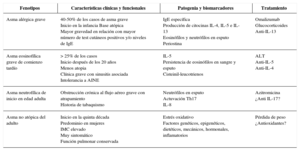
El asma, por su elevada prevalencia ligada estrechamente al aumento de las enfermedades alérgicas y su cronicidad, constituye un problema de salud a nivel mundial. No se trata de una enfermedad propiamente dicha, sino de un síndrome de la vía aérea que, compartiendo manifestaciones clínicas (tos, disnea y sibilancias), presenta diferentes patrones inflamatorios que se traducen como fenotipos específicos.

Diagnóstico

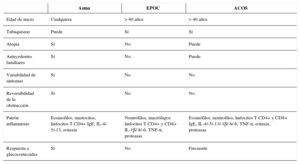
El abordaje diagnóstico secuencial permite alcanzar un diagnóstico de certeza en casi todos los casos, aunque excepcionalmente exista un síndrome mixto Asthma/COPD overlap syndrome (ACOS) que comparte características con otras patologías obstructivas crónicas.

Tratamiento

El objetivo del tratamiento en la actualidad es alcanzar el control del asma durante el mayor tiempo posible con una triple estrategia de información, medidas farmacológicas y seguimiento. El tratamiento farmacológico estandarizado y escalonado en base a los niveles de gravedad, realizando una técnica de inhalación correcta, es seguro y sirve para alcanzar el control, salvo en una pequeña proporción de pacientes con asma grave no controlado (AGNC) en los que se hace necesario descartar comorbilidades (rinosinusitis, reflujo gastroesofágico) e identificar el fenotipo inflamatorio con biomarcadores específicos hacia los que dirigir un tratamiento inmunomodulador concreto que posibilite modificar el curso y el pronóstico de la enfermedad. El tratamiento biológico, aún limitado, sin duda ofrece una atractiva posibilidad de utilización más amplia en un futuro muy cercano.

Palabras clave
Fenotipo
Comorbilidad
Biomarcadores
Tratamiento inmunomodulador
Diagnóstico
Abstract
Introduction

Asthma is a global health problem due to its high prevalence, closely linked to the increase of allergies, and to its chronicity. It is not a disease per se, but rather an airway syndrome that, sharing clinical manifestations (cough, dyspnea and wheezing), presents different inflammatory patterns that translate into specific phenotypes.

Diagnosis

A sequential diagnostic approach allows to establish a diagnostic certainty in almost all cases, even if exceptionally there is a mixed ACOS syndrome that shared features from other chronic obstructive conditions.

Treatment

The goal of the treatment nowadays is to control the asthma for as long as possible with a tripe strategy of information, pharmacological measures and follow-ups. Standardised pharmacological treatment that is stepped according to the severity degrees, carrying out a correct inhaler technique, is safe and works to reach control, except for a small proportion of patients with SUA where it is necessary to rule out comorbidities (rhinosinusitis, gastroesophageal reflux) and identify the inflammatory phenotype with specific biomarkers that need to be targeted with a specific immunomodulatory treatment that can modify the course and prognosis of the disease. Biological treatment, still limited, undoubtedly offers an attractive possibility for a broader use in the close future.

Keywords
Phenotype
Comorbidity
Biomarkers
Immunomodulatory treatment
Diagnosis

Identifíquese

¿Aún no es suscriptor de la revista?

Comprar el acceso al artículo

Comprando el artículo el pdf del mismo podrá ser descargado

Teléfono para incidencias

De lunes a viernes de 9h a 18h (GMT+1) excepto los meses de julio y agosto que será de 9 a 15h

Llamadas desde España 932 415 960
Llamadas desde fuera de España +34 932 415 960
Bibliografía
[1]
201703300046334118
201703300046334119
The Global Asthma Report 2014. Global Burden of Disease due to Asthma. Disponible en: www.globalasthmanetwork.org
[2]
2017033000463341110
M. Rodríguez-Rodríguez.
Control del asma y su repercusión económica.
Las bases alérgicas del asma., mra Ediciones, pp. 33-46
[3]
2017033000463341111
2017033000463341112
GEMA 4.1. Guía española para el manejo del asma. Madrid: Luzán 5, S.L.;2016. Disponible http://www.gemasma.com/
[4]
2017033000463341113
2017033000463341114
J. Barnes.
Asma. Enfermedades del Aparato Respiratorio.
Harrison Principios de Medicina Interna, 19ª ed., McGraw-Hill Interamérica Editores S.A, pp. 1-13
[5]
2017033000463341115
M. Rodríguez Rodríguez, J. Barbarroja Escudero, Darío Antolín Amérigo.
Tabaco y enfermedades alérgicas.
Tratado de tabaquismo., 3ª ed., Aulamédica,
173-90
[6]
2017033000463341116
S. Sánchez-Cuellar, C. López Riolobos, M. Somiedo Gutiérrez.
Asma: patogenia y bases moleculares en actualización en asma.
Ergón, (2013), pp. 19-33
[7]
2017033000463341117
I. Agache, C.A. Akdis.
Endotypes of allergic diseases and asthma: An important step in building blocks for the future of precision medicine.
Allergology International., (2016), 65
243-52
[8]
2017033000463341118
2017033000463341119
M. Rodríguez Rodríguez, C. Pérez Francés, M.J. Pascual Miravalles.
Clínica y diagnóstico del asma.
Tratado de alergología de la Sociedad Española de Alergología e Inmunología C línica SEAIC., 2ª ed., Ergón,
607-21
[9]
2017033000463341120
J. Fernández-Lahera Martínez, D. Romero Ribate, C. Villasante.
Ergón, (2013),
61-5
[10]
2017033000463341121
L. Puente Maestú.
Luzán, (2010), pp. 1-80
[11]
2017033000463341122
Sociedad Española de Alergología e Inmunología clínica. Asma En: Chivato Pérez T, Antepara Ercoreca I, editores. Recomendaciones y algoritmos de práctica clínica. Madrid: Luzán 5, S.L.; 2010.
[12]
2017033000463341123
2017033000463341124
M. Rodríguez Rodríguez, D. Antolín-Amerigo, J. Barbarroja, M.J. Sánchez-González.
Protocolo diagnóstico del asma.
Medicine., (2013), 11
1829-34
[13]
2017033000463341125
R. Pellegrino, G. Viegi, V. Brusasco, R.O. Crapo, F. Burgos, R. Casaburi, et al.
Interpretative strategies for lung function test.
Eur Respir J., (2005), 26
948-68
[14]
2017033000463341126
M. Rodríguez-Rodríguez.
Registros de flujo espiratorio máximo.
Pruebas de función pulmonar e inflamación bronquial en el asma, editores., GSK, pp. 37-53
[15]
2017033000463341127
2017033000463341128
M. Perpiñá Tordera, F. García Río, F.J. Álvarez Gutierrez, C. Cisneros Serrano, L. Compte Torrero, L.M. Entrenas Costa, et al.
Guidelines for the study of nonspecific bronchial hyperresponsiveness in asthma. Spanish Society of Pulmonology and Thoracic Surgery (SEPAR).
Arch Bronconeumol., (2013), 49
432-46
[16]
2017033000463341129
R.A. Dweik, P.B. Boggs, S.C. Erzurum.
An official ATS clinical practice guideline: Interpretation of exhaled nitric oxide levels (FENO) for clinical applications.
Am J Respir Crit Care Med., (2011), 184
602-15
[17]
2017033000463341130
M.W. Pijnenburg, W. Hofhuis, W.C. Hop, J.C. De Jongste.
Exhaled nitric oxide predicts asthma relapse in children with clinical asthma remission.
Thorax., (2005), 60
215-8
[18]
2017033000463341131
M.D. Lougheed, C. Lemiere, F.M. Ducharme, C. Licskai, S.D. Dell, B.H. Rowe, and Canadian Thoracic Society Asthma Clinical Assembly, et al.
Canadian Thoracic Society 2012 guideline update: diagnosis and management of asthma in preschoolers, children and adults. Noninvasive measurements of airway inflammation.
Can Respir J., (2012), 19
127-64 Erratas en: Can Respir J. 2013; 20(3):185
[19]
2017033000463341132
Asensi Monzó, MT, Castillo Laita JA, Esteller Carceller M. Diagnóstico del asma. El pediatra de Atención Primaria y el diagnóstico de asma. Documentos técnicos del GVR (publicación DTGVR-6) Disponible en: http://aepap.org/grupos/grupo-de-vias-respiratorias
[20]
2017033000463341133
2017033000463341134
2015 GINA: Global strategy for asthma management and prevention. En: http://www.ginasthma.org/local/uploads/files/GINA_Report_2015.pdf.
[21]
2017033000463341135
2017033000463341136
M. Rodríguez Rodríguez, D. Antolín Amérgigo, J. Barbarroja Escudero, M. Álvarez de Mon.
Alergia de las vías respiratorias.
Medicine., (2013), 11
1797-807
[22]
2017033000463341137
Guía de práctica clínica para el diagnóstico y tratamiento de pacientes con EPOC.
Grupo de trabajo de, GESEPOC.
Arch, Bronconeumol., (2012), 48Supl1 pp. 2-58
[23]
2017033000463341138
2017033000463341139
B. Ding, A. Enstone.
Asthma and chronic obstructive pulmonary disease overlap syndrome (ACOS): structured literature review and physician insights.
Expert Rev Respir Med., (2016), 10
363-71
[24]
2017033000463341140
2017033000463341141
M. Rodríguez Rodríguez, A. Parra Arrondo.
Educación del paciente asmático, mra Ediciones,
373-92
[25]
2017033000463341142
M.A. Ruiz Cobos, M.B. Arnalich Jiménez, A. Casanova Espinosa.
Ergón, (2013), pp. 87-102
[26]
2017033000463341143
A. Niimi.
Cough, asthma and cysteinyl-leukotrienes.
Pulm Pharmacol Ther., (2013), 26
514-9
[27]
2017033000463341144
2017033000463341145
F. Frati, C. Incorvaia, C. Lombardi, G. Senna.
Allergen immunotherapy: 100 years, but it does not look like.
Eur Ann Allergy Clin Immunol., (2012), 44 pp. 99-106
[28]
2017033000463341146
S. Heck, J. Nguyen, D.D. Le, R. Bals, Q.T. Dinh.
Pharmacological therapy of bronchial asthma: the role of biologicals.
Int Arch Allergy Immunol., (2015), 168
241-52
[29]
2017033000463341147
C.H. Lin, S.L. Cheng.
A review of omalizumab for the management of severe asthma.
Drug Des Devel Ther., (2016), 10
2369-78
[30]
2017033000463341148
M. Humbert, W. Busse, N.A. Hanania, P.J. Lowe, J. Canvin, V.J. Erpenbeck, et al.
Omalizumab in asthma: an update on recent developments.
J Allergy Clin Immunol Pract., (2014), 2
525-36
[31]
2017033000463341149
L. Borish.
The immunology of asthma. Asthma phenotypes and their implications for personalized treatment.
Ann Allergy Asthma Immunol., (2016), 117
108-14
[32]
2017033000463341150
2017033000463341151
J.R. Stokes, T.B. Casale.
Caracterization of asthma endotypes: implications for therapy.
Ann Allergy Asthma Immunol., (2016), 117
121-5
[33]
2017033000463341152
I. Agache, A.A. Cezmi.
Endotypes of allergic diseases and asthma: An important step in building blocks for the future of precisión medicine.
Allergology Internationational., (2016), 65
243-52
[34]
2017033000463341153
Laxmanan B, Egressy K, Murgu SD, White SR, Hogarth DK. Advances in bronchial thermoplasty. Chest. 201;150(3):694-704.
[35]
2017033000463341154
S. Quirce, I. Bobolea, J. Domínguez-Ortega, P. Barranco.
Futuras terapias biológicas en el asma.
Arch Bronconeumol., (2014), 50
355-61
[36]
2017033000463341155
F. Menzella, M. Lusuardi, C. Galeone, L. Zucchi.
Tailored therapy for severe asthma.
Multidiscip Respir Med., (2015), 10 pp. 1-8