
Vol. 12. Núm. 30.
Páginas 1757-1766 (Abril 2017)

Actualización
Rinitis alérgica

Allergic rhinitis

D. Antolín Amérigo SotoM.J. Sánchez GonzálezJ. Barbarroja EscuderoM. Álvarez-Mon
Doi : https://10.1016/j.med.2017.03.011
Opciones
Resumen
Concepto

La rinitis se define por trastornos nasales caracterizados por estornudos, prurito nasal, rinorrea y obstrucción o congestión nasal, constituyendo un factor de riesgo de potenciales complicaciones respiratorias.

Epidemiología

Es una causa infravalorada de morbilidad, originando elevados costes para aquellos que la padecen, tanto económicos como sociales, afectando a su calidad de vida. La RA es la enfermedad alérgica más común y una de las patologías más frecuentes a nivel mundial, particularmente en los países desarrollados.

Clasificación

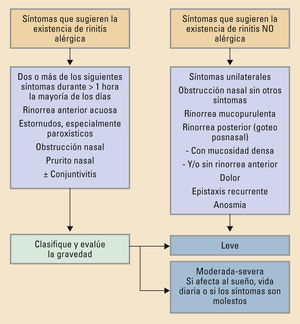
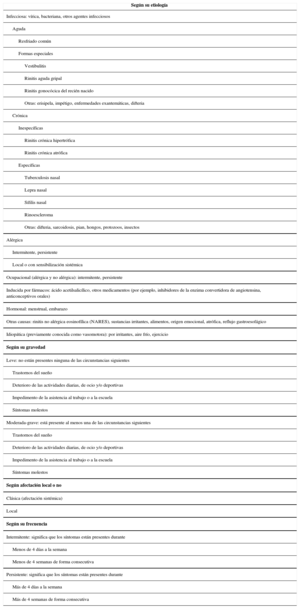
Se clasifica como rinitis alérgica (RA) o no alérgica, y a su vez se subclasifican según su frecuencia en persistente (más de 4 días en semana y más de 4 semanas consecutivas) o intermitente (no cumple criterios anteriores), y según su gravedad en moderada-grave (si afecta al sueño, vida diaria o si los síntomas son molestos) o leve (si no cumple criterios de moderada-grave).

Diagnóstico

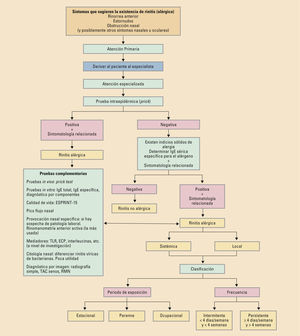
El diagnóstico se realiza mediante historia clínica, pruebas cutáneas y/o IgE específica, así como con otras pruebas complementarias útiles.

Tratamiento

Muchos de los pacientes están sin tratamiento, infratratados o incorrectamente tratados. La instauración de un tratamiento adecuado a los pacientes con RA supondría un importante ahorro en costes indirectos.

Palabras clave
Rinitis alérgica
Rinorrea
Persistente
Nasal
IgE específica
Abstract
Concept

Rhinitis is defined as nasal conditions characterised by sneezing, nasal itching, rhinorrhoea and nasal obstruction or congestion, which makes it a risk factor for potential respiratory complications.

Epidemiology

It is an underestimated cause for morbidity, originating high costs for those who suffer from it, both economic and social ones, affecting their quality of life. AR is the most frequent allergic disease and one of the most frequent conditions worldwide, particularly in developed countries.

Classification

It is classified as allergic rhinitis (AR) or nonallergic rhinitis, and they are subdivided according to their frequency into persistent (more than 4 days a week and more than 4 consecutive weeks) or intermittent (does not meet previous criteria), and according to their severity into moderate-severe (if it affects sleep, daily routine or of symptoms are unpleasant) or mild (if it does not meet the criteria for moderate-severe).

Diagnosis

Diagnosis is reached by analysing medical records, conducting skin and/or specific IgE tests, as well as other useful complementary tests.

Treatment

Many patients remain untreated, undertreated or treated incorrectly. Starting an adequate treatment for patients with AR would make significant savings in indirect costs.

Keywords
Allergy rhinitis
Rhinorroea
Persistent
Nasal
Specific IgE

Identifíquese

¿Aún no es suscriptor de la revista?

Comprar el acceso al artículo

Comprando el artículo el pdf del mismo podrá ser descargado

Teléfono para incidencias

De lunes a viernes de 9h a 18h (GMT+1) excepto los meses de julio y agosto que será de 9 a 15h

Llamadas desde España 932 415 960
Llamadas desde fuera de España +34 932 415 960
Bibliografía
[1]
201703300047347478
201703300047347479
T. Dordal Culla, F. Vega de la Osada, V. González Núñez, M.L. González Gutiérrez.
Rinitis alérgica. Capítulo 8.
Tratado de alergología SEAIC, 2ª ed., Ergón, pp. 489-511
[2]
2017033000473474710
2017033000473474711
V. Bauchau, S.R. Durham.
Prevalence and rate of diagnosis of allergic rhinitis in Europe.
Eur Respir J., (2004), 24
758-64
[3]
2017033000473474712
E. Tornador-Gaya, R. Tosca-Segura, A. Arnedo-Pena, J. Puig-Barbera, J.B. Bellido-Blasco, M.R. Pac-Sa, et al.
[Incidence of allergic rhinitis in a cohort of schoolchildren between 1994 and 2002 in Castellon (Spain), following the ISAAC study].
An Pediatr (Barc)., (2007), 66
154-8
[4]
2017033000473474713
2017033000473474714
B. de la Hoz Caballer, M. Rodríguez, J. Fraj, I. Cerecedo, D. Antolín-Amérigo, C. Colás.
Allergic rhinitis and its impact on work productivity in primary care practice and a comparison with other common diseases: the Cross-sectional study to evAluate work Productivity in allergic Rhinitis compared with other common diseases (CAPRI) study.
Am J Rhinol Allergy., (2012), 26
390-4
[5]
2017033000473474715
A. Togias.
Mechanistic features of allergic rhinitis.
J Allergy Clin Immunol., (2000), 105
S559-604
[6]
2017033000473474716
C. Pereira, A. Valero, C. Loureiro, I. Davila, Martínez-Cocera, C. Murio, et al.
Iberian study of aeroallergens sensitisation in allergic rhinitis.
Allerg Immunol., (2006), 38
186-94
[7]
2017033000473474717
A. Navarro, A. Valero, B. Juliá, S. Quirce.
Coexistence of asthma and allergic rhinitis in adult patients attending allergy clinics: ONEAIR study.
J Investig Allergol Clin Immunol., (2008), 18
233-8
[8]
2017033000473474718
J.A. Castillo Vizuete, J. Mullol Miret.
[Rhinitis and asthma comorbidity in Spain: the RINAIR study].
Arch Bronconeumol., (2008), 44 pp. 597-603
[9]
2017033000473474719
2017033000473474720
R.A. Nathan.
Management of patients with allergic rhinitis and asthma: literature review.
South Med J., (2009), 102
935-41
[10]
2017033000473474721
2017033000473474722
G. Scadding.
Cytokine profiles in allergic rhinitis.
Curr Allergy Asthma Rep., (May 2014), 14 pp. 435
[11]
2017033000473474723
2017033000473474724
J. Bousquet, H.J. Schunemann, J. Fonseca, B. Samolinski, C. Bachert, G.W. Canonica, et al.
MACVIA-ARIA Sentinel NetworK for allergic rhinitis (MASK-rhinitis): the new generation guideline implementation.
1372-92
[12]
2017033000473474725
E. Macy.
A rhinitis primer for family medicine.
Perm J, (2012), 16
61-6
[13]
2017033000473474726
P.S. Norman.
A rational approach to desensitization.
J Allergy., (1969), 44
129-45
[14]
2017033000473474727
J.T. Connell.
Quantitative intranasal pollen challenges, 3: the priming effect in allergic rhinitis.
J Allergy., (1969), 43 pp. 33-44
[15]
2017033000473474728
J. Bousquet, W. Jacquot, A. Vignola, C. Bachert, P. van Cauwenberge.
Allergic rhinitis: a disease remodeling the upper airways?.
J Allergy Clin Immunol., (2004), 113
43-9
[16]
2017033000473474729
P. Small, H. Kim.
Allergic rhinitis.
Allergy Asthma Clin Immunol., (2011), 7Suppl1 pp. S3
[17]
2017033000473474730
N. Lakhani, M. North, A.K. Ellis.
Clinical manifestations of allergic rhinitis.
J Allergy Therapy., (2012), S5
007
[18]
2017033000473474731
H.A. Kakli, T.D. Riley.
Allergic Rhinitis.
Prim Care, (2016), 43
465-75
[19]
2017033000473474732
2017033000473474733
Position paper: allergen standardization and skin tests.
The European Academy of Allergology and Clinical Immunology.
Allergy, (1993), 48
S48-82
[20]
2017033000473474734
T. Haahtela, G.J. Burbach, C. Bachert, C. Bindslev-Jensen, S. Bonini, J. Bousquet, et al.
Clinical relevance is associated with allergen-specific wheal size in skin prick testing.
Clin Exp Allergy., (2014), 44
407-16
[21]
2017033000473474735
2017033000473474736
M.T. Dordal, M. Lluch-Bernal, M.C. Sánchez, C. Rondón, A. Navarro, J. Montoro, (SEAIC Rhinoconjunctivitis Committee), et al.
Allergen-Specific Nasal Provocation Testing: Review by the Rhinoconjunctivitis Committee of the Spanish Society of Allergy and Clinical Immunology.
J Investig Allergol Clin Immunol., (2011), 21 pp. 1-12
[22]
2017033000473474737
M. Okano, T. Fujiwara, T. Higaki, S. Makihara, T. Haruna, Y. Noda, et al.
Characterization of pollen antigen-induced IL-31 production by PBMCs in patients with allergic rhinitis.
J Allergy Clin Immunol., (2011), 127
277-9, 279.e1-11
[23]
2017033000473474738
G. Ottaviano, W.J. Fokkens.
Measurements of nasal airflow and patency: a critical review with emphasis on the use of peak nasal inspiratory flow in daily practice.
162-74
[24]
2017033000473474739
2017033000473474740
V. Hox, S. Bobic, I. Callebaux, M. Jorissen, P.W. Hellings.
Nasal obstruction and smell impairment in nasal polyp disease: correlation between objective and subjective parameters.
Rhinology., (2010), 48
426-32
[25]
2017033000473474741
2017033000473474742
M. Kristiansen, S. Dhami, G. Netuveli, S. Halken, A. Muraro, G. Roberts, et al.
Allergen immunotherapy for the prevention of allergy: a systematic review and meta-analysis.
Pediatr Allergy Immunol. En prensa, (2016),
[26]
2017033000473474743
2017033000473474744
N.G. Papadopoulos, J.A. Bernstein, P. Demoly, M. Dykewicz, W. Fokkens, P.W. Hellings, et al.
Phenotypes and endotypes of rhinitis and their impact on management: a PRACTALL report.
Allergy., (2015), 70 pp. 474-494
[27]
2017033000473474745
D.I. Bernstein, G. Schwartz, J.A. Bernstein.
Allergic rhinitis: mechanisms and treatment.
Immunol Allergy Clin North Am., (2016), 36
261-78
[28]
2017033000473474746
L. Klimek, J. Mullol, P. Hellings, P. Gevaert, R. Mösges, W. Fokkens.
Recent pharmacological developments in the treatment of perennial and persistent allergic rhinitis.
Expert Opin Pharmacother., (2016), 17
657-69
[29]
2017033000473474747
2017033000473474748
L.M. Wheatley, A. Togias.
Clinical practice. Allergic rhinitis.
456-63
[30]
2017033000473474749
S.R. Durham, W. Emminger, A. Kapp, G. Colombo, J.G. de Monchy, S. Rak, et al.
Long-term clinical efficacy in grass pollen-induced rhinoconjunctivitis after treatment with SQ-standardized grass allergy immunotherapy tablet.
J Allergy Clin Immunol., (2010), 125
131-7
[31]
2017033000473474750
C. Moreno Aguilar, M.A. Gonzalo Garijo, I. Sánchez Machín.
Seguridad y eficacia de la inmunoterapia.
Tratado de alergología., 2ª ed., Ergón-SEAIC,
1181-94
[32]
2017033000473474751
C. Ozcan, O. Ismi.
Botulinum toxin for rhinitis.
Curr Allergy Asthma Rep., (2016), 16 pp. 58
[33]
C. Colás, M. Brosa, E. Antón, J. Montoro, A. Navarro, M.T. Dordal, et al.
Rhinoconjunctivitis Committee of the Spanish Society of Allergy and Clinical Immunology. Estimate of the total costs of allergic rhinitis in specialized care based on real-world data: the FERIN Study.
Allergy. En prensa, (2016),