

Vol. 12. Núm. 9.
Páginas 505-514 (Abril 2016)

Actualización
Afectación hepática en enfermedades infecciosas. Hepatopatías en pacientes inmunodeficientes

Liver involvement in infectious diseases. Liver disease in immunodeficient patients

M.T. Arias-LosteA. PuenteP. Ruiz-BuenoC. Rodríguez de LopeJ. Crespo García
Doi : https://10.1016/j.med.2016.04.004
Opciones
Resumen
Introducción

En el contexto de un proceso infeccioso sistémico, es frecuente la presencia de alteraciones clínicas o analíticas que sugieren afectación a nivel hepático. Estas alteraciones, sin embargo, no siempre se justifican por una colonización directa del agente infeccioso en el parénquima hepático o biliar, sino que también pueden tener un origen indirecto a través del daño mediado por endotoxinemia o bacteriemia, o bien isquémico, en el contexto de una sepsis grave.

Etiopatogenia

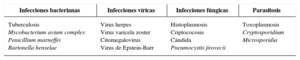
La etiología de la enfermedad hepática de origen infeccioso es variable e incluye bacterias, virus, hongos y parásitos.

Epidemiología

La frecuencia con la que se presentan cada una de ellas varía fundamentalmente en función del espacio geográfico en el que nos encontremos y del estado de inmunocompetencia del paciente.

Objetivo

En esta revisión, se abordarán las manifestaciones hepáticas en infecciones bacterianas, fúngicas y por parásitos, así como las principales infecciones oportunistas en el enfermo por el VIH.

Palabras clave
Absceso hepático piógeno
Sepsis
Hepatitis
Colestasis
VIH
Abstract
Introduction

It is frequent to observe an abnormal liver function test or liver related symptoms in the course of systemic infections. Nevertheless, these conditions do not always mirror a direct liver colonization and can be due to indirect liver damage mediated by endotoxemia and bacteriemia as well as an ischemic injury in the context of severe sepsis.

Etiopathogenesis

The etiology of liver disease due to infections includes bacteria, virus, yeast and parasites.

Epidemilogy

The frequency of the different mentioned pathogens is related to both the geographic location and the immunologic condition of the host.

Objective

This review is focused on liver manifestations during different systemic infections as well as the liver involvement in the most common opportunistic infections in HIV patients.

Keywords
Pyogenic liver abscess
Sepsis
Hepatitis
Cholestasis
HIV

Identifíquese

¿Aún no es suscriptor de la revista?
Comprar el acceso al artículo

Comprando el artículo el pdf del mismo podrá ser descargado

Teléfono para incidencias

De lunes a viernes de 9h a 18h (GMT+1) excepto los meses de julio y agosto que será de 9 a 15h
Llamadas desde España 932 415 960
Llamadas desde fuera de España +34 932 415 960
Bibliografía
[1]
M. Fuchs, A.J. Sanyal.
Sepsis and cholestasis.
Clin Liver Dis., (2008), 12 pp. 151-172
[2]
P. Tugwell, A.O. Williams.
Jaundice associated with lobar pneumonia. A clinical, laboratory and histological study.
Q J Med., (1977), 46 pp. 97-118
[3]
J. Rahimian, T. Wilson, V. Oram, R.S. Holzman.
Pyogenic liver abscess: recent trends in etiology and mortality.
Clinical infectious diseases: an official publication of the Infectious Diseases Society of America, (2004), 39 pp. 1654-1659
[4]
E.R. Lederman, N.F. Crum.
Pyogenic liver abscess with a focus on Klebsiella pneumoniae as a primary pathog: an emerging disease with unique clinical characteristics.
American J Gastroenterol, (2005), 100 pp. 322-331
[5]
J.J. Mezhir, Y. Fong, L.M. Jacks, G.I. Getrajdman, L.A. Brody, A.M. Covey, et al.
Current management of pyogenic liver abscess: surgery is now second-line treatment.
J Am Coll Surg, (2010), 210 pp. 975-983
[6]
Y.L. Cai, X.Z. Xiong, J. Lu, Y. Cheng, C. Yang, Y.X. Lin, et al.
Percutaneous needle aspiration versus catheter drainage in the management of liver abscess: a systematic review and meta-analysis.
HPB., (2015), 17 pp. 195-201
[7]
K. Yaita, I. Sameshima, H. Takeyama, S. Matsuyama, C. Nagahara, R. Hashiguchi, et al.
Liver abscess caused by multidrug-resistant Pseudomonas aeruginosa treated with colistin; a case report and review of the literature.
Intern Med., (2013), 52 pp. 1407-1412
[8]
Y.H. Lam, S.K. Wong, D.W. Lee, J.Y. Lau, A.C. Chan, R.Y. Yiu, et al.
ERCP and pyogenic liver abscess.
Gastrointest Endosc, (1999), 50 pp. 340-344
[9]
M. Andre, O. Aumaitre, T. Papo, J.L. Kemeny, D. Vital-Durand, H. Rousset, et al.
Disseminated aseptic abscesses associated with Crohn's disease: a new entity?.
Dig Dis Sci., (1998), 43 pp. 420-428
[10]
N. Tiliakos, J.M. Shamma’a, S.M. Nasrallah.
Syphilitic hepatitis.
Am J Gastroenterol, (1980), 73 pp. 60-61
[11]
G. Maincent, H. Labadie, M. Fabre, P. Novello, K. Derghal, C. Patriarche, et al.
Tertiary hepatic syphilis. A treatable cause of multinodular liver.
Dig Dis Sci., (1997), 42 pp. 447-450
[12]
L. Dayan, C. Ooi.
Syphilis treatment: old and new.
Expert Opin Pharmacother, (2005), 6 pp. 2271-2280
[13]
H.H. Huang, C.M. Tsai, Y.S. Tyan.
Unusual cause should be kept in mind of abdominal pain in female patient. Fitz-Hugh-Curtis syndrome.
Gastroenterology, (2011), 140 pp. e7-e8
[14]
M.R. Gray-Swain, J.F. Peipert.
Pelvic inflammatory disease in adolescents.
Curr Opin Obstet Gynecol, (2006), 18 pp. 503-510
[15]
J. Charan, D. Saxena, S. Mulla, P. Yadav.
Antibiotics for the treatment of leptospirosis: systematic review and meta-analysis of controlled trials.
Int J Prev Med., (2013), 4 pp. 501-510
[16]
R.U. Palaniappan, S. Ramanujam, Y.F. Chang.
Leptospirosis: pathogenesis, immunity, and diagnosis.
Curr Opin Infect Dis., (2007), 20 pp. 284-292
[17]
G. Stanek, G.P. Wormser, J. Gray, F. Strle.
Lyme borreliosis.
[18]
C.C. Wielders, A.M. Wuister, V.L. de Visser, M.G. de Jager-Leclercq, C.A. Groot, F. Dijkstra, et al.
Characteristics of hospitalized acute Q fever patients during a large epidemic.
The Netherlands. PloS One, (2014), 9 pp. e91764
[19]
F. Zinzindohoue, J.B. Guiard-Schmid, B. La Scola, J. Frottier, R. Parc.
Portal triad involvement in cat-scratch disease.
Lancet, (1996), 348 pp. 1178-1179
[20]
G. Prutsky, J.P. Domecq, L. Mori, S. Bebko, M. Matzumura, A. Sabouni, et al.
Treatment outcomes of human bartonellosis: a systematic review and meta-analysis.
Int J Infect Dis., (2013), 17 pp. e811-e819
[21]
L. Barutta, D. Ferrigno, R. Melchio, V. Borretta, C. Bracco, C. Brignone, et al.
Hepatic brucelloma.
Lancet Infect Dis, (2013), 13 pp. 987-993
[22]
M. Scholing, P.M. Schneeberger, P. van den Dries, J.P. Drenth.
Clinical features of liver involvement in adult patients with listeriosis.
Review of the literature. Infection, (2007), 35 pp. 212-218
[23]
M.M. Mourad, C. Liossis, A. Algarni, S. Kumar, S.R. Bramhall.
Primary hepatic tuberculosis in immunocompetent adults: a UK case series.
Oxf Med Case Reports, (2014), 2014 pp. 148-150
[24]
T. Toptas, B. Ilhan, H. Bilgin, E. Dincses, O. Ozdogan, I. Kaygusuz-Atagunduz, et al.
Miliary tuberculosis induced acute liver failure.
Case Rep Infect Dis., (2015), 2015 pp. 759341
[25]
M. Varela, J. Fernández, M. Navasa, J. Bruix.
Pseudotumoral hepatic tuberculosis.
J Hepatol, (2003), 39 pp. 654
[26]
O. Akhan, A.E. Yildiz, D. Akinci, B.D. Yildiz, T. Ciftci.
Is the adjuvant albendazole treatment really needed with PAIR in the management of liver hydatid cysts? A prospective, randomized trial with short-term follow-up results.
Cardiovasc Intervent Radiol, (2014), 37 pp. 1568-1574
[27]
S. Nasseri-Moghaddam, A. Abrishami, A. Taefi, R. Malekzadeh.
Percutaneous needle aspiration, injection, and re-aspiration with or without benzimidazole coverage for uncomplicated hepatic hydatid cysts.
Cochrane Database Syst Rev, (2011),
[28]
J.M. Ramia, I. Poves, C. Castellon, L. Diez-Valladares, C. Loinaz, A. Serrablo, et al.
Radical laparoscopic treatment for liver hydatidosis.
World J Surg, (2013), 37 pp. 2387-2392
[29]
S.E. Rowan, M.E. Levi, J.M. Youngwerth, B. Brauer, G.T. Everson, S.C. Johnson.
The variable presentations and broadening geographic distribution of hepatic fascioliasis.
Clin Gastroenterol Hepatol, (2012), 10 pp. 598-602
[30]
Y. Shaker, N. Samy, E. Ashour.
Hepatobiliary Schistosomiasis.
J Clin Transl Hepatol, (2014), 2 pp. 212-216
[31]
G. Saadatnia, M. Golkar.
A review on human toxoplasmosis.
Scand J Infect Dis, (2012), 44 pp. 805-814
[32]
Guidelines for the treatment of malaria. 3rd ed. Geneva: World Health Organization; 2015
[33]
M.G. Peters, V. Soriano.
HIV and the liver.
Sherlock's diseases of the liver and biliary system, Wiley-Blackwell, pp. 438-451
[34]
K. Buchacz, R.K. Baker, F.J. Palella Jr., J.S. Chmiel, K.A. Lichtenstein, R.M. Novak, et al.
AIDS-defining opportunistic illnesses in US patients, 1994-2007: a cohort study.
[35]
S. Gasquet, M. Maurin, P. Brouqui, H. Lepidi, D. Raoult.
Bacillary angiomatosis in immunocompromised patients.
Aids, (1998), 12 pp. 1793-1803
[36]
D. Mizushima, T. Nishijima, S. Yashiro, K. Teruya, Y. Kikuchi, N. Katai, et al.
Diagnostic utility of quantitative plasma cytomegalovirus DNA PCR for cytomegalovirus end-organ diseases in patients with HIV-1 infection.
J Acquir Immune Defic Syndr, (2015), 68 pp. 140-146
[37]
C. Rabaud, T. May, C. Amiel, C. Katlama, C. Leport, P. Ambroise-Thomas, et al.
Extracerebral toxoplasmosis in patients infected with HIV.
A French National Survey. Medicine (Baltimore), (1994), 73 pp. 306-314
[38]
T.E. Yusuf, T.H. Baron.
AIDS Cholangiopathy.
Curr Treat Options Gastroenterol, (2004), 7 pp. 111-117
[39]
D. Armstrong-James, G. Meintjes, G.D. Brown.
A neglected epidemic: fungal infections in HIV/AIDS.
Trends Microbiol, (2014), 22 pp. 120-127