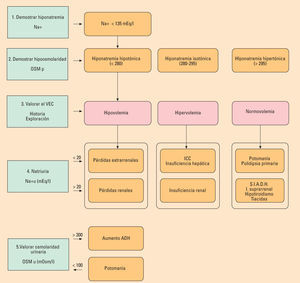
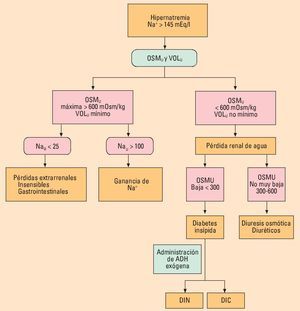
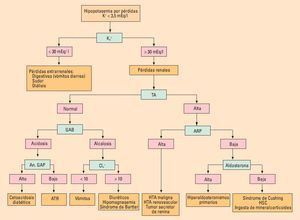
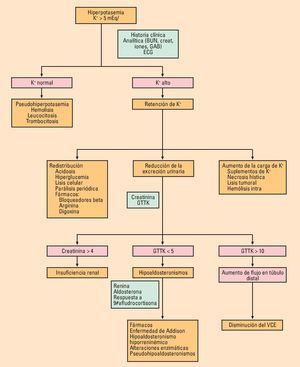
Las alteraciones hidroelectrolíticas son un problema frecuente e importante en el medio hospitalario. Los trastornos del sodio reflejan una alteración en el balance del agua .La hiponatremia es el trastorno más frecuente, se revisa profundizando en el diagnóstico etiológico y el tratamiento, con revisión de los nuevos antagonistas de la vasopresina .La evaluación de la hipernatremia con una historia clínica detallada y la osmolaridad urinaria y las bases para su tratamiento completan los trastornos del sodio. Posteriormente se revisan los trastornos del potasio haciendo hincapié en los algoritmos para el diagnóstico etiológico y el tratamiento de la hiperpotasemia como urgencia médica potencial .Se pretende un enfoque fundamentalmente clínico de estas situaciones.
Identifíquese
¿Aún no es suscriptor de la revista?

Comprar el acceso al artículo
Comprando el artículo el pdf del mismo podrá ser descargado
Teléfono para incidencias
De lunes a viernes de 9h a 18h (GMT+1) excepto los meses de julio y agosto que será de 9 a 15h
Llamadas desde España
932 415 960
Llamadas desde fuera de España
+34 932 415 960
Bibliografía
[1]
Ayus JC, Tejedor A, Caramelo C..
Agua, electrolitos y equilibrio ácido-base..
1ª ed. , (Buenos Aires, Madrid: Panamericana), 2007. p. 2-79
[2]
Adrogué HJ, Madias, NE..
Hyponatremia..
N Engl J Med. , (2000), 342 pp. 1581-9
[3]
Rose BD, Post TW..
Clinical physiology of acid-base and elec-trolyte disorders..
5th ed. , (New York: McGraw-Hill), 2001. p. 699-716
[4]
Anderson RJ, Chung HM, Kluge R, Schrier R..
Hyponatremia: a proprospective analysis of its epidemiology and the pathogenetic role of vasopressin..
Ann Intern Med. , (1985), 102 pp. 164
[6]
Turchin A, Seifter JL, Seely E..
Clinical problem-solving. Mind the gap..
N Engl J Med. , (2003), 349 pp. 1465
[7]
Gankam Kengne F, Andres C, Sattar L, Melot C, Decaux G..
Mild hyponatremia and risk of fracture in the ambulatory elderly..
QJM. , (2008), 101 pp. 583
[8]
Renneboog B, Musch, Vandemergel X, Manto MU, Decaux G..
Mild chronic hyponatremia is associated with falls, unsteadiness, and attention deficits..
Am J Med. , (2006), 119:71.e1
[9]
Laureno R, Karp BI..
Myelinolysis after correction of hyponatremia..
Ann Intern Med. , (1997), 126 pp. 57
[10]
Yeates KE, Singer M, Morton AR..
Salt and water: a simple approach to hyponatremia..
CMAJ. , (2004), 170 pp. 365
[11]
Verbalis JG, Goldsmith SR, Greenberg A, Schrier RW, Sterns RH..
Hyponatremia treatment guidelines 2007: expert panel recommendations..
Am J Med. , (2007), 120 pp. S1
[12]
Chung HM, Kluge R, Schrier R, Anderson RJ..
Clinical assessment of extracellular fluid volume in hyponatremia..
Am J Med. , (1987), 83 pp. 905
[13]
Sterns RH, Nigwekar SU, Hix JK..
the treatment of hyponatremia..
Semin Nephrol. , (2009), 29 pp. 282
[14]
Schrier R, Gross P, Gheorghia M, Berl T, Verbalis JG, Czerwiec FS, et al..
Tolvaptan, a selective oral vasopressin V2-receptor antagonist, for hyponatremia..
N Engl J Med. , (2006), 355 pp. 2099
[15]
Adrogué HJ, Madias NE..
Hypernatremia..
N Engl J Med. , (2000), 342 pp. 1493
[16]
Rose BD, Post T..
Clinical physiology of acid-base and electrolyte dis-orders..
5th ed. , (New York: McGraw-Hill), 2001. p. 749-61
[17]
Rose BD..
New approach to disturbances in the plasma sodium concentration..
Am J Med. , (1986), 81 pp. 1033
[18]
Kahn A, Brachet E, Blum D..
Controlled fall in natremia and risk of seiseizures in hypertonic dehydration..
Intensive Care Med. , (1979), 5 pp. 27
[19]
Miller M, Dalakos T, Moses AM, Fellerman H, Streeten DH..
Recognit, Recognition of partial defects in antidiuretic hormone secretion..
Ann Intern Med. , (1970), 73 pp. 721-9
[20]
Adrogué HJ, Madias NE..
Changes in plasma potassium concentration during acute acid-base disturbances..
Am J Med. , (1981), 71 pp. 456
[21]
Adrogué HJ, Lederer ED, Suki N, Eknoyan G..
Determinants of plasplasma potassium levels in diabetic ketoacidosis..
Medicine (Baltimore). , (1986), 65 pp. 163
[22]
Mount DB, Zandi-Nejad K..
Disorders of potassium balance. En: Brenner BM, editor. Brenner and Rector''s the Kidney..
Philadelphia: W. , (B Saunders Co), 2008. p. 547
[23]
Rose BD, Post T..
Hypokalemia. En: Rose BD, Post T , editors. Clinical physiology of acid-base and electrolyte disorders. 5th ed. Londres: McGraw-Hill: 2001..
p. , (836),
[24]
Gennari FJ..
Hypokalemia..
N Engl J Med. , (1998), 339 pp. 451
[25]
Stewart PM..
Mineralocorticoid hypertension..
Lancet. , (1999), 353 pp. 1341
[26]
Cohn JN, Kowey PR, Whelton PK, Prisant LM..
New guidelines for pohelton PK, Prisant LM. New guidelines for potassium replacement in clinical practice: a contemporary review by the National Council on Potassium in Clinical Practice..
Arch Intern Med. , (2000), 160 pp. 2429
[27]
Rose BD, Post T..
Clinical physiology of acid-base and electrolyte dis-orders..
5th ed. , (New York: McGraw-Hill), 2001. p. 383-96, 898-910
[28]
Mount DB, Zandi-Nejad K..
Disorders of potassium balance. En: Brenner BM, editor. Brenner and Rector''s the Kidney. 8th ed..
Philadelphia: W. , (B Saunders Co), 2008. p. 547
[29]
Cea L, Martínez AJ, Torres JA..
Trastornos hidroelectrolíticos. En: Carnevali Ruiz P, Medina Iglesias C, editores. Manual de diagnóstico y terapéutica médica. Madrid: EGRAF. 5ª ed. 2003..
p. , (677-98),
[30]
Pergola PE, DeFronzo R..
Clinical disorders of hyperkalemia. En: Seldin D , Giebisch G, editors. the kidney: physiology and pathophysiology. Vol..
2. , (Londom: Lippincott illiams & ilkins), 2000. p. 1647
[31]
Montague BT, Ouellette JR, Buller GK..
Retrospective review of the frequency of ECG changes in hyperkalemia..
Clin J Am Soc Nephrol. , (2008), 3 pp. 324
[32]
Szerlip HM, Weiss J, Singer I..
Profound hyperkalemia without electrocardiographic manifestations..
Am J Kidney Dis. , (1986), 7 pp. 461
[33]
KuvinJT..
Electrocardiographic changes of hipercaliemia:imágenes en clinical medicine..
Nengl J Med. , (1998), 338 pp. 662
[34]
Braunwald E, Faucy AS, Fasper DL, Hauser SL, Longo DL, Jameson JL, editores..
Harrison''s Principios de Medicina Interna..
15ª ed. , (Ed New York: Mc Graw Hill), 2002. p. 322-36
