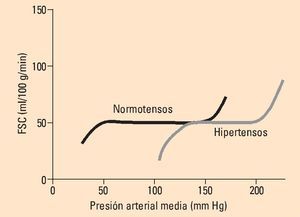
Las crisis hipertensivas representan el 1,45% de las urgencias atendidas en los hospitales españoles. Se definen como la elevación aguda de la presión arterial y se clasifican en emergencias o urgencias hipertensivas en función de si existe riesgo vital o no para el paciente. El diagnóstico diferencial entre urgencias y emergencias hipertensivas es sumamente importante ya que las emergencias hipertensivas deben ser tratadas de manera precoz, de forma intrahospitalaria y con medicación intravenosa para conseguir un descenso inmediato de las cifras de presión arterial, sin embargo, en las urgencias hipertensivas se recomienda un descenso progresivo de las cifras tensionales ya que el descenso brusco de las mismas se asocia a una mayor morbimortalidad. En este capítulo se dan las claves para diferenciar entre las urgencias y las emergencias hipertensivas así como los objetivos terapéuticos de cada una de las situaciones que podemos encontrarnos en las urgencias de nuestros hospitales.
Identifíquese
¿Aún no es suscriptor de la revista?

Comprar el acceso al artículo
Comprando el artículo el pdf del mismo podrá ser descargado
Teléfono para incidencias
De lunes a viernes de 9h a 18h (GMT+1) excepto los meses de julio y agosto que será de 9 a 15h
Llamadas desde España
932 415 960
Llamadas desde fuera de España
+34 932 415 960
Bibliografía
[1]
Annel WB, Castelli WP, McNamara PM, Sorlie P..
Some factors affecting morbidity and mortality in hypertension. The Framingham study..
Milbank Memorial Fund Q. , (1969), 47 pp. 116-42
[2]
Banegas JR, Rodríguez-Artalejo F, Cruz JJ, Guallar P, Rey J..
Blood pressure in Spain: distribution, awareness, control and benefits of a reduction in average pressure..
Hypertension. , (1998), 32 pp. 998-1002
[3]
Gabriel R, Vega S, Suárez C..
Prevalencia, conocimiento y control de la hipertensión arterial en la población anciana española: resultados del estudio EPICARDIAN..
Hipertensión. , (1996), 13Suppl1 pp. 15
[4]
Pérez E, Juárez S, Laguna P y Grupo de estudio SUHCRIHTA..
Crisis hipertensivas en los servicios de urgencias hospitalarios. Estudio SUHCRIHTA..
Emergencias. , (2001), 13 pp. 82-8
[5]
Leal M, Abellán J, Gómez P, Martínez A, Hernández F, García-Galbis J..
Crisis hipertensivas en pacientes como predictor de riesgo cardiovascular. Seguimiento durante 5 años..
Hipertens Riesgo Vasc. , (2009), 26 pp. 252-6
[6]
Sociedad Española de Hipertensión-Liga Española para la lucha contra la Hipertensión Arterial (SEH-LELHA)..
Guía de diagnóstico y tratamiento de la hipertensión arterial en España 2005. Tratamiento de la hipertensión arterial en situaciones especiales..
Hipertensión. , (2005), 22 pp. 1-84
[7]
Mancia G, De Backer G, Dominiczak A, Cifkova R, Fagard R, Germano G, et al..
2007 Guidelines for the Management of Arterial Hypertension: The Task Force for the Manegement of Arterial Hypertension of the European Society of Hypertension (ESH) and of the European Society of Cardiology (ESC)..
J Hypertens. , (2007), 25 pp. 1105-87
[8]
Marik PE, Varon J..
Hypertensive crisis: challenges and manegement..
Chest. , (2007), 131 pp. 1949-62
[9]
Chobanian AV, Bakris GL, Black HR..
The Seventh Report of the Joint National Committee on Prevention, Detection, Evaluation, and Treatment of High Blood Pressure: The JNC7 Report..
JAMA. , (2003), 289 pp. 2560-72
[10]
Llabrés J, Blázquez JA..
Hipertensión arterial en urgencias. Manejo clínico y terapéutico de las crisis hipertensivas..
Medicine. , (2007), 9
[11]
Rodríguez M, Mateos P, Fernández C, Martell N, Luque M..
Crisis hipertensivas: prevalencia y aspectos clínicos..
Rev Clin Esp. , (2002), 202 pp. 255-8
[12]
Herrero P, Vázquez J, Álvarez A, Fernández F..
Abordaje diagnóstico y terapéutico de las crisis hipertensivas..
Hipertensión. , (2003), 20 pp. 273-82
[13]
Mishra SI, Jones-Burton C, Fink JC, Brown J, Bakris GL, Weir MR..
Does dietary salt increase the risk for progression of kidney disease? Curr Hypertens Rep..
, (2005), 7 pp. 385-91
[14]
Ault MJ, Ellrodt AG..
Pathophysiological events leading to the end-organ effects of acute hypertension..
Am J Emerg Med. , (1985), 3 pp. 10-5
[15]
Wallach R, Karp RB, Reves JG, Oparil S, Smith LR, James TN..
Pathogenesis of paroxysmal hypertension developing during and after coronary bypass surgery: a study of hemodynamic and humoral factors..
Am J Cardiol. , (1980), 46 pp. 559-65
[16]
Montgomery HE, Kiernan LA, Whitworth CE, Fleming S, Unger T, Gohlke P, et al..
Inhibition of tissue angiotensin converting enzyme activity prevents malignant hypertension in TGR(mREN2)27..
J Hypertens. , (1998), 16 pp. 635-43
[17]
Kaplan NM, Lieberman E, Neal W..
Hipertension crisis. Clinical hypertension..
7th ed. , (Baltimore: Williams & Wilkins), 2003. p.339-53
[18]
Strandgaard S, Paulson OB..
Cerebral blood flow and its pathophysiology of hypertension..
Am J Hypertens. , (1989), 2 pp. 486-92
[19]
Piedra-León M, García-Gómez MC, Velilla N, Fernández-Fresnedo G, Arias M..
Análisis clínico de las crisis hipertensivas en el servicio de Urgencias de un hospital de tercer nivel..
Hipertensión. , (2007), 24 pp. 185-6
[20]
Zampaglione B, Pascale C, Marchisio M, Cavallo-Perin P..
Hypertensive urgencies and emergencies. Prevalence and clinical presentation..
Hypertension. , (1996), 27 pp. 144-7
[21]
Lip G, Beevers M, Beevers G..
The failure of malignant hypertension to decline: a survey of 24 years experience in a multiracial population in England..
J Hypertens. , (1994), 12 pp. 1297-305
[22]
Sobrino J, Figuera M, Vinyoles E..
Emergencias y urgencias hipertensivas en atención primaria..
FMC. , (2007), 14 pp. 489-95
[23]
Sobrino J, Hernández R..
Situaciones urgentes en hipertensión arterial..
Hipertens Riesgo Vasc. , (2009), 26 pp. 20-7
[24]
Cherney D, Straus S..
Management of patients with hypertensive urgencies and emergencies. A systematic review of the literature..
J Gen Intern Med. , (2002), 17 pp. 937-45
[25]
Varon J, Marik PE..
Clinical review: the manegement of hypertensive crisis..
Crit Care. , (2003), 7 pp. 374-84
[26]
Keith NH, Wagener HP, Barker M..
Some different types of essential hypertension: their course and prognosis..
Am J Med Sci. , (1939), 197 pp. 332-43
[27]
Rodríguez MA, Kumar S, De Caro M..
Hypertensive crisis..
Cardiol Rev. , (2010), 18 pp. 102-7
[28]
Elliott WJ..
Clinical features in the management of selected hypertensive emergencies..
Prog Cardiovasc Dis. , (2006), 48 pp. 316-25
[29]
Adams HP, Del Zoppo G, Alberts MJ, Bhatt DL, Brass L, Furlan A, et al..
Guidelines for the management of adults with ischemic stroke. A guideline from the Americam Heart Assoccation/Americam Stroke Council, Clinical Cardiology Council, Cardiovascular Radiology and Intervention Council, and the Atherosclerotic Peripheral Vascular Disease and Quality of Care Outcomes in Research Interdisciplinary Working Group..
Stroke. , (2007), 38 pp. 2001-23
[30]
Broderick J, Connolly S, Feldmann E, Hanley D, Kase C, Krieger D, et al..
Guidelines for the management of spontaneous intracereintracerebral hemorrhage in adults. A Guideline from the American Herat Association/AmericanStroke Association Stroke Council, High Blood Pressure ResearchCouncil, and the Quality of Care and Outcomes inResearch Interdisciplinary Working Group..
Stroke. , (2007), 38 pp. 2001-23
[31]
Anderson CS, Huang Y, Arima H, Neal B, Peng B, Heely E, et al..
Intensive blood pressure reduction in acdute cerebral hemorrhage trial (INTERACT): randomized pilot trial..
LancetNeurol. , (2008), 7 pp. 391-9
[32]
Quereshi AI..
Antihypertensive treatment of acute cerebral hemorrhage (ATACH) trial..
En: Late-breaking science abstracts. ,
[33]
Pérez MI, Musini VM..
Pharmacological interventions for Hyper-Pharmacological interventions for Hyper-tensive emergencies: a Cochrane systematic review..
J Hum Hyper-tens. , (2008), 22 pp. 598-607
